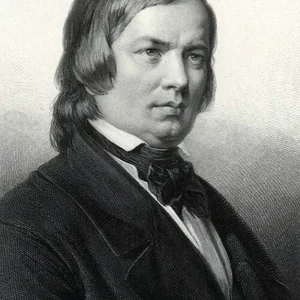

Robert Schumann was a German composer and pianist, a major figure of musical Romanticism. He is famous for his piano works, his lieder, and his chamber music, as well as for his activity as a music critic.
Robert Schumann(1810 — 1856)
Robert Schumann
royaume de Saxe
6 min read
Frequently asked questions
Famous Quotes
« To compose well, it is enough to remember a tune that no one has ever heard.»
Key Facts
- Born in 1810 in Zwickau, Saxony (Germany)
- Composed Carnaval, Op. 9, for piano in 1834-1835
- Married the pianist Clara Wieck in 1840, his year of song (Dichterliebe, Frauenliebe und -leben)
- Founded the journal Neue Zeitschrift für Musik in 1834, where he championed Chopin and Brahms
- Died in 1856 in Endenich, after a breakdown and confinement
Works & Achievements
Piano suite made up of short pieces evoking the characters of a masked ball, including Florestan and Eusebius, Schumann's imaginary alter egos.
A collection of thirteen piano pieces evoking the world of childhood, including the famous "Reverie" (Träumerei).
A cycle of sixteen lieder set to poems by Heinrich Heine, a peak of the German Romantic art song.
A song cycle set to poems by Chamisso, tracing the romantic life of a woman.
A major work of the Romantic piano repertoire, premiered by Clara Schumann herself.
Schumann's first symphony, radiant and energetic, inspired by the arrival of spring and his marital happiness.
A symphony inspired by the landscapes of the Rhineland and the majesty of Cologne Cathedral.
A masterpiece of Romantic chamber music, dedicated to Clara, who premiered the piano part.
Anecdotes
As a teenager, Schumann dreamed of becoming a piano virtuoso. To speed up the independence of his fingers, he is said to have invented a mechanical device to immobilize certain fingers while he exercised the others. His right hand was permanently damaged as a result, which ended his hopes of a career as a pianist and pushed him toward composition.
In 1834, Schumann founded the *Neue Zeitschrift für Musik* (New Journal of Music), a journal of criticism. In it he invented imaginary characters such as Florestan the impetuous and Eusebius the dreamer to express the two sides of his personality in his articles, and it was he who revealed to the public the budding genius of **Brahms** and **Chopin**.
Schumann fell in love with Clara Wieck, daughter of his piano teacher Friedrich Wieck. The father fiercely opposed the marriage, and the lovers had to take the matter to court to obtain permission to marry, which they finally did in **1840**.
The year **1840**, the year of his marriage to Clara, is nicknamed his “year of song”: carried away by happiness, Schumann composed nearly 140 songs, more than half of his entire output of lieder.
Afflicted with severe mental illness, Schumann threw himself into the Rhine in February **1854**. Rescued by boatmen, he asked to be committed to an asylum in Endenich, near Bonn, where he spent the last two years of his life.
Primary Sources
Hats off, gentlemen, a genius! — the phrase with which Schumann hailed the discovery of Frédéric Chopin's works.
I thought that he would come, and that he must necessarily come, a man called to give the highest and most ideal expression of the spirit of our time. He has come, this young blood.
Diaries kept in turn by Robert and Clara, recording their shared life, their musical work, and their domestic joys.
Letters exchanged during their thwarted engagement, bearing witness to their love and their struggle against the opposition of Friedrich Wieck.
Key Places
Town in Saxony where Robert Schumann was born in 1810. His birthplace is today a museum dedicated to him.
Major musical center where Schumann studied, founded his journal, and composed much of his work. There he mixed with Mendelssohn and married Clara.
Capital of Saxony where the Schumann couple settled from 1844 to 1850. Robert lived there amid the upheavals of the 1849 revolution.
Rhineland city where Schumann became music director starting in 1850. It was there that he met the young Brahms in 1853.
District of Bonn home to the asylum in which Schumann was committed after his suicide attempt. He died there in 1856.
Typical Objects

The central instrument of Schumann's work, for which he composed a large part of his music. The piano of the 19th century, more powerful and expressive, accompanied the rise of Romanticism.

The tools with which Schumann set down his scores and wrote his music criticism. Both musical and journalistic writing filled his days.

Sheets of manuscript paper on which Schumann notated his piano works, his lieder and his symphonies. Many bear annotations and corrections in his own hand.

A music criticism journal founded by Schumann in 1834. It brought young talents such as Chopin and Brahms to public attention and championed a demanding vision of music.

Small instruments used to tune the pitch of notes and to set the tempo. The metronome, popularized in the early 19th century, became a reference point for Romantic composers.

A book gathering songs for voice and piano set to poems by Heine, Eichendorff or Chamisso. The lied is one of Schumann's great specialties.
School Curriculum
Vocabulary & Tags
Key Vocabulary
Daily Life
Morning
Schumann often devoted his mornings to composition, in the quiet of his study. Sensitive to the slightest noise, he demanded absolute silence and could work for hours on end, immersed in his musical ideas.
Afternoon
In the afternoon, he wrote his articles for the Neue Zeitschrift für Musik, read the scores of young composers and kept up an abundant correspondence. In Leipzig, he also frequented musical circles and friends such as Mendelssohn.
Evening
Evenings were spent playing chamber music at home, where Clara played the piano, or at concerts and gatherings of artists. Schumann also liked to withdraw to cafés and taverns to discuss art and literature.
Food
Schumann enjoyed the middle-class German cooking of his time as well as wine, of which he sometimes made generous use. Coffee and beer accompanied his long working days and his evenings among friends.
Clothing
As a cultivated bourgeois of the 19th century, Schumann wore a dark frock coat, waistcoat, high-collared shirt and a knotted cravat. His neat attire reflected his status as a respected artist and journalist.
Housing
The Schumann couple lived in comfortable middle-class apartments in Leipzig, Dresden and then Düsseldorf. The home, organized around the pianos, was both a place of family life and a workshop for musical creation.