 flip
flipThe Duplays' soup and boiled beef
The Duplays' soup and boiled beef
Why this dish? Robespierre dined every day at the table of the Duplay family, honest cabinetmakers of Rue Saint-Honoré. They served the simple, nourishing fare of Parisian artisans: a simmered pot whose broth made the soup and the meat the main dish. It was there, between sessions of the Convention, that he took his frugal meals.
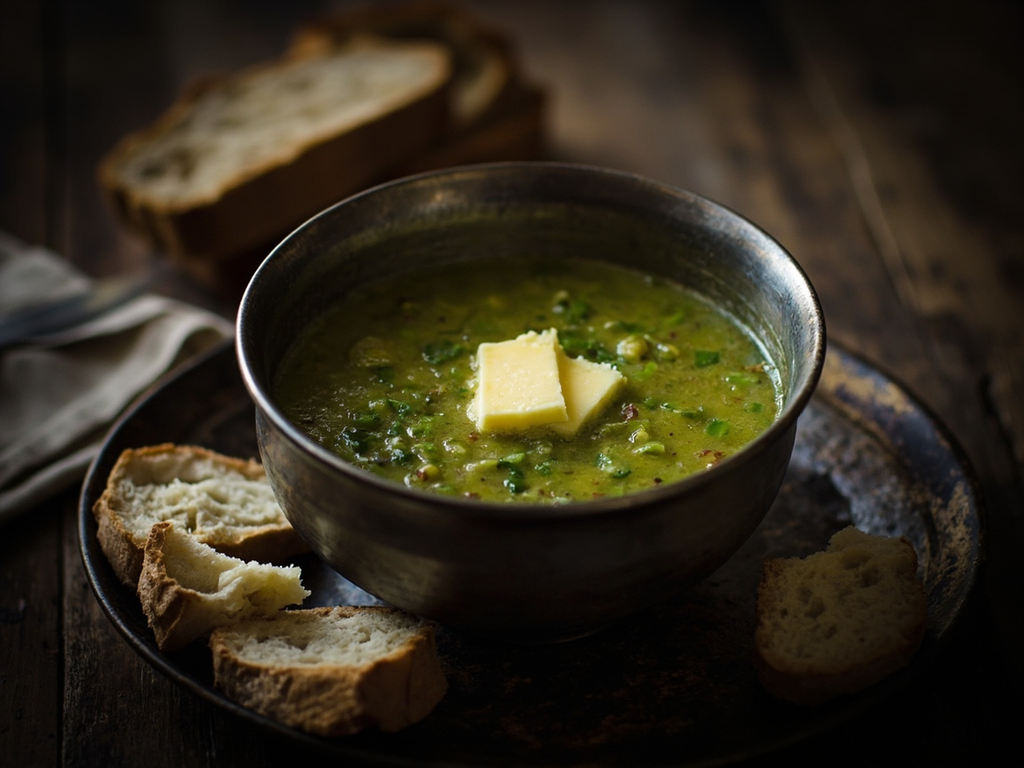
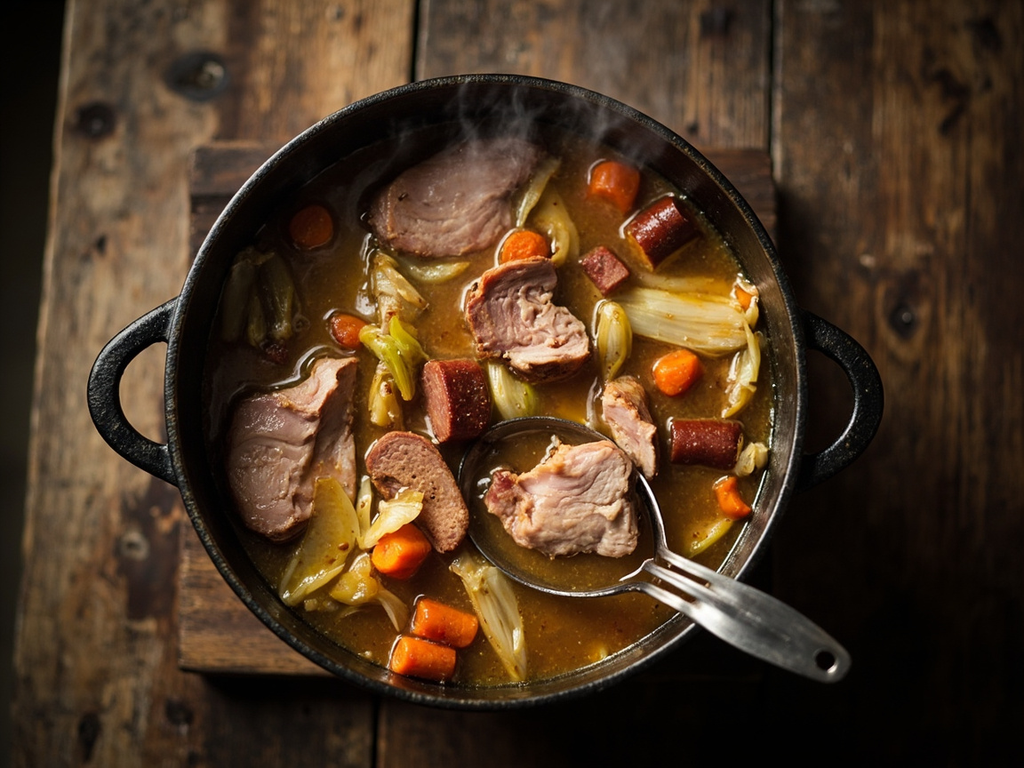
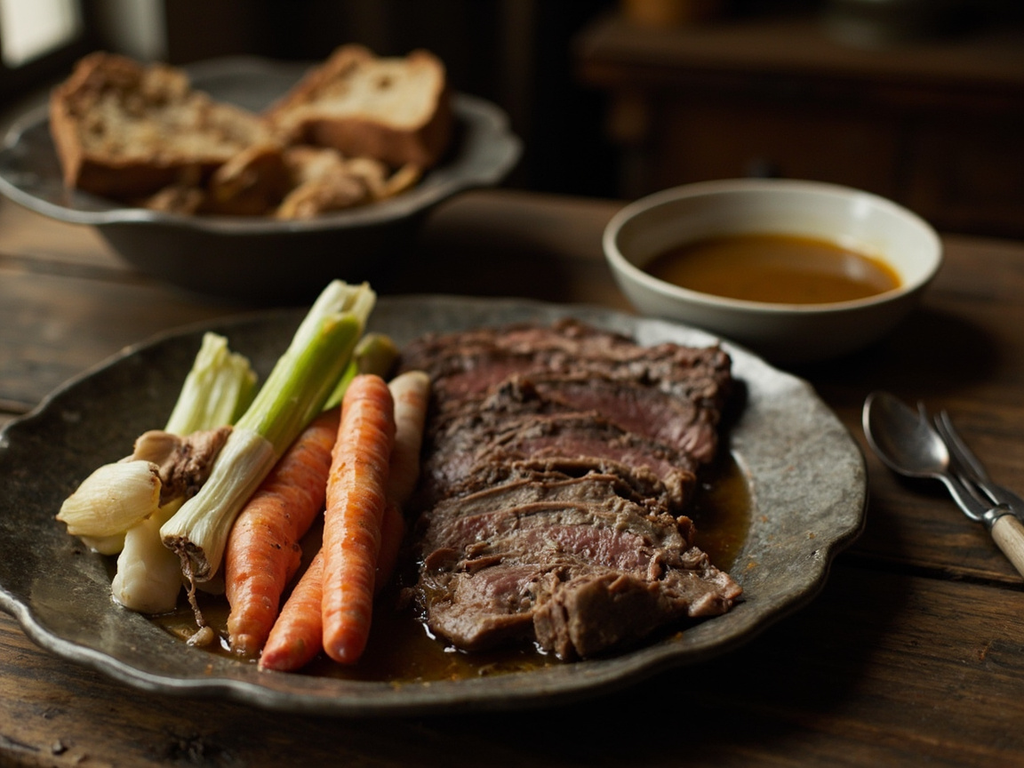
A single pot for two courses: a piece of beef and winter vegetables simmer for hours; the broth, poured over bread, becomes the soup, and the drained meat makes the boiled beef with its vegetables.
Citizen, seek not here the sauces of aristocrats nor the excesses of their corrupt table: a free man is content with a good broth and an honest piece of meat. At my hosts the Duplays', one throws into the pot the beef, the leek, the turnip, and lets the fire do its work slowly. I dip my bread in the soup, I take my share of the boiled beef, and that suffices me amply. Virtue begins at table, with frugality.
- •Piece of beef for boiling (shin, chuck) — a good piece (meat and broth flavor)
- •Leeks, turnips, carrots — as needed (pot vegetables)
- •Cabbage — half a head (nourishing vegetable)
- •Onion studded with a clove — one (flavor)
- •Stale bread — a few slices (to soak in the soup)
- •Salt, peppercorns — to taste (seasoning)
The Duplays' soup and boiled beef
A single pot for two courses: a piece of beef and winter vegetables simmer for hours; the broth, poured over bread, becomes the soup, and the drained meat makes the boiled beef with its vegetables.
Why this dish? Robespierre dined every day at the table of the Duplay family, honest cabinetmakers of Rue Saint-Honoré. They served the simple, nourishing fare of Parisian artisans: a simmered pot whose broth made the soup and the meat the main dish. It was there, between sessions of the Convention, that he took his frugal meals.
Citizen, seek not here the sauces of aristocrats nor the excesses of their corrupt table: a free man is content with a good broth and an honest piece of meat. At my hosts the Duplays', one throws into the pot the beef, the leek, the turnip, and lets the fire do its work slowly. I dip my bread in the soup, I take my share of the boiled beef, and that suffices me amply. Virtue begins at table, with frugality.
Ingredients (period version)
- Piece of beef for boiling (shin, chuck) — a good piece (meat and broth flavor)
- Leeks, turnips, carrots — as needed (pot vegetables)
- Cabbage — half a head (nourishing vegetable)
- Onion studded with a clove — one (flavor)
- Stale bread — a few slices (to soak in the soup)
- Salt, peppercorns — to taste (seasoning)
Ingredients
- Beef for pot-au-feu (chuck, shin) — 800 g (meat and broth)
- Leeks — 2 (vegetable)
- Carrots — 3 (vegetable)
- Turnips — 2 (vegetable)
- Green cabbage — 1/4 head (vegetable)
- Onion + 1 clove — 1 (flavor)
- Stale country bread — 4 slices (soup)
- Coarse salt, peppercorns — to taste (seasoning)
Method
- Place the beef in a large pot of cold water, bring gently to a simmer and skim carefully.
- Add the studded onion, salt and peppercorns, then simmer over low heat for about 2 1/2 hours.
- Add the carrots, turnips and leeks, then the cabbage, and continue for 45 minutes until everything is tender.
- Strain a ladleful of broth per plate over the slices of stale bread: this is the soup.
- Then serve the sliced meat with the drained vegetables and a little coarse salt: this is the boiled beef.
How it was made : The pot-au-feu (then called "bouilli") was the pillar of popular and bourgeois cuisine in the 18th century, described in Menon's books. A single fire fed the whole household: the broth as a starter, the meat as a main course, nothing was wasted — an economy that suited Robespierre's claimed austerity.
The contemporary twist : Serve the steaming broth in a glass, "Consommé of the Incorruptible" style, and keep the bone marrow on a grilled garlic-rubbed toast.
Sources : Menon, La Cuisinière bourgeoise (1746)
Robespierre · Charactorium