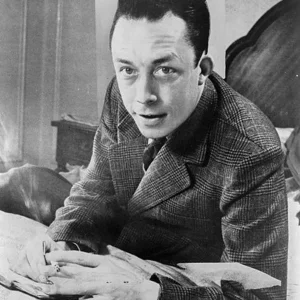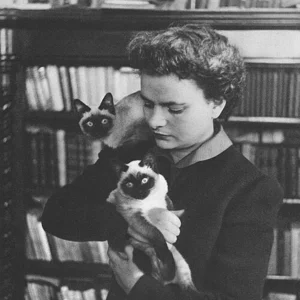

Romain Gary, born Roman Kacew in Vilnius in 1914, was a French novelist, aviator, and diplomat. He is the only author to have won the Prix Goncourt twice, one of them under the pen name Émile Ajar.
Romain Gary(1914 — 1980)
Romain Gary
France, Empire russe, Deuxième République de Pologne
6 min read
Frequently asked questions
Famous Quotes
« Humor is a declaration of dignity, an assertion of man's superiority over all that happens to him.»
« One cannot live without love.»
Key Facts
- Born in Vilnius in 1914 under the name Roman Kacew
- Pilot in the Free French Forces during the Second World War, made a Companion of the Liberation
- Won the Prix Goncourt in 1956 for The Roots of Heaven
- Won a second Prix Goncourt in 1975 for The Life Before Us, signed with the pen name Émile Ajar
- Died in Paris in 1980
Works & Achievements
His first novel, inspired by the Resistance and the war, which established him as a writer.
A novel about protecting Africa's elephants, often regarded as the first great ecological novel; winner of the Prix Goncourt.
A deeply moving autobiographical account devoted to his mother and to maternal love.
The first novel published under the pen name Émile Ajar, the story of a lonely man and his python.
Written under the name Émile Ajar, the story of Momo and Madame Rosa; a second Prix Goncourt won in secret.
His final novel, about memory, loyalty and the Resistance during the Occupation.
A posthumous text in which he reveals and explains the hoax of his double Goncourt.
Anecdotes
Romain Gary is the only writer to have won the Prix Goncourt twice, even though the rules forbid it. He received it in 1956 under his own name for “The Roots of Heaven,” then in 1975 under the pseudonym Émile Ajar for “The Life Before Us.” No one uncovered the hoax during his lifetime.
To make people believe that Émile Ajar truly existed, Gary asked his second cousin, Paul Pavlowitch, to play the role of the mysterious author in front of journalists. The truth only came out after the writer's death, thanks to a text he had left behind: “Life and Death of Émile Ajar.”
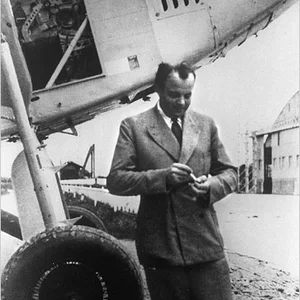
Born Jewish in Vilnius, Gary fled occupied France in 1940 to join General de Gaulle's Free French Forces in London. A wartime aviator, he was decorated as a Companion of the Liberation, one of the highest honors of the Resistance.
In “Promise at Dawn,” Gary tells the story of his mother, Mina, who kept insisting that he would become a great writer, a hero, and a diplomat of France. Raised alone by her in poverty, he spent his life fulfilling, one by one, these immense promises.
In 1962 Gary married the famous American actress Jean Seberg, star of the film “Breathless.” Their highly publicized marriage was marked by tragedy: Seberg's death in 1979 came shortly before the writer's suicide in 1980.
Primary Sources
With maternal love, life makes a promise at dawn that it can never keep.
One must love.
I had a wonderful time. Goodbye and thank you.
I have at last expressed myself fully.
Key Places
Birthplace of Roman Kacew in 1914, then part of the Russian Empire. He spent his early years there before heading west.
City where he spent part of his childhood with his mother before settling in France.
City where he settled in 1928 and attended secondary school. It was there that his mother nurtured her dreams of greatness for him.
Capital where in 1940 he joined General de Gaulle's Free French Forces to continue the fight.
City where Gary served as Consul General of France in the 1950s. There he mingled with the film world and met Jean Seberg.
City where he lived, wrote and died on 2 December 1980. The center of his literary life and of the Émile Ajar hoax.
Typical Objects

The writer's everyday working tool in the 20th century, on which Gary typed his novels. It allowed him to juggle his multiple identities, including that of Émile Ajar.

During the war, Gary served as an airman and bomber observer within the Free French Forces. The aircraft symbolizes his military commitment to Free France.

A decoration created by General de Gaulle to honor the Companions of the Liberation. Gary received it for his commitment to the Resistance and Free France.

An official document attesting to his role as a French diplomat, notably as Consul General in Los Angeles. It bears witness to his double life as a writer and a representative of France.

Handwritten or typed versions of his novels, often reworked. Those signed Émile Ajar were the key to his literary hoax.

The object that gives its title to his last novel, “The Kites”. In it, the kite symbolizes imagination, memory, and faithfulness in the face of History.
School Curriculum
Vocabulary & Tags
Key Vocabulary
Daily Life
Morning
Romain Gary often devoted his mornings to writing, a discipline he practiced with consistency. Seated at his desk, he wrote and revised his manuscripts, sometimes under several authorial identities at once.
Afternoon
A career diplomat, he carried out official duties in the afternoon, received visitors, and represented France, notably during his posting as consul in Los Angeles. He also read a great deal to nourish his work.
Evening
In the evening, he moved through the literary, artistic, and cinematic circles of Paris or the United States. These encounters fed his reflections on humanity and social pretense.
Food
Gary shared the diet of a cultivated twentieth-century Frenchman, blending Parisian gastronomy with the cosmopolitan influences of his travels. His cooking also bore traces of his Eastern European origins.
Clothing
Depending on the circumstances, he wore an airman's uniform during the war, the understated suit of a diplomat in his official duties, or freer attire in artistic circles. His polished appearance matched his public image.
Housing
Over the course of his life, he lived in modest lodgings in Nice during his youth, then in comfortable residences as his diplomatic posts and literary success dictated, notably a Parisian apartment on rue du Bac.
Historical Timeline
Period Vocabulary
Liens externes & ressources
Références
Œuvres
Éducation européenne
1945
Les Racines du ciel
1956
La Promesse de l'aube
1960
Gros-Câlin
1974
La Vie devant soi
1975
Les Cerfs-volants
1980
Vie et mort d'Émile Ajar
1981