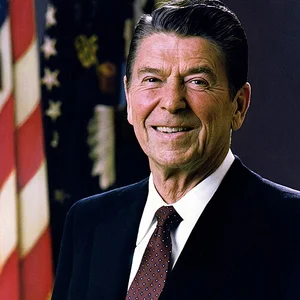

Ronald Reagan was the 40th President of the United States (1981-1989). A former Hollywood actor who became Governor of California, he embodied American conservatism and played a major role in the final years of the Cold War.
Ronald Reagan(1911 — 2004)
Ronald Reagan
États-Unis
6 min read
Frequently asked questions
Famous Quotes
« Mr. Gorbachev, tear down this wall!»
« Government is not the solution to our problem; government is the problem.»
Key Facts
- Elected 40th President of the United States in 1980, re-elected in 1984
- Implemented “Reaganomics,” a neoliberal economic policy based on tax cuts (from 1981)
- Launched the Strategic Defense Initiative (“Star Wars”) in 1983, reigniting the arms race
- Signed the INF Treaty on intermediate-range nuclear forces with Gorbachev in 1987
- Speech at the Brandenburg Gate calling for the Berlin Wall to be torn down (1987)
Works & Achievements
Hollywood film in which Reagan plays football player George Gipp, a role that earned him his nickname “the Gipper.”
Reagan led the film actors' union, his first experience in negotiation and political leadership.
Two terms leading the most populous state in the United States, a springboard to the presidency.
A program of tax cuts, deregulation, and reduced social spending that laid the foundations of American neoliberalism.
A proposed space-based missile shield designed to protect the United States from a Soviet nuclear attack.
An agreement signed with Gorbachev eliminating an entire category of nuclear missiles, a major step in détente.
Memoirs published after his presidency, retracing his journey from actor to head of state.
Anecdotes
On March 30, 1981, barely 69 days after taking office, Reagan was the target of an assassination attempt in Washington. Struck by a bullet that lodged near his heart, he kept his sense of humor: he quipped to his surgeons, “I hope you're all Republicans.” He survived, and his popularity soared.
Before politics, Reagan was a Hollywood actor and appeared in some fifty films. His role as American football player George Gipp in *Knute Rockne, All American* (1940) earned him the nickname “the Gipper,” which he kept throughout his political career.
In June 1987, standing before the Brandenburg Gate in Berlin, Reagan issued a now-famous challenge to Mikhail Gorbachev: “Mr. Gorbachev, tear down this wall!” The Berlin Wall would fall two years later.
Reagan was nicknamed “the Great Communicator” for his ease in front of the cameras, a skill inherited from his career as an actor and radio host. He had in fact started out as a sports broadcaster on the radio in Iowa during the 1930s.
In 1994, five years after leaving the presidency, Reagan announced in a handwritten letter made public that he had Alzheimer's disease. This moving letter raised awareness of the illness among the American public. He died ten years later, in 2004.
Primary Sources
General Secretary Gorbachev, if you seek peace, if you seek prosperity for the Soviet Union and Eastern Europe, if you seek liberalization: Come here to this gate! Mr. Gorbachev, open this gate! Mr. Gorbachev, tear down this wall!
In this present crisis, government is not the solution to our problem; government is the problem.
I urge you to beware the temptation... to ignore the facts of history and the aggressive impulses of an evil empire.
I now begin the journey that will lead me into the sunset of my life. I know that for America there will always be a bright dawn ahead.
We will never forget them, nor the last time we saw them, this morning, as they prepared for their journey and waved goodbye and 'slipped the surly bonds of earth' to 'touch the face of God.'
Key Places
Small Midwestern town where Ronald Reagan was born in 1911 above a shop. His modest childhood in rural America shaped his values.
Los Angeles neighborhood where Reagan pursued his movie acting career starting in 1937. It was there that he learned the art of communication that would serve his political career.
Residence and seat of American presidential power where Reagan lived and governed from 1981 to 1989. The center of his domestic and foreign policy.
Berlin monument in front of which Reagan delivered his famous 1987 call to tear down the wall. A symbolic site of Germany's division and later its reunification.
Reagan's ranch in the mountains near Santa Barbara, nicknamed the “Western White House.” He went horseback riding there and regularly recharged at the property.
Presidential library and Reagan's burial site in California. It preserves his archives and houses an actual Air Force One.
Typical Objects

Reagan always kept a jar of jelly bean candies on his desk in the Oval Office. He had loved them ever since he quit smoking a pipe, and he offered them around during cabinet meetings.

A keen horseman, Reagan often wore cowboy attire on his California ranch. This image reinforced his aura as an authentic, rugged American.

Used to working on film sets, Reagan relied on small cards for his speeches and press conferences. This professional communicator's tool was part of his working method.

Reagan mastered the art of the televised speech better than any president before him. Television was his main political weapon for speaking directly to the American people.

This black briefcase, carried by a military aide, held the launch codes for the American nuclear arsenal. A symbol of presidential power during the Cold War.

The iconic presidential aircraft allowed Reagan to travel all over the world, notably for his summits with Gorbachev. It embodies the power and mobility of the American president.
School Curriculum
Vocabulary & Tags
Key Vocabulary
Tags
Daily Life
Morning
At the White House, Reagan rose without excessive zeal and began his day by reading the newspapers and a national security briefing. Known for delegating widely, he favored broad direction over details.
Afternoon
The afternoon was devoted to cabinet meetings, meetings with foreign heads of state, and speeches. Reagan relied heavily on his advisers and knew how to conserve his energy.
Evening
In the evening, he often dined one-on-one with his wife Nancy, to whom he was very close. A former actor, he enjoyed watching films at the presidential residence.
Food
Reagan had a famous fondness for jelly beans, which he nibbled on daily. He also enjoyed meatloaf and macaroni and cheese, simple dishes of traditional America.
Clothing
In public, he wore understated, elegant tailor-made suits. At his ranch, he traded the suit for cowboy attire: jeans, boots, and a hat, cultivating his image as an authentic American.
Housing
During his presidency, he resided at the White House, but he loved retreating to his California ranch, Rancho del Cielo. This rustic, isolated mountain property was his refuge.
Historical Timeline
Period Vocabulary
Liens externes & ressources
Références
Œuvres
Gouvernorat de Californie
1967-1975
Reaganomics (politique économique)
1981
Initiative de défense stratégique (SDI / « Guerre des étoiles »)
1983
Traité INF (forces nucléaires intermédiaires)
1987
An American Life (autobiographie)
1990