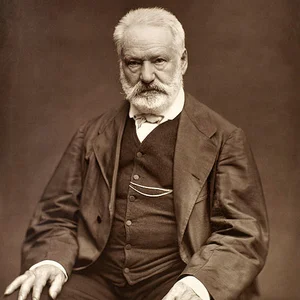

A major French writer of the 19th century, Victor Hugo (1802–1885) is the author of iconic novels such as Les Misérables and The Hunchback of Notre-Dame. Poet, playwright, and committed politician, he championed the rights of the poor and fought against the death penalty.
Victor Hugo(1802 — 1885)
Victor Hugo
France
7 min read
Frequently asked questions
Famous Quotes
« So long as there shall exist, by reason of law and custom, a social condemnation which, in the midst of civilization, artificially creates a hell on earth, and complicates with human fatality a destiny that is divine; so long as the three problems of the century — the degradation of man by poverty, the ruin of woman by starvation, and the crippling of children by physical and spiritual blight — are not solved; so long as ignorance and misery remain on earth, books like this cannot be useless.»
« The imagination of a poor man is never empty.»
« I am the force that drives the world toward the light.»
« He who opens a school door, closes a prison.»
Key Facts
- 1831: Publication of The Hunchback of Notre-Dame, a major literary success
- 1851: 19-year exile following his opposition to Napoleon III's coup d'état
- 1862: Publication of Les Misérables, a landmark novel of social engagement
- 1885: State funeral, cementing his status as a towering figure of French literature
- 1848–1870: Political involvement as a deputy and advocate for the abolition of the death penalty
Works & Achievements
A play whose opening night sparked the famous Battle of Hernani between classicists and Romantics. It marks the triumph of Romantic drama on the French stage.
A historical novel set in the 15th century featuring Quasimodo, Esmeralda, and Frollo. It established Hugo as the leader of the Romantic movement and saved the cathedral from planned demolition.
A lyrical poetry collection on nature, family, and melancholy, revealing the intimate and personal dimension of Hugo's poetry.
A Romantic drama blending love, honor, and social ambition in 17th-century Spain. One of Hugo's theatrical masterpieces, still performed today.
A collection of political poems written in exile, a scathing verse pamphlet against Napoleon III and the coup d'état of December 2, 1851.
A monumental social novel tracing the fate of Jean Valjean in 19th-century France. A universal plea for social justice, translated worldwide and adapted countless times.
A vast poetic fresco in three series recounting the history of humanity from Creation to an ideal future. One of the most ambitious poetic works in French literature.
Anecdotes
In 1841, Victor Hugo was elected to the Académie française at the age of 39, consecrating his talent as a poet and writer. This election marked his entry into the most prestigious literary institution in France, where he would sit among the greatest writers of his era.
During the performance of his drama 'Hernani' in 1830, a real battle broke out in the theatre between the champions of Romanticism and the defenders of classical theatre. That evening became legendary and symbolized the victory of Romanticism over the old theatrical rules.
Hugo fiercely opposed the death penalty and defended this position in Parliament as a deputy. In 1829 he published 'The Last Day of a Condemned Man', a novel denouncing the injustice of capital execution that made a profound impression on public opinion.
In 1851, after opposing Napoleon III's coup d'état, Victor Hugo was forced into exile in Belgium and then in the Channel Islands to escape political persecution. He spent 19 years in exile, a period during which he continued to write works committed against tyranny.
Victor Hugo's funeral in 1885 became a national event, with a procession of more than 100,000 people through the streets of Paris. The nation paid tribute to him by placing him in the Panthéon, recognizing his status as the greatest French writer of the 19th century.
Primary Sources
There is a spectacle more grand than the sea, it is the sky; there is a spectacle more grand than the sky, it is the interior of the soul.
I tell you that poverty is a social scourge; I tell you that destitution is not a fatality, that it is a shame upon our civilization.
Condemned to death! It has been five weeks now that I have lived with this thought, always alone with it, always frozen by its presence, always bent beneath its weight.
The drama must be a concentrating mirror which, far from weakening them, gathers and condenses the coloring rays, which makes of a glimmer a light, of a light a flame.
When liberty returns, I shall return. I share the exile of liberty. When liberty comes back, through whatever door it chooses, I shall come back.
Key Places
House acquired by Hugo in 1856 during his exile. He decorated it entirely himself and wrote Les Misérables and La Légende des siècles there.
Hugo lived at 6, Place des Vosges from 1832 to 1848. This house, now the Maison de Victor Hugo museum, was the center of his Parisian social and literary life.
The Gothic cathedral inspired his eponymous novel of 1831. Hugo campaigned throughout his life for the preservation of French medieval architectural heritage.
Victor Hugo was interred there on June 1, 1885, following historic national funeral rites, joining the great figures of the French Republic.
Victor Hugo's birthplace, born on February 26, 1802. He retains a strong sense of identity tied to the Franche-Comté heritage and his military father.
Typical Objects

Hugo wrote his works with a quill, often standing at a writing desk. He averaged eighty pages per day during his most prolific creative periods.

Victor Hugo practiced drawing with an original technique, using ink, coffee, and soot. He left behind several thousand expressive drawings.

From the cliffs of Guernsey, Hugo observed the horizon and the sea with his telescope, feeding a fascination for the ocean that permeates his works such as Toilers of the Sea.

An emblematic garment of the Romantic intellectual and statesman, the black high-collared frock coat is Hugo's characteristic attire in his official portraits.

The carved wooden desk installed on the top floor of his house in Guernsey, facing the sea, from which Hugo wrote a large part of his work during his exile.

Hugo owned a vast library of European Romantic authors — Shakespeare, Goethe, Schiller — whose works profoundly influenced his vision of drama and poetry.
School Curriculum
Vocabulary & Tags
Key Vocabulary
Tags
Mouvement
Daily Life
Morning
Hugo woke early, around six o'clock, and began working standing at his writing desk from dawn. He had a frugal breakfast — black coffee and bread — before devoting himself to writing for several hours at a stretch, producing a considerable volume of text.
Afternoon
Afternoons were devoted to walks, particularly on the cliffs of Guernsey during his exile, or through the streets of Paris. Hugo also received visitors, correspondents or admirers, and attended to his extensive political and literary correspondence.
Evening
Evenings were often social: dinners with artists, writers or politicians, lively conversations in the salon. In Guernsey, he might draw in ink or return to correcting a manuscript by candlelight.
Food
Hugo followed a sober and inexpensive diet, by choice or by necessity of exile. He appreciated simple meals: soup, vegetables, Norman cheese and moderate red wine. He often shared his table with the poor and political outcasts.
Clothing
In public, Hugo wore the black frock coat or dress coat of the respectable statesman, top hat and cane. At home, he worked in a dressing gown. In his later years, he sported the patriarchal white beard that became his iconic image.
Housing
In Paris, he lived in fine bourgeois apartments, notably on the Place des Vosges. In exile in Guernsey, he lived at Hauteville House, which he decorated himself in an exuberant style mixing carved woodwork, faience and symbolic objects, a reflection of his inner world.
Historical Timeline
Period Vocabulary
Visual Style
Un style inspiré des gravures romantiques du XIXe siècle, mêlant le dramatisme gothique de Gustave Doré à l'intensité émotionnelle des peintures romantiques, avec des contrastes marqués entre lumière dorée et ombres profondes pour refléter la dualité entre beauté et misère.
Sound Ambience
Une ambiance sonore du Paris du XIXe siècle mêlant les bruits des quartiers populaires aux échos de débats politiques passionnés, sublimés par la musique romantique et les accents humanitaires de Victor Hugo.
Liens externes & ressources
Références
Œuvres
Les Misérables
1862
Notre-Dame de Paris
1831
Les Châtiments
1853
Quatre-vingt-treize
1874
Opposition à la peine de mort
1834-1885
L'Homme Qui Rit
1869