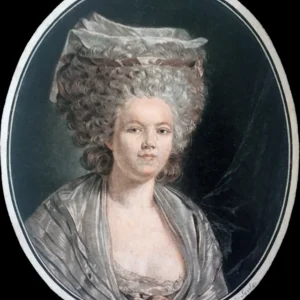

A French fashion merchant, Rose Bertin was the dressmaker and style advisor to Queen Marie-Antoinette. Nicknamed the “minister of fashion,” she introduced extravagant hairstyles and outfits that made her a pioneering figure of haute couture.
Rose Bertin(1747 — 1813)
Rose Bertin
France
6 min read
Frequently asked questions
Key Facts
- Born in 1747 in Abbeville and died in 1813 in Épinay-sur-Seine
- Opens her fashion boutique “Le Grand Mogol” in Paris in 1770
- Becomes Marie-Antoinette's official supplier from 1774 onward
- Nicknamed the “minister of fashion” for her influence on the queen's outfits
- Emigrates during the French Revolution before returning to France
Works & Achievements
Creation of hundreds of outfits for the queen, making Versailles the world capital of elegance. A major work that defined the style of an entire era.
Monumental hairstyles designed with the hairdresser Léonard, adorned with symbolic objects. They became the emblem of the extravagance of court fashion.
Launch, together with Marie-Antoinette, of a fashion for simple muslin dresses. An innovation foreshadowing the more natural style of the late century.
Supplying outfits to the courts of Sweden, Spain, Russia and Naples. Rose Bertin established Paris as the center of European fashion.
A pioneering fashion house blending creativity, prestige and an aristocratic clientele. The ancestor of the great haute couture houses.
Anecdotes
Rose Bertin received Marie-Antoinette twice a week in her private apartments at Versailles, an extremely rare privilege for a mere shopkeeper. People said with irony that she had become the true “minister of fashion” of the kingdom, so great was her influence on the tastes of the court.
Together with the hairdresser Léonard, Rose Bertin invented the famous “poufs,” monumental hairstyles built on frames into which miniature objects were placed. The most famous, the “pouf à la frégate,” featured a model warship to celebrate a French naval victory.
Her Parisian boutique, “Le Grand Mogol,” on the rue Saint-Honoré, drew the entire European aristocracy. Her prices were so high and her arrogance so notorious that she was mockingly nicknamed the “minister of fashion.”
During the Revolution, Rose Bertin emigrated for a time to London but, it is said, continued to supply former clients. She weathered the upheaval without mounting the scaffold, unlike her most famous client, and died peacefully in 1813.
Rose Bertin helped spread French fashion throughout Europe: she dressed queens and princesses of Sweden, Spain, and Russia. She was one of the first to turn clothing design into a business of international prestige.
Primary Sources
The admission of this girl into the queen's inner circle, by introducing her to the idea of frivolous pleasures, did more harm than one could possibly imagine.
The fashion merchant, admitted into the private apartments, spoke of hairstyles and finery with a tone of equality that scandalized the elder ladies of the court.
Mademoiselle Bertin reigns over fashion; nothing is worn that has not come from her hands or received her approval.
Key Places
Town in Picardy where Rose Bertin was born in 1747 into a modest family. She started there as an apprentice before heading to Paris.
Luxury boutique opened by Rose Bertin in 1773, a gathering place for the European aristocracy. The heart of her fashion empire.
Royal residence where Rose Bertin was received by Marie-Antoinette for regular fittings. A showcase for her most spectacular creations.
City where Rose Bertin took refuge for a time during the Revolution. There she kept up contacts with former clients who had emigrated.
Town north of Paris where Rose Bertin died in 1813. There she ended her life far from the splendor of the vanished court.
Typical Objects

A monumental hairstyle built on a frame, adorned with feathers, ribbons and miniature objects evoking current events. A symbol of the extravagance of court fashion.

A ceremonial gown with deep pleats at the back and wide panniers, made of richly embroidered silk. The emblematic attire of the ladies of the court of Versailles.

A light gown of white muslin introduced by Marie-Antoinette and Rose Bertin, breaking with the lavishness of silks. It heralded a more natural fashion.

A miniature mannequin dressed in the latest creations, sent to foreign courts to spread Parisian fashion. The ancestor of the fashion catalogue.

A frame of wicker or whalebone worn under the skirt to widen the hips considerably. Indispensable to grand court dress.

Trimmings made and assembled by the fashion merchants to decorate gowns and hairstyles. The heart of Rose Bertin's trade lay in these ornaments.
School Curriculum
Vocabulary & Tags
Key Vocabulary
Daily Life
Morning
Rose Bertin went to her shop on the rue Saint-Honoré early in the morning to oversee her seamstresses and select fabrics and trimmings. Mornings were devoted to designing new creations and receiving her first distinguished clients.
Afternoon
Twice a week, she traveled to Versailles for private fittings with Marie-Antoinette. The rest of the time, she negotiated with silk merchants, feather-workers, and florists to gather the finest materials.
Evening
In the evening, Rose Bertin settled her accounts, often considerable ones, and prepared the orders destined for foreign courts. Her reputation for pride stemmed from the fact that she treated her noblest clients almost as equals.
Food
As a well-off Parisian bourgeoise of the 18th century, she could enjoy white bread, meats, poultry, wines, and coffee, a fashionable luxury. Her table was more refined than that of common people, without reaching the splendor of the court.
Clothing
She wore elegant yet restrained outfits, befitting her trade without competing with her clients. As a *marchande de modes* (fashion merchant), she was herself the showcase of her own craftsmanship.
Housing
Rose Bertin lived and worked in Paris, in a commercial district near the Palais-Royal and the court. Her luxurious shop bore witness to her exceptional social success for a girl of humble origins.
Historical Timeline
Period Vocabulary
Liens externes & ressources
Références
Œuvres
Garde-robe de Marie-Antoinette
1774-1792
Les coiffures « poufs »
vers 1774-1780
La chemise à la reine (robe en gaulle)
vers 1781-1783
Diffusion internationale de la mode française
1770-1790
Le commerce de luxe « Le Grand Mogol »
1773