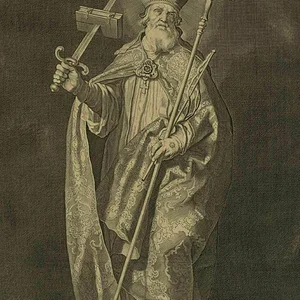

An Anglo-Saxon Benedictine monk who became a missionary bishop, he evangelized Germania in the 8th century and reorganized the Frankish Church. Regarded as the “apostle of the Germans,” he was martyred in Frisia.
Saint Boniface(675 — 754)
Boniface of Mainz
Wessex, royaume des Francs
6 min read
Frequently asked questions
Key Facts
- Born around 675 in the Anglo-Saxon kingdom of Wessex under the name Winfrid
- Received from Pope Gregory II in 719 the mission to evangelize the Germanic peoples, along with the name Boniface
- Said to have felled the “Oak of Donar” (Thor's Oak) at Geismar around 723, a symbolic act of breaking with Germanic paganism
- Appointed Archbishop of Mainz and organizer of the Frankish Church under the Carolingians
- Martyred in Frisia at Dokkum in 754 (or 755), buried at the Abbey of Fulda, which he had founded
Works & Achievements
Conversion of many peoples of Hesse, Thuringia and Frisia, which earned Boniface the title of “apostle of the Germans”.
Creation and structuring of bishoprics such as Würzburg, Erfurt and Büraburg, providing Germania with a stable ecclesiastical hierarchy.
Presided over several councils (Concilium Germanicum) that restored the discipline of the clergy and the authority of Rome.
Support for the creation of this Benedictine monastery, which became a major center of culture and pilgrimage.
A collection of letters exchanged with popes, kings and monks, a precious source on the Christianization and society of the 8th century.
According to tradition, participation in the anointing of Pepin the Short, sealing the alliance between the Carolingians and the Roman Church.
Anecdotes
Around 723, near Geismar in Hesse, Boniface is said to have felled with an axe the “Oak of Donar,” a sacred tree dedicated to the Germanic god of thunder. Since lightning did not strike him down, many pagans converted, struck by the powerlessness of their deity.
Boniface kept up an extensive correspondence: several dozen of his letters have been preserved. In them he even writes to the pope to ask for very practical advice, for example about what a missionary may eat or about the validity of baptisms that were poorly pronounced.
In 754, while he was administering confirmation to new converts near Dokkum in Frisia, Boniface and his companions were attacked and killed by a band of armed pagans. Tradition holds that he tried to shield himself from the blows with a book of the Gospels.
A manuscript kept at Fulda, the Codex Ragyndrudis, bears gashes that tradition attributes to the sword blows of his martyrdom: it is thought to be the book Boniface is said to have raised to protect himself.
Pope Gregory II changed his name: born Wynfrith in England, he received the Latin name “Bonifatius” (“he who does good”) as a sign of his new mission in the service of Rome.
Primary Sources
At once, in the sight of all, the man of God set upon the tree. But when he had cut a little way into the trunk, the enormous mass of the oak, shaken by a blast from above, came crashing down.
I humbly ask your paternity to instruct me on what ought to be done concerning these peoples who still live in the error of paganism.
We appoint you archbishop, so that through your ministry the faith of Christ may spread among the nations that do not yet know God.
Without the patronage of the prince of the Franks, I can neither govern the people of the Church, nor protect the priests and clerics, the monks and the handmaids of God.
Key Places
Anglo-Saxon kingdom where Wynfrith was born around 675 and where he was trained as a Benedictine monk.
Place where Boniface felled the sacred oak of Donar around 723, a decisive episode in the evangelization of Germania.
Rhineland city of which Boniface became archbishop in 747, the center of his reforming work on the Frankish Church.
Monastery founded in 744 by his disciple Sturm; Boniface was buried there, making it a great center of pilgrimage.
Site of Boniface's martyrdom in 754, where he was killed along with his companions by pagans.
Capital of the papacy, where Boniface traveled several times to receive his mission, his consecration, and the pallium.
Typical Objects

A curved staff carried by a bishop, a symbol of his role as a shepherd guiding his flock of faithful. Boniface received it as the emblem of his missionary office.

A band of white wool adorned with crosses, sent by the pope and worn over the shoulders to mark the dignity of an archbishop. It bound Boniface directly to the authority of Rome.

A manuscript that tradition associates with the martyrdom: Boniface is said to have raised it to shield himself from the blows. It still bears gashes attributed to the attackers' weapons.

A tool used symbolically when the Oak of Donar was felled, an act that marked the victory of Christianity over the pagan cults. The same axe also served to clear forests in order to build churches and monasteries.

A dark woolen, belted robe worn by the monks who followed the rule of Saint Benedict. Boniface kept it his whole life, even after becoming an archbishop.

A precious chest holding the bones of Boniface at the Abbey of Fulda. It made the monastery one of the most important pilgrimage sites in medieval Germania.
School Curriculum
Vocabulary & Tags
Key Vocabulary
Tags
Daily Life
Morning
Awake well before dawn, **Boniface** chanted the monastic offices (matins and lauds) with his companions. Communal prayer and the reading of Scripture set the rhythm of the day's first hours.
Afternoon
The afternoon was devoted to missionary work: baptisms, preaching to pagan populations, or administering the new dioceses. He also dictated numerous letters to his secretaries.
Evening
Evening brought the offices of vespers and compline, followed by a time of silence. **Boniface** would reread Scripture and prepare for his journeys or his meetings with the Frankish princes.
Food
Faithful to the Benedictine rule, he ate frugally: bread, vegetables, fish, and sometimes a little wine or beer. The meat of large four-footed animals was avoided as a rule, and fasts were frequent.
Clothing
He wore the dark woolen tunic and the cowl of the Benedictine monks, belted with a cord. As a bishop, he added the liturgical insignia: the crosier, the *pallium*, and the ring.
Housing
His missionary life had him lodging in modest monastic cells, freshly built wooden huts or, during his travels, under the protection of monasteries and Frankish courts.
Historical Timeline
Period Vocabulary
Liens externes & ressources
Références
Œuvres
Évangelisation de la Germanie
718-754
Organisation des diocèses germaniques
vers 741-742
Réforme de l'Église franque
742-747
Fondation de l'abbaye de Fulda
744
Correspondance (Epistolae)
vers 716-754
Renforcement du lien Francs-papauté
751