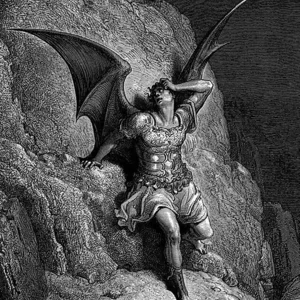

Samael is a malevolent angel in Jewish tradition, often identified with the Angel of Death and the Accuser (Satan). A central figure in Kabbalah and the Talmud, he embodies evil and opposition to the divine.
Samael
Satan
8 min read
Frequently asked questions
Key Facts
- Mentioned in the Babylonian Talmud (2nd–6th century) as the accusing angel
- In medieval Kabbalah, Samael is associated with the sphere of divine severity (Geburah)
- His name is interpreted as 'Poison of God' (sam = poison, El = God)
- He is sometimes identified with Satan in rabbinic literature
- A figure carried over into Jewish apocryphal texts such as the Book of Enoch
Works & Achievements
A foundational text of Rabbinic Judaism, compiled in the Babylonian academies. It is the earliest systematic source describing Samael as the Angel of Death, the Heavenly Accuser, and prince of demons.
A narrative Midrash attributed to Rabbi Eliezer ben Hyrcanus. This text contains the most detailed accounts of Samael's fall, his role in the seduction of Eve, and his nature as a fallen angel.
An apocryphal text in Hebrew and Aramaic that introduces the mythological pairing of Samael and Lilith, laying the foundation for medieval Kabbalistic demonology.
The first major Kabbalistic text, it systematizes Samael's role as an entity of structural evil opposed to divine light, establishing the foundations of Kabbalah's dualistic cosmology.
The masterwork of medieval Kabbalah, the Zohar devotes numerous passages to Samael as the leader of the Sitra Achra (the Other Side), husband of Lilith, and chief antagonist of divine creation.
Recorded by his disciple Hayyim Vital in the Etz Hayyim, these teachings integrate Samael into the cosmogony of the 'breaking of the vessels' (Shvirat ha-Kelim) and the process of repairing the world (Tikkun Olam).
Anecdotes
In the Babylonian Talmud, Samael is identified as the angel who wrestled with Jacob through the night at the ford of the Jabbok. Some rabbis teach that Jacob did not fight an ordinary man, but the 'celestial prince' of Esau — Samael himself — representing the forces of evil.
According to the Talmudic tractate Sotah, Samael descended to earth in the form of the serpent to seduce Eve in the Garden of Eden. Kabbalistic tradition adds that he rode upon the serpent, and that from this union was born Cain, humanity's first murderer.
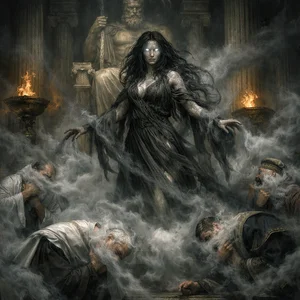
In medieval Kabbalah, Samael is presented as the husband of Lilith, the first wife of Adam according to certain texts. Together they form the diabolical couple of the 'Sitra Achra' (the Other Side), the principle of evil opposed to divine light.
The Book of Job, in the Hebrew Bible, features 'ha-Satan' (the Accuser), who makes a wager with God over Job's faithfulness and receives permission to subject him to terrible trials. Rabbinic tradition gradually equated this figure with Samael, casting him as the celestial prosecutor in God's divine court.
According to the Pirkei De-Rabbi Eliezer, Samael is the angel who brought death to Moses. God refused him access to the prophet's soul, however, and it was ultimately God himself who gathered Moses' soul with a kiss — so that Samael could never claim it.
Primary Sources
"Samael, the wicked, descended and rode upon the serpent... and the spirit of Samael entered into the serpent."
"Samael rode upon the serpent, whose appearance resembled that of a camel. Samael was the greatest of the angels in heaven, and he took the serpent as his mount."
"Samael is called the great prince of accusation in the supernal celestial regions... He is the chief of all accusers, and he stands before the Holy One, blessed be He, to accuse mankind."
"Lilith left Adam and went to dwell by the Red Sea... Samael took her as his wife, and together they begat a multitude of demons."
"And what is his name? Samael is his name. And why is he called thus? Because he is the angel of death ('sar shel mavet'), and his poison ('sam') is death."
Key Places
The great rabbinic academies of Babylon were where the Babylonian Talmud was composed (3rd–6th centuries), a foundational text in which Samael takes on his systematic role as the angel of death and divine adversary.
In the 13th century, Girona was home to one of the earliest major kabbalistic schools in Europe, where masters such as Nahmanides developed doctrines about Samael and the Sitra Achra that would later inspire the Zohar.
Following the expulsion from Spain (1492), Safed became the world capital of Kabbalah. Isaac Luria and Joseph Karo developed there a complex cosmology in which Samael serves as the chief of the forces of evil within the shattered universe.
The Garden of Eden is the setting for Samael's foundational act: riding upon the serpent, he tempts Eve and brings about the fall of humanity, according to the kabbalistic retelling of Genesis.
It was at the Jabbok that Jacob wrestled through the night with a mysterious adversary (Genesis 32). Rabbinic tradition identifies this adversary as Samael, the heavenly prince of Esau, in a struggle that prefigures Israel's battle against the forces of evil.
Typical Objects

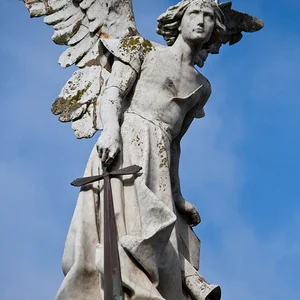
In the Talmud, the angel of death (identified with Samael) carries a sword from which hangs a drop of deadly bile. According to legend, it is this drop, falling upon the lips of the dying, that causes death.

In his role as Heavenly Accuser, Samael is associated with the scales that weigh the merits and sins of men before the divine tribunal. This attribute links him to the figure of the prosecutor in the celestial judicial system of rabbinic theology.

In the Zohar, Samael is described as carrying a scroll upon which the sins of men are recorded, which he presents before God to seek their condemnation. This role as archivist of evil is central to his function as the Accuser.

According to the Pirkei DeRabbi Eliezer, Samael used the serpent as his mount to enter the Garden of Eden and tempt Eve. The serpent serves as both his vehicle and his avatar in the rabbinic tradition.

The very name Samael is etymologically linked to the Hebrew word 'sam' (venom, poison). This cup of poison symbolizes his deadly nature and his capacity to corrupt the human soul through temptation and sin.

In kabbalistic cosmology, Samael is the prince of the Sitra Achra (the Other Side), the realm of impure forces. This symbolic veil represents the barrier that separates mankind from divine light when they succumb to evil.
School Curriculum
Vocabulary & Tags
Key Vocabulary
Tags
Daily Life
Morning
Before dawn, Samael stands in the upper celestial spheres, presenting to the divine tribunal the scroll of humanity's nightly transgressions. According to the Zohar, it is at the hour when night draws to its close that he holds the greatest power over the souls of sinners.
Afternoon
During the daylight hours, Samael moves among the living in invisible forms, seeking opportunities for temptation. Talmudic tradition teaches that he lies especially in wait for people in their moments of anger, desire, and pride, to lead them astray from the divine path.
Evening
At twilight — the ambiguous hour between day and night — Samael is said to be particularly active in his role as the angel of death. The Talmud advises the faithful not to venture alone to crossroads at this hour, for it is there that Samael prowls to carry off the souls whose time has come.
Food
A spiritual being by nature, Samael does not eat in any literal sense. In Kabbalistic symbolism, he 'feeds' on human transgressions and unfulfilled prayers, which constitute his power and sustenance within the mystical economy of the universe.
Clothing
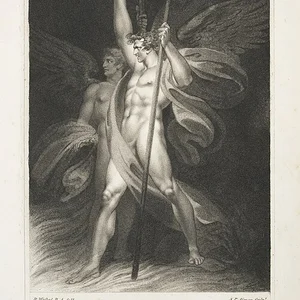
Kabbalistic texts describe Samael clothed in darkness, his six black wings forming a cloak of night. Unlike the luminous angels who wear garments of white light, Samael is often depicted draped in the colors of the Sitra Achra: blood red, black, and deep purple.
Housing
Samael dwells in the realm of the Sitra Achra (the Other Side), the dark counterpart of the divine world in Kabbalistic cosmology. He is also associated with Gehenna (Gehinnom), the place of soul purification in rabbinic tradition, of which he is said to be one of the ruling princes.
Historical Timeline
Period Vocabulary
Visual Style
Esthétique sombre inspirée des enluminures médiévales juives et byzantines : un ange aux ailes noires entouré de calligraphie hébraïque, dans une palette d'indigo, de noir et de cramoisi évoquant la Sitra Achra kabbalistique.
Sound Ambience
Une atmosphère mystérieuse et solennelle mêlant les sons des académies rabbiniques de Babylone — parchemins, chants araméens, shofar — à l'ambiance nocturne et inquiétante associée à l'ange de la mort dans la tradition talmudique.
Liens externes & ressources
Références
Œuvres
Talmud de Babylone (Talmud Bavli)
IIIe–VIe siècle ap. J.-C.
Pirké de-Rabbi Éliézer
VIIIe–IXe siècle
Alphabet de Ben Sira (Alphabetum Siracidis)
IXe–Xe siècle
Sefer ha-Bahir (Livre de la Clarté)
c. 1150–1180, Provence
Zohar (Livre de la Splendeur)
c. 1280, Castille — attribué à Moïse de Léon
Écrits kabbalistiques d'Isaac Louria (Ari)
c. 1560–1572, Safed