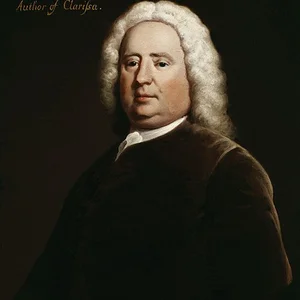

Samuel Richardson was an English writer and printer of the 18th century. A pioneer of the epistolary novel, he is regarded as one of the founders of the modern novel through his works centered on psychology and morality.
Samuel Richardson(1687 — 1761)
Samuel Richardson
royaume de Grande-Bretagne, royaume d'Angleterre
6 min read
Frequently asked questions
Key Facts
- Born in 1689 in Derbyshire, England
- Published Pamela, or Virtue Rewarded in 1740, an immense European success
- Brought out Clarissa, or the History of a Young Lady between 1747 and 1748, his epistolary masterpiece
- Published The History of Sir Charles Grandison in 1753
- Died in 1761 in London, leaving a lasting influence on the European novel (Rousseau, Diderot)
Works & Achievements
Before turning to fiction, Richardson published his own annotated version of the fables, a sign of his taste for moral instruction.
His first novel and an enormous success, told entirely through letters; it helped lay the foundations of the modern English novel.
A manual of model letters whose writing gave rise, almost by accident, to “Pamela.”
The second part of Pamela, written in part to respond to the imitations and parodies of his first success.
Considered his masterpiece: a monumental and tragic epistolary novel, the height of psychological analysis.
His last novel, which offers the portrait of a perfectly virtuous and kindly male hero.
Anecdotes
As a child, Samuel Richardson was so composed that his schoolmates nicknamed him “Serious” and “Gravity.” Around the age of thirteen, three girls from the neighborhood, knowing him to be discreet and skilled with a pen, asked him to write their love letters to their suitors on their behalf. He later said that this role of confidant taught him very early to observe the hearts of women.
Richardson did not write his first novel until he was over fifty, almost by chance. Two booksellers had commissioned him to produce a manual of model letters for poorly educated people; while drafting a sample letter from a young servant girl threatened by her master, he grew so impassioned by the story that he turned it into a complete novel, “Pamela” (1740).
The success of “Pamela” was such that people spoke of “Pamela-mania”: fans and prints illustrating the novel were sold, and it is said that in some villages the inhabitants rang the church bells upon learning of the heroine's marriage, as though she were a real person.
When “Clarissa” appeared in installments, devastated readers begged Richardson to save the heroine. One admirer, Lady Bradshaigh, wrote to him at length under a false name to plead for a happy ending. The author refused: he was set on his tragic ending to show that virtue does not always triumph in this world.
A prosperous printer, Richardson liked to submit his manuscripts to a circle of cultivated women friends who gave him their opinions chapter after chapter. In his country house near London, he would read his novels-in-progress aloud and discuss the fate of his characters with this small committee of women readers.
Primary Sources
A novel published "in order to cultivate the principles of virtue and religion in the minds of the youth of both sexes" — according to the original title page.
The collection promises to teach "not only the requisite style and forms to be observed in writing familiar letters, but how to think and act justly and prudently in the common concerns of human life".
The work presents itself as "comprehending the most important concerns of private life", and in his postscript Richardson defends the novel's right to end tragically.
Richardson's last novel, it aims to offer the portrait of "a man of true honour", the virtuous male counterpart to his heroines.
Key Places
Region in central England where Samuel Richardson was born, into a family of joiner-craftsmen. He spent his childhood there before leaving to learn a trade in London.
Heart of London's printing trade where Richardson did his apprenticeship and later set up his thriving workshop. It was there that he printed and wrote the bulk of his work.
Country house where Richardson loved to host his circle of female friends and readers, reading them his manuscripts in progress.
Richardson's last home, in a leafy suburb west of London, where he passed away in 1761.
Parish church of the printers' district where Samuel Richardson was buried. Nicknamed “the church of journalists and printers.”
Typical Objects

A heavy lever-operated machine, heir to Gutenberg, on which Richardson printed books, parliamentary journals and his own novels. His fortune as a writer rested first and foremost on his trade as a printer.

A compartmented case holding the metal letters that the compositor assembled by hand to form the pages. Handling the type was at the heart of the printer's trade.

The everyday writing instrument with which Richardson penned his immense novels and his abundant correspondence. His career in fact began by writing letters on behalf of others.

The very heart of Richardson's work: his novels are written in the form of letters exchanged between the characters. He also maintained a vast real-life correspondence with his readers and friends.

Large volumes, sometimes in several tomes like “Clarissa,” sold to the eager readers of the 18th century. The book as an object became a fashionable bourgeois entertainment.

A small metal rule held in the hand in which the type was lined up letter by letter, row after row. An emblematic tool of the printer's patient craftsmanship.
School Curriculum
Vocabulary & Tags
Key Vocabulary
Tags
Daily Life
Morning
Richardson started early, as a conscientious printer: he would walk through his Salisbury Court workshop to check the page composition, the proofs, and the work of his employees. The morning blended overseeing the business with the first hours of writing.
Afternoon
The afternoon might be devoted to the printing business — contracts with booksellers, printing the journals of Parliament — and, as his fame grew, to the writing of his novels, which he composed standing at a tall desk.
Evening
In the evening, especially at his country house, he loved to entertain a circle of cultivated women friends and readers, reading his chapters-in-progress aloud to them and discussing at length the fate of his characters.
Food
His table was that of a well-off eighteenth-century London bourgeois: roast meats, bread, vegetables, cheeses, accompanied by beer, wine, or tea, a drink then increasingly fashionable in England.
Clothing
He wore the sober dress of the respectable bourgeois: a coat, waistcoat, and breeches of cloth in discreet colours, stockings, buckled shoes, and the powdered wig customary among established men.
Housing
He lived in a town house-cum-workshop, where home and printing press stood side by side, and he also owned a country house in the leafy outskirts of London to escape the bustle and write in peace.
Historical Timeline
Period Vocabulary
Liens externes & ressources
Références
Œuvres
Édition révisée des Fables d'Ésope
1739
Pamela, ou la Vertu récompensée
1740
Letters Written to and for Particular Friends
1741
Pamela in her Exalted Condition (suite de Pamela)
1741
Clarissa, ou l'Histoire d'une jeune dame
1748
The History of Sir Charles Grandison
1753