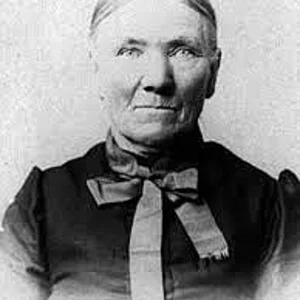

Sarah E. Goode was an American inventor and entrepreneur, one of the first African American women to receive a patent in the United States. Born into slavery, she became a furniture merchant in Chicago and invented a folding cabinet bed in 1885.
Sarah E. Goode(1855 — 1905)
Sarah E. Goode
États-Unis
5 min read
Frequently asked questions
Key Facts
- Born around 1855 into slavery in Toledo, Ohio, she was freed at the end of the Civil War in 1865.
- She settled in Chicago after the war and opened a furniture store there.
- On July 14, 1885, she received U.S. patent no. 322,177 for a folding cabinet bed, an ancestor of the fold-away bed.
- Her invention helped save space in small urban dwellings.
- She is one of the first African American women to receive a patent in the United States; she died in 1905.
Works & Achievements
The official document that protects her invention. It makes Sarah Goode one of the first African American women to hold a patent in the United States.
The invented object itself: a folding bed that converts into a desk, designed to save space in the modest dwellings of industrial cities.
Her furniture store, which made her a businesswoman and inspired her invention through contact with her customers' needs.
Her folding-bed principle foreshadows the wall-mounted fold-away beds (such as the Murphy bed) popularized at the turn of the 20th century.
Anecdotes
On July 14, 1885, Sarah E. Goode received U.S. patent No. 322,177 for a “cabinet bed,” a bed that folds up to form a desk-secretary. She was one of the very first African American women to be granted a patent in the United States.
Born into slavery, Sarah became a free woman after the Civil War and the abolition of slavery in 1865. Settling in Chicago, she ran a furniture store there, which gave her the idea for her invention.
Her folding bed solved a real problem: in the cramped workers' apartments of the big cities, space was in desperately short supply. Once folded, the piece of furniture looked like a roll-top desk, with compartments for storing paper and an inkwell.
Sarah Goode's invention is often regarded as a forerunner of the famous “Murphy bed” (a wall-mounted fold-away bed), patented by William Murphy around 1900, some fifteen years later.
In 2012, a Chicago high school was named the “Sarah E. Goode STEM Academy” in her honor, to encourage students to pursue science and technology.
Primary Sources
Be it known that I, Sarah E. Goode, of Chicago, in the county of Cook and State of Illinois, have invented certain new and useful Improvements in Folding-Beds.
The invention describes a folding bed that, once closed, turns into a desk fitted with compartments, in order to save space in small dwellings.
The patent figures show the hinged mechanism that allows the bedframe to be raised and the bed to be folded down to reveal a writing surface and storage compartments.
Key Places
Large industrial city in the North where Sarah Goode settled, ran her furniture business, and designed her invention. She spent most of her adult life there.
The agency that examines and grants American patents. It is where Sarah Goode's patent no. 322,177 was registered in 1885.
A high school opened in 2012 and named in honor of the inventor. It keeps her memory alive by teaching students science and technology.
Typical Objects
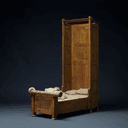
Sarah Goode's signature invention: a bed that folds up to become a desk. It freed up space during the day in small urban apartments.
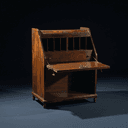
Once the bed was folded away, the piece of furniture revealed a writing surface and slots for paper and an inkwell. The same object thus served both for sleeping and for working.

Patent No. 322,177 describes the invention in words and drawings. It legally protects the inventor's idea and officially attests to her creation.

The system of hinges and pivots made it possible to raise the bed frame and fold the bed down effortlessly. It is the technical heart of the invention.
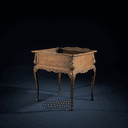
Sarah Goode ran a furniture business. The pieces she sold and observed day to day nourished her practical sense as an inventor.
School Curriculum
Vocabulary & Tags
Key Vocabulary
Tags
Daily Life
Morning
Sarah starts her day early to open her furniture business. She checks the stock, greets the first customers and observes their needs, especially those living in small homes.
Afternoon
The afternoon is split between sales, managing the accounts and thinking through her design ideas. It is while reflecting on her customers' lack of space that she imagines her folding bed.
Evening
In the evening, she can sketch and refine her projects, discussing them with cabinetmakers able to build her furniture. The long evenings are lit by an oil lamp, and then by electricity in the modernized neighborhoods.
Food
The diet of a Chicago city dweller at this time relies on bread, meat, potatoes, beans and canned goods. The markets and grocery stores of the industrial North offer more varied food than in the rural South.
Clothing
A shopkeeper of the late 19th century wears long dresses fitted at the waist, petticoats and a corset, with a hat for going out. Work clothes stay plain and neat to inspire confidence in the clientele.
Housing
Chicago is rebuilding after the fire of 1871 with brick buildings and often cramped housing. It is precisely this lack of space that drives the invention of a two-in-one piece of furniture.
Historical Timeline
Period Vocabulary
Liens externes & ressources
Références
Œuvres
Brevet n° 322 177 — « Cabinet-Bed »
14 juillet 1885
Lit-armoire repliable
1885
Commerce de mobilier à Chicago
vers 1870-1900
Influence sur le lit escamotable moderne
après 1885