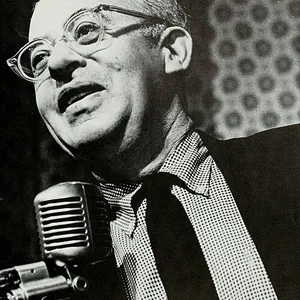

Saul Alinsky was an American sociologist and community activist, considered the founder of modern community organizing. He developed methods of collective action to empower disadvantaged populations in urban neighborhoods.
Saul Alinsky(1909 — 1972)
Saul Alinsky
États-Unis
6 min read
Frequently asked questions
Key Facts
- Born in 1909 in Chicago to a family of Russian Jewish immigrants
- Founded the Industrial Areas Foundation in 1940 to train community organizers
- Organized the working-class Back of the Yards neighborhood in Chicago starting in 1939
- Published Reveille for Radicals (1946), a best-seller on grassroots organizing
- Published Rules for Radicals (1971), the reference manual of community organizing, the year before his death in 1972
Works & Achievements
The first neighborhood council founded by Alinsky, the founding model of community organizing that unites rival communities around shared goals.
An organization created to train professional organizers and spread his methods across the country. It still exists today.
Alinsky's first book, a best-seller that theorizes the organizer's role in a participatory democracy.
An African American neighborhood coalition in Chicago, considered one of the most powerful community organizations of its time.
A mobilization of the Black community against the giant Kodak to secure jobs, which became a textbook case of negotiating with a major corporation.
Alinsky's major work and intellectual testament, which lays out his twelve rules for action and has had a lasting influence on modern activism.
Anecdotes
In 1939, Saul Alinsky founded the Back of the Yards Neighborhood Council in a working-class neighborhood of Chicago located near the immense stockyards described by Upton Sinclair in *The Jungle*. He achieved the remarkable feat of uniting immigrant communities that despised one another — Poles, Czechs, Lithuanians, Mexicans — around common goals such as better wages and housing.
Alinsky loved to recount provocative tactics for forcing the powerful to negotiate. One of the most famous, which remained mostly a threat, was his plan to stage a massive occupation of the restrooms at Chicago's O'Hare Airport in order to paralyze the city and extract concessions from the authorities. The mere rumor was said to be enough to make the opposing side give in.
For his book *Rules for Radicals* (1971), Alinsky wrote an ironic and provocative dedication to Lucifer, whom he humorously presented as the very first radical in history to have successfully won his own kingdom. This wink provoked sharp criticism from his conservative opponents.
Alinsky cultivated the art of humor and ridicule as a political weapon. He claimed that “ridicule is man's most potent weapon” because an opponent never knows how to respond to it, and because it demoralizes the other side more surely than anger does.
As a young man, Alinsky funded part of his sociology studies by spending time in Chicago's organized crime scene. For two years he observed Al Capone's gang, not as an accomplice but as a researcher, in order to understand from the inside how power and organizations worked.
Primary Sources
A community organizer must create disorder within the established order, but he also knows that he will then have to build a new order out of that chaos.
A living democratic society is one whose citizens take an active part and fight for their rights, not a passive and resigned crowd.
Power is not only what you have but what the enemy thinks you have. Ridicule is man's most potent weapon.
I believe deeply in people. The only question for me is whether people will be given the chance to wield real power over their own lives.
Key Places
Alinsky's birthplace and the laboratory for all his community organizing experiments. It was here that he observed power, from the slaughterhouses to the ghettos.
Working-class neighborhood near the slaughterhouses where Alinsky founded his first neighborhood council in 1939. The cradle of modern community organizing.
African American neighborhood on Chicago's South Side where Alinsky launched The Woodlawn Organization in 1961. There he applied his methods to the fight against segregation and real estate speculation.
The institution where Alinsky studied sociology and criminology. It was here that he began investigating power and organizations.
The city where, in 1965, Alinsky organized the FIGHT coalition to defend the African American community against the Kodak company. A famous example of a campaign against a major corporation.
Coastal town in California where Saul Alinsky died of a heart attack in 1972.
Typical Objects

Alinsky's manifesto-book that codifies his organizing methods and his twelve tactical rules. It became a reference for generations of activists.

Printed leaflet distributed in neighborhoods to announce a meeting or an action. A basic tool for rallying residents around a cause.

A bullhorn used at rallies and demonstrations to address the crowd. A symbol of the voiceless claiming a place in public speech.

A document setting out the specific demands addressed to elected officials, landlords, or businesses during negotiations. It turns diffuse anger into concrete goals.

A board held up by demonstrators bearing a slogan. It makes the neighborhood's demands visible in public space.

An essential instrument for the organizer to coordinate networks of residents and prepare large-scale actions. The telephone network was the lifeblood of mobilization.
School Curriculum
Vocabulary & Tags
Key Vocabulary
Tags
Daily Life
Morning
Alinsky's morning often began with reading the local newspapers to spot the conflicts and injustices of the moment. He made numerous phone calls to prepare his campaigns and coordinate his networks of residents.
Afternoon
The afternoon was devoted to fieldwork: walking through the neighborhoods, meeting residents, listening to their anger and their needs. He practiced the art of identifying a community's natural leaders.
Evening
In the evening, Alinsky led or prepared neighborhood meetings in church basements or parish halls. He also loved to talk for hours, blending political strategy, humor, and provocation.
Food
Alinsky led the life of a twentieth-century American urban intellectual, gladly sharing simple meals in the working-class neighborhoods he organized. Coffee and sandwiches punctuated his long days of meetings.
Clothing
He dressed plainly, in a suit and tie and dress shirt, in the manner of a sociologist or a businessman of his time. This conventional appearance contrasted with the radical nature of his ideas and allowed him to be taken seriously by the powerful.
Housing
Alinsky lived in an urban setting, mainly in **Chicago**, as close as possible to the working-class and blue-collar neighborhoods he organized. His life was marked by constant travel across the United States to launch new campaigns.
Historical Timeline
Period Vocabulary
Liens externes & ressources
Références
Œuvres
Back of the Yards Neighborhood Council
1939
Industrial Areas Foundation (IAF)
1940
Reveille for Radicals
1946
The Woodlawn Organization (TWO)
1961
Campagne FIGHT à Rochester
1965
Rules for Radicals
1971