
Japanese author
Sei Shōnagon(966 — 1025)
Sei Shōnagon
Japon
6 min read
Frequently asked questions
Key Facts
Works & Achievements
A major work of medieval Japanese literature combining personal observations, lists of things loved or loathed, and poetic reflections on life at the imperial court. This fragmented collection profoundly influenced Japanese literature and remains an invaluable record of aristocratic life during the Heian period.
Active contributions to poetry competitions (utaawase) and the cultural life of the imperial court, where her compositions in waka (31-syllable poems) established her as one of the greatest poets of her age.
The creation of numerous organized enumerations of natural phenomena, objects, and situations arranged according to aesthetic or emotional criteria, establishing a new form of literary expression that continues to influence Japanese thought.
Detailed documentation of the customs, rituals, and intrigues of the imperial court, offering historians an invaluable source on the political and social workings of medieval Japan in the 10th–11th centuries.
Development of original ideas on beauty, elegance (miyabi), and refinement in aristocratic culture, laying the foundations of medieval Japanese aesthetics and the courtly ideal.
Anecdotes
Sei Shōnagon served as a lady-in-waiting at the Japanese imperial court around 990, during the reign of Empress Teishi. She had access to the palace's most privileged spaces and could observe the aristocratic life of Japan's highest society, which provided the raw material for her most celebrated observations.
She composed her masterwork, the 'Makura no sōshi' (The Pillow Book), as a collection of observations on court life, containing lists of things she loved or loathed, amusing anecdotes, and poetic reflections. This groundbreaking book invented an entirely new literary genre in Japan and showcases her sparkling personality and sharp critical eye.
Sei Shōnagon was renowned for her biting wit and sarcastic remarks at court, which earned her both admiration and jealousy from her peers. Some aristocratic women considered her impertinent — most notably her rival Izumi Shikibu — creating a literary rivalry that left its mark on Japanese culture of the era.
She received an exceptional education in poetry, calligraphy, and Chinese literature, fields that were typically reserved for men, making her a remarkable intellectual figure of her time. Her father was a celebrated poet, which had given her access to knowledge rarely available to women in medieval Japan.
Primary Sources
At this moment, what I enjoy is observing things closely. When I see something beautiful or interesting, I cannot help but write it down. That is how I came to write these notes in no particular order.
At the Emperor's court, there was a lady-in-waiting renowned for her sharp wit and her penetrating observations on court life. She was known for noticing details that others overlooked.
Pleasing things: finding notes one wrote long ago; reading an essay or poem one had forgotten; beautiful calligraphy on dyed paper.
Key Places
The imperial capital of Japan where Sei Shōnagon lived and worked at the imperial court. It was the center of her intellectual life and the place where she wrote her celebrated The Pillow Book.
The seat of the imperial court where Sei Shōnagon served as a lady-in-waiting (kōi) to Empress Teishi. There she observed the refined life of the nobility that would inspire her work.
A region in central Japan said to be the homeland of Sei Shōnagon's family. Her father, Kiyohara no Motosuke, was a renowned scholar from this area.
A Buddhist temple near Kyoto where, according to tradition, Sei Shōnagon retreated after leaving the court. It served as a place of spiritual withdrawal in the later years of her life.
An important pilgrimage site south of Kyoto frequented by the Heian nobility. It represents the religious and cultural context of Sei Shōnagon's era.
Typical Objects

A paper scroll on which Japanese literary works were written. Sei Shōnagon composed her Pillow Book in this format, widely used by Heian-period writers for both poetry and prose.

The essential tool of the medieval Japanese writer, used to trace characters with elegance. Sei Shōnagon mastered this instrument for her refined calligraphy, a hallmark of the learned class.

Black ink used for writing and calligraphy. Indispensable to Japanese literary and artistic creation, it represents the art of writing that Sei Shōnagon practiced with great virtuosity.

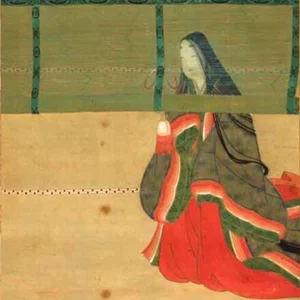
Traditional garment worn by ladies of the imperial court, often made of multicolored silk. As a lady-in-waiting at court, Sei Shōnagon wore these elegant kimonos that were emblematic of Heian aristocracy.

Both a fashion accessory and a practical object at the Japanese imperial court. Noblewomen, including Sei Shōnagon, carried decorated fans often adorned with poems or paintings.

An object used to burn fragrant incense, highly prized in the Heian court. Sei Shōnagon mentions incense in her Pillow Book, reflecting the importance of refined scents in aristocratic aesthetic life.

The medium on which Sei Shōnagon compiled her daily observations, which would become the Pillow Book (Makura no Sōshi). This collection of impressions, poems, and lists remains her greatest masterpiece.

High-quality handcrafted Japanese paper used for writing letters and literature. Made from plant fibers, it provided an elegant surface for the poetic compositions of Sei Shōnagon and her contemporaries.
School Curriculum
Vocabulary & Tags
Key Vocabulary
Daily Life
Morning
Sei Shōnagon wakes in her apartments at the imperial court and prepares herself carefully with the help of her ladies-in-waiting. She applies the cosmetics of the era — white face powder and painted eyebrows — before donning her court robes.
Afternoon
She attends gatherings at the imperial court as a lady-in-waiting to the Empress, taking part in literary discussions and poetic exchanges with other noblewomen. She observes the rituals and official ceremonies of the imperial palace.
Evening
As the day draws to a close, Sei Shōnagon retreats to her quarters to devote herself to writing and composing poetry. She records her observations on court life and daily events, setting down the notes that will become her celebrated 'The Pillow Book'.
Food
Her diet consists of white rice, fish and seafood prepared according to court customs, seasonal vegetables, and occasional meat. She drinks tea and attends the refined banquets of the imperial court, where dishes are presented according to a strict protocol.
Clothing
She wears the magnificent 'juni-hitoe' (layered robes of twelve sheets of colored silk), a mark of her status as a noblewoman of the court. Her long black hair, never cut, falls all the way to the floor, adorned with flowers and delicate accessories that change with the seasons.
Housing
Sei Shōnagon resides in the imperial palace of Heian-kyō (Kyoto), in apartments reserved for the Empress's ladies-in-waiting. Her quarters are elegantly decorated with tatami mats, painted folding screens, and refined furnishings typical of the Heian nobility.
Historical Timeline
Period Vocabulary
Visual Style
Un style visuel qui fusionne l'esthétique raffinée du Heian avec la technique traditionnelle de la peinture à l'encre japonaise, caractérisé par des touches délicates, des feuilles d'or et une atmosphère intime et poétique évoquant les manuscrits et les carnet intimes de la cour impériale du XIe siècle.
Sound Ambience
Une ambiance sonore raffinée de la cour impériale du Japon Heian, mêlant l'intimité de l'écriture aux sons délicats de la vie aristocratique : froissement de soies, musique de cour lointaine, pluie sur les toits, et le calme contemplatif d'une femme de lettres à son bureau.
Liens externes & ressources
Références
Œuvres
Notes de chevet (Makura no Sōshi)
début du XIe siècle (vers 1010)
Poésie de cour et participation littéraire
970-1025
Listes thématiques et classifications esthétiques
début du XIe siècle
Observations de la vie courtoise (Heian)
970-1025
Réflexions philosophiques et esthétiques
début du XIe siècle