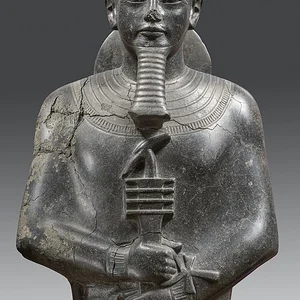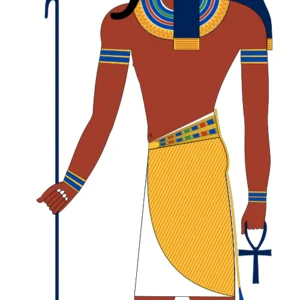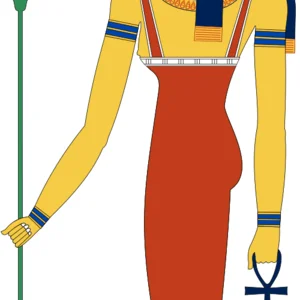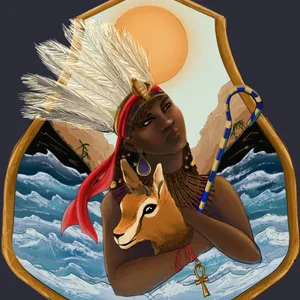

A lioness goddess of ancient Egyptian mythology, Sekhmet embodies both warlike destruction and healing power. Daughter of Ra, she is the protector of the pharaoh on the battlefield and the patron of physicians. Her cult, attested as far back as the Old Kingdom, was especially vibrant in Memphis.
Sekhmet
Sekhmet
8 min read
Frequently asked questions
Famous Quotes
« "I am she whose breath burns like the fire of the desert." (words attributed to Sekhmet by Egyptian mythological tradition, Coffin Texts)»
Key Facts
- Attested as early as the Old Kingdom (c. 2700 BCE) in religious texts and iconographic representations
- According to the myth of the Destruction of Humanity (Book of the Celestial Cow), Ra sent her to punish humankind; she was stopped by the trick of beer stained red like blood
- Her main cult center was Memphis, where she was associated with Ptah and Nefertem (the Memphite Triad)
- Sekhmet's priests also served as physicians and healers, uniting the power of destruction with the power of cure
- More than 700 statues of Sekhmet were erected by Amenhotep III (c. 1380 BCE) in the Temple of Mut at Karnak
Works & Achievements
The central narrative of the Sekhmet myth, telling how she was sent by Ra to punish rebellious humanity. This foundational myth illustrates her destructive omnipotence and the necessity of ritual appeasement.
A group of more than 700 black granite statues depicting Sekhmet, commissioned by Amenhotep III. Now dispersed across the world's greatest museums, they represent one of the most ambitious sculptural programs in ancient Egypt.
A body of texts sung and recited during the annual ceremonies to pacify the goddess. These hymns, preserved on papyri and temple walls, bear witness to the richness of her cult over more than two millennia.
A corpus of medical and magical prescriptions transmitted under the authority of Sekhmet. These texts established a sacred medical tradition in which healing was as much a matter of ritual as of clinical practice.
Inscriptions and reliefs depicting Ramesses II under the protection of Sekhmet during the Battle of Kadesh. These scenes consecrate the goddess's role as supreme protector of the pharaoh in battle.
Anecdotes
According to the Myth of the Destruction of Mankind, Ra sent Sekhmet to punish humans who had rebelled against him. The lioness goddess unleashed such violent fury that Ra himself feared she would annihilate all of humanity. To stop her, the gods flooded the fields with beer dyed red to resemble blood. Sekhmet was deceived, drank every drop, and fell asleep — saving humanity in the process.
Each year, during the ancient Egyptian New Year festival, the priests of Memphis performed a ritual known as 'the appeasing of Sekhmet.' Hundreds of statues of the goddess were anointed with scented oil and hymns were sung in her honor for several days, to ward off epidemics and misfortune in the year ahead. This ritual reflects Sekhmet's dual nature: at once a source of disease and the only one capable of curing it.
Amenhotep III, pharaoh of the New Kingdom (c. 1388–1351 BCE), had more than seven hundred statues of Sekhmet erected at Thebes, most of them in the mortuary temple of Medinet Habu and throughout the Karnak complex. This extraordinary number was intended to multiply divine intercessions, protecting the pharaoh and all of Egypt from the forces of chaos.
Sekhmet was regarded as the patron goddess of Egyptian physicians and surgeons, who bore the title 'priests of Sekhmet.' They invoked the goddess before every procedure, as illness was believed to be her 'arrows' — and only she could call them back. This duality of destruction and healing made her a deeply ambivalent and feared figure.
Primary Sources
Re said: 'Summon for me my Eye, as well as Shu, Tefnut, Geb and Nut, along with the fathers and mothers who were with me when I was still in the Nun.' And the Eye of Re descended in the form of Hathor-Sekhmet to punish mankind.
Hail to you, Sekhmet-Bastet, great of magic, mistress of the two lands, Eye of Re, you who travel the paths of fire and send the arrows of disease, yet also hold the remedy in your hand.
The king is Sekhmet, he leaps forth like flame, he strikes like the lioness, no god can stand against him for he is the son of Re, protected by the great goddess of two faces.
These formulas were found in the writings of the temple of Sekhmet, patron of physicians. Before any procedure, the practitioner shall invoke the lion-headed goddess so that she may deign to withdraw her arrows of disease from the patient's body.
Key Places
The main center of Sekhmet's cult, home to her great temple linked to that of Ptah. Memphis was the religious and political heart of Egypt during the Old Kingdom.
The site where Amenhotep III erected hundreds of statues of Sekhmet, many of which are still visible today. This complex bears witness to the importance of her cult during the New Kingdom.
The funerary temple of Amenhotep III where numerous statues of Sekhmet were discovered. This site reflects the royal desire to ensure the goddess's permanent protection.
The royal necropolis of the Old Kingdom where the Pyramid Texts — the earliest documents mentioning Sekhmet — were found carved on the walls of burial chambers.
A Ptolemaic-era temple where depictions of Sekhmet syncretized with Hathor are preserved, attesting to the continuity of her cult into the Greco-Roman period.
Typical Objects

A percussion instrument used in rituals to appease Sekhmet. The sound of the sistrum was believed to calm the goddess's fury and ward off harmful forces.

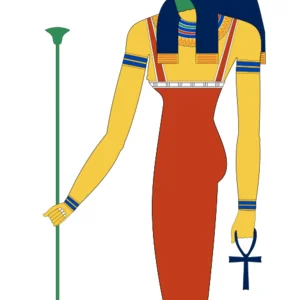
A scepter topped with the head of a fantastical animal, symbolizing power and divine dominion. Sekhmet is often depicted holding one, a sign of her authority over war and disease.

Sekhmet's distinctive headdress, reflecting her status as daughter of Ra and Eye of the Sun. The uraeus — a rearing cobra — symbolizes royal protection and destructive fire.

Sekhmet is depicted in hundreds of granite statues, seated or standing, with the head of a lioness. These statues were placed in temples to concentrate her protective power.

The Egyptian symbol of eternal life, which Sekhmet sometimes carries in her hand, highlighting her dual nature: goddess of both death and healing, capable of taking life and giving it.

In liturgical texts, the diseases sent by Sekhmet are called her 'arrows.' Priest-physicians used magic spells to symbolically remove these arrows from the bodies of the sick.
School Curriculum
Vocabulary & Tags
Key Vocabulary
Tags
Daily Life
Morning
In the temples dedicated to her, dawn is devoted to the ritual opening of the naos: priests break the night's seal, wash and anoint the goddess's statue, present food offerings, and recite hymns to welcome the rising sun. This awakening ritual marks the daily victory of Ra over darkness, in which Sekhmet takes part as the eye of the sun.
Afternoon
Priest-physicians spend the afternoon receiving the sick who come to the temple seeking healing. Consultations blending medical diagnosis with ritual invocation are held in special rooms. Offerings of oil, milk, and lotus flowers are placed before statues of Sekhmet to win her healing favor.
Evening
In the evening, libations of beer and wine are offered to Sekhmet during rituals intended to 'calm her fury' for the night ahead. Musicians play the sistrum and singers chant hymns of pacification. The high priest seals the naos once more, entrusting the temple and its worshippers to the goddess's nocturnal protection.
Food
Food offerings made to Sekhmet include raw meat (reflecting her nature as a predator), cow's milk, red beer evoking the blood of myth, and flatbreads. The priests in charge of her cult observed strict purificatory regimens involving fasting and abstinence before major ceremonies.
Clothing
Sekhmet is depicted wearing a long, form-fitting linen sheath dress in red — the color of fire and blood — cinched at the waist with a golden belt. Her headdress is a solar disk topped by a golden uraeus. The priestesses responsible for her cult wore white robes during appeasement rituals, symbolizing purity in the face of the goddess's power.
Housing
Sekhmet's temple at Memphis, built alongside the sanctuary of Ptah, is a fortress of sandstone and granite with massive columns. The enclosure includes a sacred lake, hypostyle halls, offering storerooms, and an inner sanctuary (naos) in whose darkness the cult statue stands enthroned. Only light filtered through narrow slits in the stone illuminates the goddess's stone face.
Historical Timeline
Period Vocabulary
Visual Style
Style monumental de l'art égyptien antique : silhouette hiératique à tête de lionne en robe rouge, coiffée du disque solaire, sur fond de grès ocre gravé de hiéroglyphes, avec des accents en lapis-lazuli et feuille d'or.
Sound Ambience
L'atmosphère sonore d'un temple de Sekhmet mêle percussions rituelles des sistrums, chants de prêtres, crépitement des lampes à huile et parfums d'encens, ponctués d'un souffle de vent du désert évoquant le rugissement de la lionne.
Liens externes & ressources
Références
Œuvres
Cycle mythologique de la Destruction de l'humanité
Attesté vers 1350 av. J.-C. (origine plus ancienne)
Statues colossales d'Amenhotep III
Vers 1370 av. J.-C.
Hymnes liturgiques à Sekhmet (rituels d'apaisement)
Du Moyen Empire à la période ptolémaïque
Formules médicales des prêtres-médecins de Sekhmet
Vers 1550 av. J.-C. (Papyrus d'Ebers)
Reliefs du temple de Karnak (campagnes militaires)
Vers 1274 av. J.-C. (règne de Ramsès II)