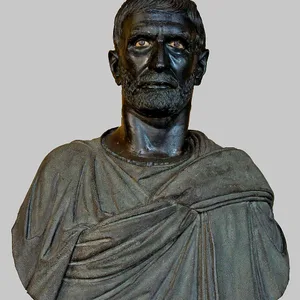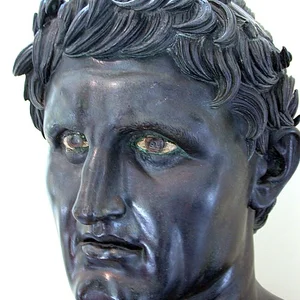

A Macedonian general under Alexander the Great, Seleucus became one of the Diadochi after his death and founded the Seleucid dynasty. He built the largest of the Hellenistic kingdoms, stretching from Anatolia to the Indus.
Seleucus I Nicator(357 av. J.-C. — 280 av. J.-C.)
Seleucus I
royaume de Macédoine, royaume séleucide
6 min read
Frequently asked questions
Key Facts
- An officer of Alexander the Great, he commanded the hypaspists (an elite corps) during the Asian campaign (327 BC)
- Became satrap of Babylon in 321 BC after the agreement of Triparadisus
- Founded the Seleucid dynasty in 312/311 BC (the starting point of the Seleucid era)
- Around 305-303 BC, treaty with Chandragupta Maurya: the eastern satrapies were ceded in exchange for 500 war elephants
- Victor of the Battle of Ipsus (301 BC); assassinated in 281 BC after his victory at Corupedium
Works & Achievements
By taking the title of king, Seleucus established a dynasty that would rule the Hellenistic East for more than two centuries.
His recapture of Babylon founded the first continuous calendar in history, used for centuries across the Near East.
A prestigious capital that would become one of the greatest cities of antiquity and a center of Greek culture.
A great Mesopotamian metropolis meant to spread Hellenism and to supplant ancient Babylon.
A diplomatic agreement fixing the eastern border and providing 500 war elephants, sealed by a marriage alliance.
A military triumph thanks to his elephants that made Seleucus the most powerful of the Diadochi and expanded his kingdom as far as the Mediterranean.
After Corupedium, his empire stretched from Anatolia to the Indus, the largest of all those born from Alexander's legacy.
Anecdotes
After Alexander's death, Seleucus began modestly: he had received only a distant satrapy, Babylonia. Driven out by his rival Antigonus the One-Eyed, he fled to Egypt, then returned to retake Babylon in 312 BC — a return so decisive that the Seleucids made it the starting point of their calendar, the “Seleucid era.”
Around 305 BC, Seleucus carried the war all the way to the gates of India, facing the emperor Chandragupta Maurya. Rather than exhaust himself, he concluded a treaty: he ceded the eastern provinces and received in exchange 500 war elephants. These beasts made the difference at the Battle of Ipsus.
At Ipsus in 301 BC, his 500 elephants formed a living wall that cut off the enemy cavalry and sealed Antigonus's defeat. This victory made Seleucus the master of an immense empire, stretching from Asia Minor to the borders of India.
Seleucus was given the surname “Nicator,” meaning “the Victor.” Yet his final conquest proved fatal: in 281 BC, master of nearly all of Alexander's empire, he was assassinated in Europe by Ptolemy Keraunos, the son of his former ally, whom he had nonetheless welcomed at his court.
For political reasons, Seleucus gave up his own wife Stratonice to his son Antiochus. According to a famous story handed down by the ancients, the young prince was secretly dying of love for his stepmother, and a perceptive physician guessed the ailment by noticing his pulse racing at the sight of the young woman.
Primary Sources
Seleucus founded cities throughout the whole extent of his empire: sixteen Antiochs named after his father, five Laodiceas named after his mother, nine named after himself, and four named after his wives.
Seleucus, having retaken Babylon with a small force, was welcomed warmly by the inhabitants, for he had shown himself generous during his satrapy; it is from this moment that the Babylonians count the years of his reign.
Seleucus gave his wife Stratonice to his son Antiochus, who was wasting away from a love he concealed; the physician Erasistratus discovered the cause of the illness by observing the young man's agitation.
Seleucus Nicator concluded an agreement with Sandrocottus (Chandragupta), ceding territories to him in exchange for five hundred elephants, and sealed the friendship with a marriage.
Key Places
Seleucus's initial capital, which he reconquered in 312 BC to found his kingdom. The starting point of the Seleucid era.
Plain in Anatolia where, in 301 BC, the great battle took place that sealed the fall of Antigonus and the rise of Seleucus's power.
City founded by Seleucus around 300 BC in honor of his father Antiochus. It became the great capital of the Seleucid empire.
Metropolis founded by Seleucus on the Tigris to rival Babylon. It became one of the greatest cities of the Hellenistic East.
Battlefield in Asia Minor where Seleucus defeated and killed Lysimachus in 281 BC, becoming master of nearly all of Alexander's empire.
Region of Europe where Seleucus was assassinated by Ptolemy Keraunos in 281 BC, shortly after his greatest victory.
Typical Objects

A large silver coin struck with the image of the king and Greek deities, circulated throughout the empire. It was used to pay soldiers and asserted the authority of Seleucus to the farthest reaches of Asia.

A combat animal acquired from the Indians, mounted with a tower sheltering archers. Seleucus's elephants proved decisive at the Battle of Ipsus.

A very long pike of more than five metres wielded by the foot soldiers of the Macedonian phalanx. It formed an impenetrable forest of points in battle.

A band of white cloth tied around the forehead, a sign of royal power adopted by the Diadochi. To wear it meant claiming the title of king.

Armour of bronze or reinforced linen worn by Hellenistic generals. It offered protection in battle while displaying the commander's rank.

An engraved inscription commemorating the creation of the many Seleucid cities such as Antioch or Seleucia. It carved the memory of the founder into stone.
School Curriculum
Vocabulary & Tags
Key Vocabulary
Daily Life
Morning
A warrior-king constantly on campaign, Seleucus often begins his day in his tent, in his army's camp. He receives messengers and officers, reviews the troops, and examines reports arriving from the distant satrapies of his vast empire.
Afternoon
The afternoon is devoted to governing: audiences, justice dispensed to the Greek and Eastern cities, and decisions about founding new towns. He dictates orders to his scribes, who write them in Greek and sometimes in Aramaic or Akkadian.
Evening
In the evening, the king holds a banquet (*symposion*) with his companions (*hetairoi*), in the Macedonian fashion, blending wine, political discussion, and strategy. These feasts are also moments when alliances and loyalties are forged.
Food
His diet blends Greek and Eastern traditions: barley or wheat bread, roasted game and mutton, fish, fruit, all washed down with wine diluted with water. To the royal feasts are added spices and refined dishes brought from Asia.
Clothing
Seleucus wears the costume of a Macedonian king: a tunic (*chiton*), a purple cloak (*chlamys*) pinned at the shoulder, and the white diadem tied around his forehead, the emblem of royalty. In battle, he dons a cuirass, helmet, and sword.
Housing
Forever on the move over hill and dale, he long lived in the royal tent among his soldiers. In his new cities such as Antioch and Seleucia, he had Greek-style palaces built, adorned with columns and courtyards, symbols of his power.
Historical Timeline
Period Vocabulary
Liens externes & ressources
Références
Œuvres
Fondation de la dynastie séleucide
305 av. J.-C.
Reconquête de Babylone et ère séleucide
312 av. J.-C.
Fondation d'Antioche sur l'Oronte
vers 300 av. J.-C.
Fondation de Séleucie du Tigre
vers 305 av. J.-C.
Traité avec Chandragupta Maurya
vers 303 av. J.-C.
Victoire d'Ipsos
301 av. J.-C.
Constitution du plus vaste royaume hellénistique
281 av. J.-C.