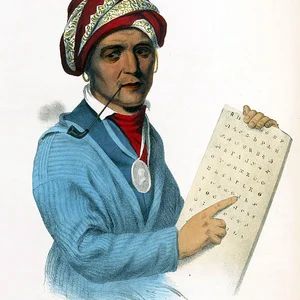

Sequoyah was a Cherokee silversmith and scholar, famous for single-handedly inventing the Cherokee syllabary around 1821. He is the only individual known in history to have created a writing system entirely from scratch without being literate himself beforehand.
Sequoyah(1770 — 1843)
Sequoyah
États-Unis
6 min read
Frequently asked questions
Key Facts
- Born around 1770 in the Cherokee village of Tuskegee (in present-day Tennessee).
- Completed the Cherokee syllabary of about 85 characters around 1821, after roughly a dozen years of work.
- The syllabary was officially adopted by the Cherokee Nation in 1825, enabling the people to become literate rapidly.
- His writing system made possible the publication of the bilingual newspaper Cherokee Phoenix beginning in 1828.
- Died in 1843 in Mexico, while searching for scattered bands of Cherokee; the Sequoia genus of trees is named in his honor.
Works & Achievements
Writing system of about 85 signs representing the syllables of the Cherokee language. The first script ever invented by a single illiterate man, and still in use today.
A test before the Cherokee chiefs proving that written messages could be read at a distance, which convinced the nation to adopt his invention.
Institutional recognition that turned Cherokee into a written language, used for laws, education, and religious texts.
The syllabary made possible the first Native American newspaper, printed in Cherokee and English at New Echota.
After the Trail of Tears, Sequoyah worked to reconcile the Western Cherokees and the deported Eastern Cherokees under a single government.
A final journey to Mexico to find emigrated Cherokees and preserve the unity of the people; he died there.
Anecdotes
Sequoyah could neither read nor write in any language when he decided to give the Cherokee a writing system. Struck by the power of white people who communicated through “talking leaves” (paper), he was convinced this secret could be reproduced. He is today the only individual in history known to have invented a complete writing system from scratch, without already being literate.
At first, Sequoyah tried to create a different sign for every word in the language. After drawing thousands of them without ever finishing, he understood his mistake and completely changed his method: he broke Cherokee down into syllables. He thus arrived at a system of only about 85 signs, much easier to memorize.
For a long time his neighbors took him for a madman or a sorcerer, and it is said that his work cabin was even burned down along with his first notes. To prove that his invention had nothing magical about it, he gave a public demonstration with his young daughter Ayoka: separated from each other, they exchanged written messages that the other read aloud, astonishing the onlookers.
The syllabary was so easy to learn that within a few years much of the Cherokee nation could read and write, sometimes more literate than its white neighbors. As early as 1828 appeared the *Cherokee Phoenix*, the first Native American newspaper, printed in both Cherokee and English.
Sequoyah died around 1843 in Mexico, while searching for a group of Cherokees who had gone to live in the south before the deportation. In his honor, the botanist Stephan Endlicher gave the name “Sequoia” to the giant trees of California, among the largest living beings in the world.
Primary Sources
He had observed that white people could put their thoughts on paper and send them across great distances; he was convinced that he could do the same for his own people.
The first newspaper printed by a Native American nation, composed partly with the help of the syllabary invented by Sequoyah and printed at New Echota.
A medal presented in recognition of his invention of the Cherokee alphabet, engraved in English on one side and in Cherokee on the other.
Guess's [Sequoyah's] system represents each syllable of the language with a distinct character, which makes it extraordinarily quick to learn.
Key Places
Cherokee village near the Little Tennessee River where Sequoyah is believed to have been born around 1770. A museum there honors his memory today.
Cherokee village where Sequoyah settled and ran his silversmith workshop. It was there that he completed much of his work on the syllabary.
Capital of the Cherokee Nation where its Constitution and the newspaper Cherokee Phoenix were adopted, the latter printed thanks to the syllabary.
Log cabin built by Sequoyah in Indian Territory after his migration westward. It is a historic site today.
Area in northern Mexico where Sequoyah died around 1843 while searching for a group of Cherokees who had gone to settle there.
Typical Objects

A writing system of about 85 signs, each representing a syllable of the Cherokee language. Invented by Sequoyah, it allowed an entire nation to become literate within a remarkably short time.

Pieces of bark, slates, and notebooks on which Sequoyah drew and tested his signs over many years. They served as the working drafts for developing the syllabary.

Hammers, chisels, and molds used by Sequoyah in his trade as a silversmith and blacksmith. This meticulous metalwork fed his taste for the precise drawing of signs.

A medal given to Sequoyah as a reward for his invention, engraved in English on one side and in Cherokee on the other. He wore it with pride until his death.

The first Native American newspaper, printed from 1828 thanks to type cast from the syllabary. It spread news, laws, and religious texts in both Cherokee and English.

The pipe Sequoyah smokes in most of his portraits, a common accessory among the Cherokee notables of his time. It is often associated with moments of reflection and conversation.
School Curriculum
Vocabulary & Tags
Key Vocabulary
Tags
Daily Life
Morning
When he woke, Sequoyah would rekindle the fire and eat a simple meal before heading to his workshop. A silversmith and blacksmith, he spent his mornings working silver and metal for his customers.
Afternoon
In the afternoon, he often went off by himself to draw and test his signs on bark and slates. For years, he sometimes neglected his fields and his trade, absorbed in his research.
Evening
In the evening, by firelight, he smoked his pipe and talked with his family and neighbors. Once the syllabary was finished, he spent these hours teaching his signs to the Cherokees who came to learn to read.
Food
The Cherokee diet was based on corn (porridges, cakes, cornbread), beans, and squash — the famous “three sisters.” To this were added hunted game, fish, nuts, and wild fruits.
Clothing
Sequoyah wore a mix of Cherokee clothing and fabrics obtained through trade with white settlers: a long shirt, a cloth turban, and a medal around his neck, as his portraits show. This attire reflected a society in the midst of transformation.
Housing
Many Cherokees of his time lived in log cabins surrounded by cultivated fields, modeled on the neighboring farms. His cabin in Oklahoma, preserved as a historic site, is a good example.
Historical Timeline
Period Vocabulary
Liens externes & ressources
Références
Œuvres
Syllabaire cherokee
vers 1821
Démonstration publique avec sa fille Ayoka
vers 1821
Adoption officielle du syllabaire par le Conseil national cherokee
1825
Contribution au Cherokee Phoenix
1828
Action pour la réunification de la nation cherokee
1839
Recherche des Cherokees du Sud
1842-1843