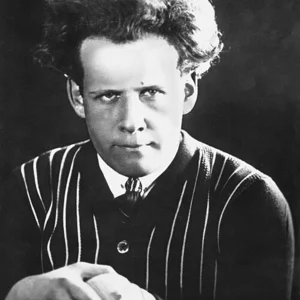

Soviet filmmaker and theorist, a pioneer of cinematic language. He revolutionized the art of film through his theory of the montage of attractions, illustrated in works such as Battleship Potemkin.
Sergei Eisenstein(1898 — 1948)
Sergei Eisenstein
Union soviétique, Empire russe
7 min read
Frequently asked questions
Famous Quotes
« Montage is the art of producing a new meaning through the collision of two images.»
Key Facts
- Born in 1898 in Riga, in the Russian Empire.
- Directed Battleship Potemkin in 1925, featuring the famous Odessa Steps sequence.
- Directed October (1928) about the Bolshevik Revolution of 1917.
- Developed the theory of the montage of attractions, a foundation of modern cinematic language.
- Shot Ivan the Terrible (1944-1946) before dying in Moscow in 1948.
Works & Achievements
Eisenstein's first feature film, about a workers' strike that is brutally suppressed. The hero is no longer an individual but the masses — the central idea of his cinema.
A masterpiece about the 1905 mutiny, featuring its famous Odessa Steps sequence. Often cited among the most influential films in the history of cinema.
An epic reconstruction of the 1917 revolution, commissioned for its tenth anniversary. Here Eisenstein pushes his “intellectual” montage to the extreme.
A film about the collectivization of the countryside and agricultural modernization. It illustrates how cinema was put at the service of Soviet politics.
A vast, unfinished project about Mexican history and culture. The confiscated reels were edited by others much later.
A historical epic about the prince who repelled the Teutonic Knights in the 13th century. His first fully sound film, with music by Prokofiev.
A two-part film about the first tsar of Russia: the first part won an award, while the second was banned by Stalin and released only in 1958.
Foundational essays (The Montage of Attractions, Film Form, The Film Sense) that profoundly shaped the theory of cinema.
Anecdotes
The famous massacre scene on the Odessa Steps, in *The Battleship Potemkin*, never actually happened: Eisenstein invented it entirely. The scene became so powerful that many viewers, even today, believe a real massacre took place on those steps in 1905.
For the first screenings of *The Battleship Potemkin* in 1925, Eisenstein had the flag raised on the mutinied ship hand-painted, frame by frame, so that it would appear bright red on the black-and-white film. This red flag, in a silent film, literally electrified audiences.
In February 1947, Eisenstein and the actor Nikolai Cherkasov were summoned in the middle of the night to the Kremlin by Stalin himself, displeased with the second part of *Ivan the Terrible*. Stalin reproached the film for showing a tsar who hesitated “like Hamlet” and a bodyguard evoking the Ku Klux Klan: the film was banned and was not released until 1958, ten years after the filmmaker's death.
Invited to Hollywood by Paramount in the early 1930s, Eisenstein never shot a single American film. He then went to Mexico to film an ambitious project, *¡Que viva México!*, but the financier Upton Sinclair cut off the funds and confiscated the reels: Eisenstein had to return to the USSR without ever being able to edit this footage himself.
Eisenstein drew constantly: he left behind thousands of preparatory sketches for his films, some of great virtuosity. A great polyglot scholar, he drew his editing ideas as much from Japanese prints as from the writings of Marx or the caricatures of Daumier.
Primary Sources
An attraction is any aggressive moment of the spectacle, that is, any element that subjects the spectator to a sensory or psychological action verified by experience and calculated to produce certain emotional shocks.
Montage is not an idea composed of successive shots, but an idea that arises from the collision of two shots independent of one another. From the confrontation of two fragments a concept is born.
Tsar Ivan was a very cruel man. You can show him as cruel. But you must show why it was necessary to be cruel.
I do not remember a time when I was not drawing. The pencil always accompanied me, long before the camera.
Key Places
Eisenstein's birthplace, then a prosperous port of the Russian Empire. He grew up there in an engineer's family before leaving to study in Petrograd.
Black Sea port where the Potemkin mutiny took place in 1905. Eisenstein filmed the famous staircase sequence there, since known as the “Potemkin Steps.”
Former imperial capital where Eisenstein filmed *October*, restaging the 1917 storming of the Winter Palace on the very site of the events.
Country where Eisenstein filmed the unfinished project *¡Que viva México!* in the early 1930s. The venture ended with him losing control of his footage.
Eisenstein was welcomed here by Paramount around 1930, but none of his American projects came to fruition. The contrast with the Hollywood industry fed his theoretical thinking.
Center of his Soviet career: the Proletkult theater, studios, teaching at the VGIK (film school). He died there in 1948.
Typical Objects

A hand-cranked, later motor-driven camera used to shoot the individual shots. It is the basic tool with which Eisenstein captured the fragments he would later assemble.

Reels of celluloid film that are cut and spliced back together on an editing table. This is where Eisenstein put his theory of montage into practice by clashing shots against one another.

Eisenstein drew hundreds of sketches to prepare his shots and framings. These drawings served as true storyboards before filming began.

A panel of text inserted between images to provide dialogue, dates, or slogans in silent cinema. Eisenstein also used them as revolutionary rallying cries.

The baby carriage tumbling down the steps in *Battleship Potemkin* has become one of the most imitated images in cinema. An everyday object transformed into an image of terror.

On the first prints of *Battleship Potemkin*, the flag of the revolt was colored red frame by frame. An emblem of the revolution in a black-and-white film.
School Curriculum
Vocabulary & Tags
Key Vocabulary
Daily Life
Morning
An early riser and tireless reader, Eisenstein often began his day immersed in books on art, history or psychology that fed his ideas. On a shoot, mornings were devoted to meticulously setting up framing and lighting.
Afternoon
Afternoons were split between the set, the editing table and teaching at the VGIK, Moscow's film school, where he trained young directors. There he would dissect films shot by shot in front of his students.
Evening
In the evening, Eisenstein wrote his theoretical essays, drew hundreds of sketches or received artist friends to discuss art and cinema. Intellectual work never really stopped.
Food
His daily life followed the ordinary Soviet routine of the 1920s–1940s, marked by shortages and rationing, especially during the war. During his travels in Mexico and the United States, he discovered very different cuisines that he observed with curiosity.
Clothing
He is most often seen in a plain suit, shirt and tie, in the urban fashion of the time, sometimes in work clothes on the set. His recognizable silhouette owed much to his abundant, tousled hair.
Housing
He lived in a Moscow apartment overrun with books, engravings and souvenirs brought back from his travels. His enormous library was his true workshop of thought.
Historical Timeline
Period Vocabulary
Liens externes & ressources
Références
Œuvres
Octobre (Dix jours qui ébranlèrent le monde)
1928
¡Que viva México!
1931-1932
Ivan le Terrible
1944-1958