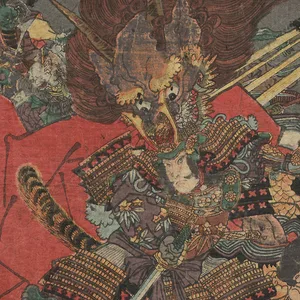

Shuten-doji is the king of oni (demons) in Japanese mythology, known for kidnapping and devouring young women from the capital from his fortress on Mount Ōe. He was defeated and beheaded by the hero Minamoto no Raikō and his four lieutenants through a ruse involving poisoned sake.
Shuten-doji
Shuten-doji
7 min read
Frequently asked questions
Key Facts
- Shuten-doji is described as the leader of the oni dwelling on Mount Ōe, northwest of Kyōto
- According to legend, he abducted young women from the imperial capital to devour them
- The emperor commanded Minamoto no Raikō (Yorimitsu) and his four companions to destroy him
- The heroes disguised themselves as wandering monks and put Shuten-doji to sleep with poisoned sake offered by the gods
- Even after being beheaded, Shuten-doji's head attempted to bite Raikō, demonstrating his demonic power
Works & Achievements
An illustrated scroll considered the founding iconographic representation of the Shuten-doji myth. It visually establishes the character of the oni king and the story of his defeat for subsequent generations.
A nō play featuring Watanabe no Tsuna, lieutenant of Raikō, confronting an oni at the Rashōmon gate in Kyoto — an episode directly linked to the legendary cycle of Shuten-doji.
A painted scroll detailing Shuten-doji's monstrous physical appearance, his macabre banquets, and Raikō's ruse; one of the finest examples of this illustrated narrative genre.
Series of prints depicting the battles of Minamoto no Raikō against Shuten-doji, popularizing the myth during the Edo period and conveying its demonic iconography to the Japanese public at large.
An early textual version of the myth incorporated into the great tale collection of the Heian period, providing one of the first written forms of the heroic cycle of Raikō against the oni.
Anecdotes
**Shuten-doji** literally means "the sake-drinking child" — a name that highlights his passion for alcohol, which would ultimately cause his downfall. According to the mythological tale, the hero **Minamoto no Raikō** offered him enchanted sake (*kikyōshu*, poisoned by deities), and the king of oni became so intoxicated that he could no longer defend himself.
Even after being decapitated, **Shuten-doji**'s severed head reportedly continued to bite **Minamoto no Raikō**'s helmet. This detail illustrates the demon's supernatural power and his resistance to death, a common motif in *yokai* and *oni* tales from the **Heian** period.
**Shuten-doji**'s fortress was located on **Mount Ōe** (in present-day **Kyoto Prefecture**), a place renowned for being formidable and all but unreachable. **Raikō**'s four lieutenants — among them **Watanabe no Tsuna**, himself celebrated as a demon-slayer — had to disguise themselves as wandering monks in order to approach without arousing suspicion.
According to some versions of the myth, **Shuten-doji** was not evil by nature: he was said to have been born of a union between a human and a supernatural being, condemned from childhood to belong to neither the world of men nor the world of spirits. This tragic dimension makes him an ambiguous figure — at once a monster and a victim of his own nature.
Primary Sources
Illustrated scroll narrating the campaign of Minamoto no Raikō against Shuten-doji on Mount Ōe. It describes the stratagem of the poisoned sake offered by the gods and the beheading of the king of the oni.
This painted scroll held at the Tokyo National Museum presents in detail the appearance of Shuten-doji, his oni servants, and the staging of the banquet during which he was deceived by the heroes in disguise.
A 12th-century tale collection compiled in the late Heian period, bringing together numerous stories of warriors confronting oni and supernatural forces in medieval Japan, providing the cultural context in which Shuten-doji was conceived.
A war chronicle from the Nanbokuchō period mentioning the exploits of the Minamoto lineage and its heroes, including Raikō, placing demonic legends within a martial historical framework.
Key Places
Legendary fortress of Shuten-doji, said to be impregnable and teeming with oni. It was on the summit of this mountain that the hero Raikō defeated the demon king after plying him with wine.
The imperial capital from which Shuten-doji abducted noble young women. The city represents the civilized, refined order that the demon threatened from his mountain stronghold.
A place of worship dedicated to the legends surrounding Mount Ōe, where depictions of oni connected to the Shuten-doji myth survive alongside popular beliefs about protective demons.
A sacred mountain associated with supernatural beings (tengu, oni) in Japanese tradition; it reflects the medieval belief that mountains harbored demonic forces.
Typical Objects

A central symbol of the legend, this is the cup in which Raikō served Shuten-doji the sake poisoned by the gods. The sake represents both the demon's fatal weakness and the hero's ingenious weapon.

The traditional weapon of oni in Japanese mythology, this heavy spike-studded club is the iconic attribute of demons and embodies their brute strength and terrifying nature.

A horned mask with bulging eyes and a grimacing mouth, used in nō theater and setsubun rituals to represent demons. The image of Shuten-doji directly inspires its design.

Minamoto no Raikō and his lieutenants wore lacquered Heian-style armor for their expedition to Mount Ōe, symbolizing military order in the face of demonic chaos.

A traditional calabash container used to carry sake during travels; in the legend, it symbolizes the trap set for Shuten-doji under the guise of an apparently harmless gift.

A sacred object bestowed by the gods upon the warriors setting out to fight the demon, representing the divine protection granted to heroes in their mission to restore order against the forces of chaos.
School Curriculum
Vocabulary & Tags
Key Vocabulary
Tags
Daily Life
Morning
Shuten-doji, king of the oni, spends his mornings in the depths of his mountain fortress, surrounded by his demonic servants. He rises late — night is his preferred domain — and inspects the new captives brought from the imperial capital.
Afternoon
In the afternoon, the demon king presides over the activities of his infernal court: he settles disputes among his oni, plans new raids on Heiankyō, and trains in the martial arts wielding his kanabō. His fortress hums with the activity of hundreds of demons in his service.
Evening
Evening is the liveliest time: Shuten-doji presides over great banquets where saké flows freely, oni feast, and drums thunder. These nights of revelry are the very image tradition has associated with him — until the fateful night when the saké was poisoned.
Food
According to myth, Shuten-doji feeds on human flesh and drinks saké in extraordinary quantities — symbols of his demonic nature and his opposition to the human order. These dietary excesses represent the absolute transgression of medieval Japanese taboos.
Clothing
He is often depicted wearing layered court robes (jūnihitoe or kariginu) in vivid colors, disturbingly contrasting with his monstrous features — horns, red or blue skin, claws. This blend of aristocratic elegance and bestiality is one of the character's most striking visual hallmarks.
Housing
His dwelling is a fortress built on the inaccessible heights of Mount Ōe, hidden from human sight. Illustrated scrolls depict it as a demonic palace of dark wooden structures, surrounded by rocky peaks and impenetrable forests, and guarded by hundreds of armed oni.
Historical Timeline
Period Vocabulary
Visual Style
Style des emaki de l'époque Muromachi : pigments minéraux sur soie vieillie, avec des rouges profonds, de l'or et du noir d'encre pour évoquer la beauté troublante du monde démoniaque.
Sound Ambience
Ambiance nocturne de la forteresse démoniaque du mont Ōe : fête des oni mêlant percussions, rires terrifiants et sons de la forêt de montagne japonaise.
Liens externes & ressources
Références
Œuvres
Ōeyama emaki (大江山絵巻)
XIVe siècle
Pièce de théâtre nō « Rashōmon »
XIVe-XVe siècle
Shuten-doji emaki (酒呑童子絵巻) du musée national de Tokyo
XVe siècle
Estampes ukiyo-e de Utagawa Kuniyoshi
XIXe siècle
Récit dans le Konjaku Monogatarishū
Vers 1120