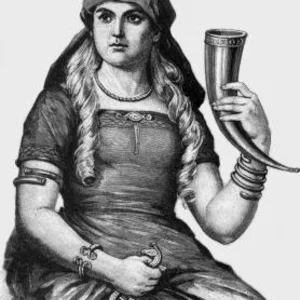

Sif is a goddess in Norse mythology, wife of the god Thor. She is famous for her magnificent golden hair, a symbol of the fertility of fields and harvests, which Loki treacherously cut off while she slept and which the dwarves reforged in pure gold.
Sif
Sif
9 min read
Frequently asked questions
Key Facts
- Wife of Thor, god of thunder, in the Norse pantheon (Asgard)
- Her golden hair was cut while she slept by Loki, the trickster spirit
- The dwarves forged her new hair from pure gold, as supple as real hair
- Symbolically associated with golden wheat fields and the fertility of the earth
- Mentioned in the Prose Edda by Snorri Sturluson (Iceland, c. 1220)
Works & Achievements
The primary narrative source on Sif, this text recounts in detail the episode of the hair cut by Loki and the crafting of the golden hair by the dwarf sons of Ívaldi. It is the essential reference text for studying this myth.
Presents Sif as one of the major goddesses of the Norse pantheon and wife of Thor. This text is a valuable source on the Norse mythological system and the place Sif occupies within it.
A poem in which Loki successively insults all the Norse gods at a banquet, including Sif. This flyting (ritual verbal contest) is an essential source on the status and honour of the Norse deities.
A poem narrating Thor's expedition to the giant Hymir's hall to obtain a cauldron. Sif appears in the background as Thor's divine wife, confirming her role as the thunder god's permanent companion.
An Icelandic manuscript that preserves the main Eddic poems mentioning Sif. Rediscovered in 1643, it is today ranked among the treasures of the world's literary heritage and is kept in Reykjavik.
Anecdotes
Sif's golden hair is one of the most celebrated treasures in Norse mythology. Loki, the god of mischief, crept into Sif's chamber one night and treacherously cut off all her hair while she slept. Enraged, Thor seized Loki and threatened to kill him if he did not immediately make amends for his deed.
To make amends for his crime, Loki traveled to Svartalfheim, the underground realm of the dwarf smiths. He persuaded the Sons of Ívaldi, the most skilled craftsmen in the Norse cosmos, to forge a head of hair from pure gold that would grow like real hair once placed on Sif's head. That same expedition brought forth other divine treasures: Odin's spear Gungnir and Freyr's magical ship Skidbladnir.
Sif is the mother of Ullr, the Norse god of skiing, hunting, and archery, born of a relationship prior to her marriage with Thor. The Prose Edda specifies that Ullr is the “son of Sif, stepson of Thor,” which shows that Sif was already an important divine figure even before becoming the wife of the god of thunder.
In the Poetic Edda, during the Lokasenna (the 'verbal sparring of Loki'), Loki turns on each of the gods gathered in Ægir's hall in succession. He targets Sif with accusations meant to tarnish her honor. This kind of ritualized verbal contest, called 'flyting' in Old Norse, was a codified literary practice in medieval Norse culture.
Sif's golden hair is interpreted by many scholars as an agrarian symbol: it is said to represent wheat fields and golden harvests. Its cutting by Loki would then symbolize a poor harvest or a prolonged winter, and its restoration by the dwarves, the return of spring fertility — a cosmic myth that reflects the anxiety of Nordic peoples in the face of the uncertainties of climate.
Primary Sources
Loki Laufeyjarson, out of pure malice, had cut all of Sif's hair while she slept. When Thor discovered it, he seized Loki and would have torn him to pieces had Loki not sworn to go to the Dark Elves and have them fashion gold that would grow like hair.
Loki addresses Sif: “Be silent, Sif! I know something about you that no one else knows: while Thor was away, you took a lover — and it was me.” This provocation, typical of the flyting genre, aims to destabilize the goddess before the assembly of the gods.
Thor's wife is Sif. She is of the race of the Æsir, and her hair is of gold. There is no woman more beautiful than she among the goddesses for the splendor of her golden hair.
This 10th-century skaldic poem celebrates Thor's exploits against the giants and mentions Sif as the divine companion of the thunder god, illustrating her standing as a great goddess in the skaldic tradition.
Key Places
The celestial home of the Norse gods, Asgard is the dwelling place of Sif and Thor. It is here that divine banquets are held, councils among the gods take place, and mythological intrigues involving Sif unfold — most notably the scene of the *Lokasenna*.
Thor's own estate within Asgard, Thrúðvangr ("the fields of power") is the marital home of Thor and Sif, associated with divine strength and the vast fertile plains of Norse mythology.
The underground world of the dwarves (Svartálfer), one of the Nine Worlds in Norse cosmology. It is here that Loki commissioned the sons of Ívaldi to craft Sif's golden hair, along with other divine treasures.
The principal Scandinavian temple (Sweden), dedicated to Odin, Thor, and Freyr. Sif, as Thor's wife, was honoured there during the great seasonal ritual sacrifices (*blót*) that shaped the religious life of the Vikings.
It was in Iceland that the Norse myths about Sif were first committed to writing, in the 12th and 13th centuries. Snorri Sturluson composed the *Prose Edda* there, and the Codex Regius (*Poetic Edda*) was compiled around **1270**.
Typical Objects

Sif's most iconic attribute, this pure gold hair was crafted by the dwarf smiths after Loki cut her real hair. It grows like real hair and symbolizes the fertility of ripe wheat fields.

A symbol of Sif's agrarian role, the wheat ears represent her nature as a goddess of the earth and harvests. Her golden hair is regularly compared in skaldic poetry to grain fields before the harvest.

A tool associated with fertility and harvest deities across many Indo-European mythologies. The sickle evokes Sif's role as the protective goddess of Norse farmers and guarantor of good harvests.

The instrument with which Loki cut Sif's hair has become a symbol of divine betrayal. This act of mutilation is one of the crimes that would contribute to Loki's ultimate punishment — chained in an underground cave.

At the divine banquets of Asgard, Sif sits among the gods. Mead, the sacred drink of the Vikings brewed from fermented honey, is the quintessential beverage of the divine feasts described in the Eddas.

In skaldic poetry, Sif is sometimes referred to indirectly through the metaphor of the golden shield, illustrating the practice of kennings — figures of speech that avoid naming a divine figure directly in order to highlight their greatness.
School Curriculum
Vocabulary & Tags
Key Vocabulary
Daily Life
Morning
In the Nordic mythological imagination, Sif begins her day at Thrúðvangr, Thor's domain. She symbolically presides over activities linked to the fertility of the earth, her golden hair shining like wheat fields at sunrise. Norse deities embody natural forces rather than living as mortals do: Sif's 'day' reflects the agrarian cycles that shaped the rhythm of Viking life.
Afternoon
In the Eddic narratives, Sif takes part in the social life of the gods of Asgard, joining divine deliberations and welcoming heroic warriors. As Thor's wife — often absent fighting the giants (Jotuns) — she watches over their home and their children: Magni and Þrúðr with Thor, and Ullr born from a previous relationship.
Evening
In the evenings, Asgard's divine banquets gather the gods around mead and heroic tales, as described in the Lokasenna. Sif sits beside Thor, venerated for her beauty and wisdom. These feasts are moments of alliance among the gods, but also of tension — it was at one such banquet that Loki verbally attacked Sif and all the Norse deities.
Food
The Norse gods feast on exceptional fare: the boar Sæhrímnir, slain and resurrected each evening in Valhalla, and the mead produced by the goat Heiðrún, whose milk transforms into a divine drink. Sif, associated with grain and the fertility of the fields, is symbolically linked to bread and harvest foods — the staple nourishment that the gods guarantee to humankind.
Clothing
In depictions inspired by the Eddic sources, Sif is adorned in garments of golden and earthy hues evoking the autumn harvest. Her golden hair — forged by the sons of Ívaldi — is her most precious attribute, shining like ripened ears of wheat and symbolizing the wealth that the earth offers to those who work its soil.
Housing
Sif resides at Thrúðvangr ('the fields of power'), Thor's domain within Asgard. The Prose Edda mentions the great hall Bilskirnir as Thor's dwelling, described as one of the most expansive divine halls with its many rooms. These mythical places, with no real geographic location, reflect the power and nobility associated with the divine couple Thor and Sif in the Norse pantheon.
Historical Timeline
Period Vocabulary
Liens externes & ressources
Références
Œuvres
Edda en prose — Skáldskaparmál (Snorri Sturluson)
vers 1220
Edda en prose — Gylfaginning (Snorri Sturluson)
vers 1220
Edda poétique — Lokasenna (auteur anonyme)
vers Xe-XIIIe siècle
Edda poétique — Hymiskviða (auteur anonyme)
vers Xe-XIIIe siècle
Codex Regius — Manuscrit de l'Edda poétique
vers 1270