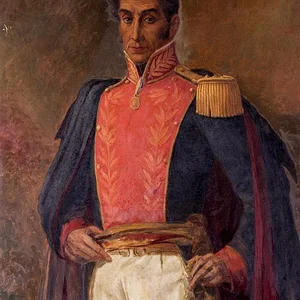

Born in Caracas in 1783, Simón Bolívar was the leading architect of South American independence from the Spanish Empire. Known as 'El Libertador,' he liberated several nations and dreamed of a great Latin American federation.
Simón Bolívar(1783 — 1830)
Simón Bolívar
Espagne, Venezuela, Équateur, Bolivie, Grande Colombie
8 min read
Frequently asked questions
Famous Quotes
« An ignorant people is the blind instrument of its own destruction.»
« I am convinced that England has the best government in the world.»
Key Facts
- 1783: Born in Caracas into a wealthy Creole family
- 1813: Declaration of the War to the Death against the Spanish, beginning the reconquest of Venezuela
- 1819: Decisive victory at the Battle of Boyacá, independence of Gran Colombia
- 1825: Bolivia is created in his honor following the liberation of Upper Peru
- 1830: Death in Santa Marta (Colombia), following the collapse of his Gran Colombia project
Works & Achievements
A major political text written in exile, in which Bolívar analyzes the situation of the Spanish-American colonies and outlines the political future of the continent. Considered one of the most important founding documents of Latin American nationalism.
A landmark constitutional speech delivered before the Congress of Angostura, in which Bolívar sets out his vision of a strong, stable republic committed to education. A key text for understanding his political thought.
A political union of New Granada, Venezuela, and Ecuador into a single federal state. One of Bolívar's greatest political achievements, though the Republic dissolved in 1830 after his death.
A constitution personally drafted by Bolívar for Bolivia, the new nation named in his honor. It provided for a lifetime presidency with the power to designate a successor, reflecting his concerns about the stability of the newly independent republics.
A diplomatic initiative by Bolívar aimed at uniting the Spanish-American nations into a confederation. Although it did not succeed, the congress foreshadowed later attempts at regional integration in Latin America.
A lightning military campaign that allowed Bolívar to reconquer Venezuela in just a few months. This campaign earned him the title of Libertador and the nickname of the American Napoleon.
Anecdotes
In 1805, at the summit of Monte Sacro in Rome, Bolívar made a solemn oath not to rest until he had liberated South America from Spanish rule. This vow, spoken before his mentor Simón Rodríguez, would guide his entire political and military life.
During the Admirable Campaign of 1813, Bolívar crossed the Andes with an exhausted, ill-equipped army, navigating mountain passes at altitudes above 4,000 meters. This daring crossing is often compared to Napoleon's passage through the Alps, and remains one of the greatest military feats in the history of the Americas.
Bolívar was a passionate reader who always traveled with a portable library containing works by Voltaire, Rousseau, and Montesquieu. It was this Enlightenment education that shaped his political vision of a free and republican South America.
At the Battle of Boyacá in 1819 — decisive for the independence of Gran Colombia — Bolívar secured victory in just two hours with a makeshift army that included European mercenaries. The Spanish viceroy fled at the mere news of Bolívar's approach.
Bolívar freed his own slaves as early as 1820 and abolished slavery in the territories under his control, long before this principle was universally accepted across the Americas. He believed that a revolution for independence could not be built on the backs of men in chains.
Primary Sources
We are not Europeans, we are not Indians, we are a middle species between the aborigines and the Spaniards. Americans by birth and Europeans by right, we find ourselves in the difficult position of disputing with the natives our titles of possession and of maintaining in the country where we were born, against the opposition of the invaders.
It is harder, I confess, to release our people from servitude than to subjugate them. I desire, more than any other, to see the greatest nation in the world formed in America, great not so much by virtue of her area and wealth as by her freedom and glory.
Spaniards and Canarians, count on death, even if you are neutral, if you do not actively work in favor of the liberation of America. Americans, count on life, even if you are guilty.
The continuation of authority in the same individual has often proved the undoing of democratic governments. Repeated elections are essential to popular systems, for nothing is as dangerous as allowing power to remain long in the hands of the same citizen.
I swear before you, I swear by the God of my fathers, I swear on their honor, I swear by my homeland, that I will not rest my arm nor my soul until I have broken the chains that oppress us by the will of Spanish power.
Key Places
Bolívar's birthplace, where he was born in 1783 into an aristocratic Creole family. It was in Caracas that Venezuela's first declaration of independence was proclaimed in 1811.
The site of Bolívar's famous 1805 oath, in which he solemnly pledged to liberate South America. This symbolic moment marked the beginning of his revolutionary calling.
The seat of the 1819 Congress where Bolívar delivered his celebrated founding address and was elected president of Gran Colombia. The city was later renamed in his honor.
The site of the decisive victory on August 7, 1819, which secured the independence of New Granada. This battle, won in under two hours, paved the way for the creation of Gran Colombia.
The Andean pass crossed by Bolívar and his troops in July 1819, despite extreme cold and high altitude. This epic crossing proved decisive in the campaign to liberate New Granada.
The place where Bolívar died on December 17, 1830, exhausted, disillusioned by the failure of his dream of unity, and suffering from tuberculosis. He was buried there before his remains were transferred to Caracas in 1842.
Typical Objects

Bolívar carried a Spanish-style saber and later an honorary saber presented by grateful republics. The bladed weapon symbolized military command and the Creole nobility in arms.

His liberator general's uniform — blue and gold with epaulettes and decorations — was a mark of his authority. The bicorne, a Napoleonic hat adopted by republican officers, symbolized the break with the old colonial order.

Bolívar always traveled with a selection of works by Enlightenment philosophers: Voltaire, Montesquieu, Rousseau. These books formed the intellectual foundation of his political vision.

Mastery of the Andean terrain was essential to his campaigns. Bolívar personally studied topographic maps to plan troop movements across thousands of kilometers.

Like many South American military men of the era, Bolívar often slept in a hammock during campaigns. This practical object reflects the harsh living conditions of his long marches through jungle and the Andes.

Bolívar was a prolific writer and orator, author of hundreds of letters and founding speeches. His quill was his other weapon: it allowed him to persuade allies, adversaries, and public opinion alike.
School Curriculum
Vocabulary & Tags
Key Vocabulary
Tags
Daily Life
Morning
Bolívar rose at dawn, often after only a few hours of sleep. On campaign, he inspected his troops and studied military maps at first light. In peacetime, he dictated correspondence to his secretaries from the moment he got up.
Afternoon
His afternoons were taken up with political meetings, diplomatic audiences, and military decisions. He planned troop movements with his generals and kept up a relentless correspondence with the governors of liberated provinces.
Evening
In the evenings, Bolívar enjoyed hosting salons with the intellectuals and officers in his circle, discussing politics and philosophy. An avid reader, he also devoted his nights to works of the Enlightenment and to drafting his speeches.
Food
His cuisine reflected that of the Venezuelan Creole nobility: arepas, grilled meats, tropical vegetables, hot chocolate, and coffee. On campaign, he often shared the frugal rations of his soldiers to keep up troop morale.
Clothing
He wore the uniform of the liberator general: a blue jacket with gold epaulettes, white breeches, tall boots, and a bicorne hat. Outside of ceremonies, he favored practical cavalry attire suited to the long rides through the Andes and the llanos.
Housing
Bolívar occupied the homes of Creole patrician families in liberated cities — grand colonial palaces with shaded patios. On campaign, he slept in tents or makeshift bivouacs, sometimes in rudimentary huts during crossings of the high Andean plateaus.
Historical Timeline
Period Vocabulary
Visual Style
Style portrait néoclassique d'influence davidienne, associant l'héroïsme militaire, la richesse des uniformes républicains et la grandeur des paysages andins et tropicaux.
Sound Ambience
Une atmosphère mêlant l'agitation des campagnes militaires andines, les sons de la nature tropicale vénézuélienne et l'effervescence politique des villes coloniales en révolution.
Liens externes & ressources
Références
Œuvres
Lettre de Jamaïque
1815
Discours d'Angostura
1819
Création de la République de Grande-Colombie
1819-1821
Constitution bolivienne
1826
Congrès de Panama
1826
Campagne admirable
1813