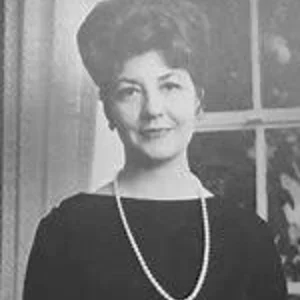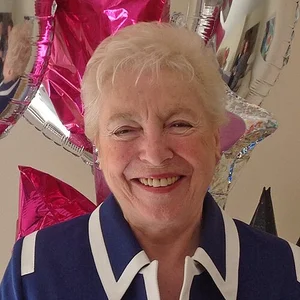

Stephanie Shirley, known as “Steve,” is a British computer scientist and entrepreneur of German origin, who arrived in the United Kingdom as a child thanks to the Kindertransport. A software pioneer, she founded a programming company in 1962 that employed almost exclusively women working from home. Later a philanthropist, she gave away most of her fortune.
Stephanie Shirley(1933 — 2025)
Stephanie Shirley
Royaume-Uni, Allemagne
6 min read
Frequently asked questions
Famous Quotes
« I wanted a company of women, for women, that would do something about the awful situation that women faced when they had to leave their work on marriage or pregnancy.»
« Why do ambitious women have flat heads? Because men pat them on the head and say, 'There, there.'»
Key Facts
- Born in 1933 in Dortmund, she fled Nazi Germany in 1939 thanks to the Kindertransport and grew up in the United Kingdom.
- In 1962, she founded Freelance Programmers, a software company employing mostly women working remotely.
- She signed her business letters “Steve” to be taken seriously in a male-dominated field.
- Her company became F International and then Xansa, valued at hundreds of millions of pounds.
- Made a Dame Commander of the British Empire (DBE) in 2000, she devoted her fortune to philanthropy, particularly autism.
Works & Achievements
A software company employing mostly women working from home, a pioneering organizational model that would become F International and later Xansa.
Software contribution to the supersonic aircraft's “black box,” demonstrating the reliability of her teams' work.
A public listing that enriched the employee shareholders and crowned the success of a groundbreaking business model.
A specialist school for autistic children that she funds, a major turning point in her philanthropy in memory of her son.
Foundations through which she gives tens of millions of pounds to autism research and to computing.
The story of her life, from refugee to entrepreneur and then philanthropist, which became a key reference on the female pioneers of software.
An internationally broadcast talk about women, ambition, and her extraordinary journey.
Anecdotes
When she started her programming company, her business letters signed “Stephanie” went unanswered. So she began signing them “Steve”: the meetings finally started coming in, and clients only discovered she was a woman once they met her face to face.
In 1939, at the age of five, she left Nazi Germany for the United Kingdom thanks to the Kindertransport, the convoys that rescued thousands of Jewish children. Separated from her parents, she would later say she wanted to “make her life one worth saving.”
In 1962, she founded her company, Freelance Programmers, with just 6 pounds in capital, on her dining room table. She employed almost exclusively women who programmed from home, at a time when motherhood pushed women out of the workforce.
Her teams took part in programming the “black box,” the flight recorder of the supersonic Concorde aircraft, proving that highly reliable software work could be carried out by women working from home.
When the company went public, part of the staff held shares: the move turned around ten of her former colleagues into millionaires. Having grown very wealthy, she would later give away most of her fortune—tens of millions of pounds—to causes connected to computing and autism.
Primary Sources
The book recounts her journey “from refugee to entrepreneur and then philanthropist” and how she launched Freelance Programmers with £6 of capital on her dining-room table.
In it she explains that she adopted the first name “Steve” in her business correspondence so she could get through the door before anyone realised she was a woman, and says she wanted to make her life “worth saving.”
She describes arriving in the United Kingdom as a child in 1939, without her parents, and the sense of debt towards her host country that guided her entire career and philanthropy.
Key Places
Industrial city in the Ruhr where she was born in 1933, and which she left as a child to flee Nazism.
London station where the Kindertransport convoys arrived, the entry point for child refugees into the United Kingdom.
Pioneering British computing research centre where she learned her trade and programmed her first machines.
Town where, from her home, she founded Freelance Programmers in 1962.
School for autistic children that she funded and founded, in memory of her son Giles, who was autistic.
Town in southern England where she settled and continued her philanthropic work.
Typical Objects

A piece of card pierced with holes encoding instructions and data, the input medium for the programs of the earliest computers. This was the medium on which software was “written” before screens existed.

A huge machine taking up an entire room, shared among many users. It was for these computers that Stephanie Shirley's programmers wrote their software.

A diagram made of boxes and arrows representing the logic of a program before it is coded. A fundamental design tool for the first analyst-programmers.

An onboard device recording an aircraft's technical data, including that of the Concorde programmed by her teams. A symbol of the software reliability demanded in aviation.
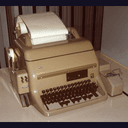
A keyboard machine connected by telephone line, allowing text to be sent and received remotely. It made computer work from home possible.
📷 CC BY-SA 3.0 · Wikimedia Commons ↗
A thick volume describing the syntax of a language and how a machine works. Indispensable in an era without tutorials or the internet to learn to code.
School Curriculum
Vocabulary & Tags
Key Vocabulary
Tags
Daily Life
Morning
An early riser, she organized her day around working from home, balancing company tasks with family life. The morning might begin by reading business correspondence, often signed “Steve,” and assigning projects among her programmers scattered across their own homes.
Afternoon
The afternoon was devoted to designing programs, reviewing flowcharts, and coordinating with her teams by telephone. She would sometimes visit clients or computing centres to discuss contracts and present her novel business model.
Evening
In the evening, she tended to her home and her son Giles, whose autism profoundly shaped her life. She also set aside time for the company's financial management and, later on, for her philanthropic projects.
Food
Her diet was that of the post-war British middle class: simple meals, frequent tea, and goods increasingly available as rationing came to an end. The cooking remained unpretentious, mirroring her personal modesty.
Clothing
She wore the neat professional attire expected of a 20th-century businesswoman: tailored suits and clean lines, designed to command respect in a man's world. Her polished appearance reinforced her authority before clients who were often wary of a woman in charge.
Housing
She lived in comfortable houses in the south of England, one of which served as her company's first headquarters. Her dining room was literally the cradle of Freelance Programmers, before the company outgrew it.
Historical Timeline
Period Vocabulary
Liens externes & ressources
Références
Œuvres
Fondation de Freelance Programmers
1962
Programmation de l'enregistreur de vol du Concorde
années 1970
Introduction en Bourse de l'entreprise
1996
Prior's Court School
1999
The Shirley Foundation et la charité Autistica
années 2000
Let IT Go (autobiographie)
2012
Conférence TED « Why do ambitious women have flat heads? »
2015