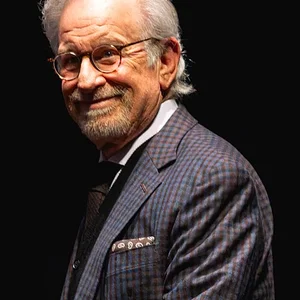

Steven Spielberg is an American film director, screenwriter, and producer born in 1946. A major figure of the New Hollywood movement, he invented the modern blockbuster while also directing critically acclaimed historical films. He ranks among the most influential and popular filmmakers of the late twentieth century.
Steven Spielberg(1946 — ?)
Steven Spielberg
États-Unis
6 min read
Frequently asked questions
Key Facts
- Directed Jaws in 1975, widely regarded as the first modern blockbuster
- Released E.T. the Extra-Terrestrial in 1982, a massive worldwide hit and an iconic family film
- Directed Schindler's List in 1993, about the Holocaust, which earned him the Academy Award for Best Director
- Co-founded DreamWorks SKG studio in 1994
- Established the Shoah Foundation in 1994 to collect testimonies from survivors of the Jewish genocide
Works & Achievements
The first major blockbuster in history; it invented the massive summer release and established Spielberg as a major director.
A science-fiction film about peaceful contact with extraterrestrials, shaping the imagination of an entire generation.
Together with George Lucas, he created the figure of Indiana Jones and revived the spectacular adventure film.
A tale about the friendship between a child and an alien; a huge worldwide success that became an icon of popular culture.
A revolution in digital special effects that made dinosaurs believable on screen and redefined effects-driven cinema.
A historical drama about the Holocaust, awarded seven Oscars, considered one of his most important works.
A realistic reconstruction of the Normandy landings that profoundly renewed the war film.
A portrait of the American president during the Civil War and the fight to abolish slavery.
Anecdotes
As a child, Steven Spielberg was already shooting little films with his father's 8 mm camera and casting his sisters in them. At 13, he made a 40-minute war film, *Escape to Nowhere*, which won him a prize in a young filmmakers' contest.
In 1975, during the filming of *Jaws*, the mechanical shark nicknamed *Bruce* kept breaking down in the salt water. Forced to show it less, Spielberg suggested the danger through the music and the shark's point of view: this technical constraint made the film far more terrifying.
For *E.T. the Extra-Terrestrial* (1982), Spielberg shot some scenes in the chronological order of the story, which is rare in filmmaking, so that the young actors would experience their friendship with E.T. more genuinely and their emotions would ring true on screen.
Before filming *Schindler's List* (1993), Spielberg gave up his salary, feeling it would be indecent to make money off the Holocaust. With the film's profits, he founded the Shoah Foundation to collect and preserve thousands of survivors' testimonies.
Rejected several times by the prestigious film school at the University of Southern California (USC) because of grades deemed too low, Spielberg went on to become one of the most powerful directors in Hollywood. USC finally awarded him an honorary degree decades later.
Primary Sources
There are 350,000 teachers passing on the lessons of the Holocaust in America's schools right now. That's what this is about.
I wanted to preserve the survivors' memories for future generations, so that no one could ever say it never happened.
Film has been my way of understanding the world and of sharing what I felt without having to say it in words.
Key Places
Birthplace of Steven Spielberg, where he was born in 1946 into an American Jewish family.
Region where Spielberg spent part of his childhood and adolescence, and where he shot his first amateur films.
School where Spielberg studied after being rejected by the major film schools; he would earn his degree there much later.
Studio that hired him in the late 1960s and where his professional career as a director began.
City and region where Spielberg shot “Schindler's List” in 1993, near the former Auschwitz camp, in a quest for historical authenticity.
Typical Objects

The small amateur camera with which the teenage Spielberg shot his first films in the 1950s-1960s. It symbolizes the democratization of the moving image in American households.

Professional device used to shoot feature films on silver halide film stock. A central tool of the director before digital became widespread.

A series of drawings planning each shot of a scene before filming. Spielberg often relies on it to design his spectacular action sequences.

The fake animatronic shark designed for "Jaws" (1975). Temperamental and often breaking down, it paradoxically shaped the film's suspense.

The supreme award of the American film academy. Spielberg has received several, notably for directing "Schindler's List" and "Saving Private Ryan".

A flexible strip coated with light-sensitive emulsion on which images were recorded before the digital era. The physical medium of the film projected in theaters.
School Curriculum
Vocabulary & Tags
Key Vocabulary
Tags
Daily Life
Morning
At the height of a shoot, Spielberg arrives on set very early, often before dawn, to make the most of natural light. He goes over his storyboard and discusses the day's shots with his cinematographer and crew.
Afternoon
The afternoon is devoted to the actual shooting: he directs the actors, adjusts the framing, and sometimes improvises new shots. Methodical, he moves from take to take while keeping up tremendous energy on set.
Evening
In the evening, he watches the *rushes* (the footage shot during the day) and prepares the next day's work. Deeply devoted to his family, he also makes an effort to set aside time for his loved ones despite the demands of filming.
Food
Like many Americans of his generation, he long enjoyed simple, popular food. On shoots, the crew is fed by the *catering*, and it is said that he has sometimes imposed certain dishes, such as hot dogs, on the whole team.
Clothing
Spielberg most often appears in casual attire: a baseball cap, a loose shirt, and a jacket, in the practical style of on-set directors. At ceremonies, he wears the suit or tuxedo that is customary in Hollywood.
Housing
A wealthy director, he lives on vast estates in California, notably in the Los Angeles area. His homes feature private screening rooms for viewing films and edits.
Historical Timeline
Period Vocabulary
Liens externes & ressources
Références
Œuvres
Les Dents de la mer (Jaws)
1975
E.T. l'extraterrestre
1982
La Liste de Schindler
1993