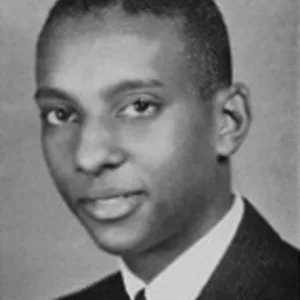

Stokely Carmichael was an African American civil rights activist and a major figure of the Black Power movement in the 1960s. A leader of the SNCC and later close to the Black Panthers, he popularized the slogan “Black Power” and radicalized the struggle for racial equality in the United States.
Stokely Carmichael(1941 — 1998)
Stokely Carmichael
États-Unis, Trinité-et-Tobago, Guinée
6 min read
Frequently asked questions
Famous Quotes
« Black Power!»
Key Facts
- Born in 1941 in Trinidad and Tobago, emigrated to the United States in 1952
- Took part in the Freedom Rides in 1961 against segregation on public transportation
- Became chairman of the SNCC (Student Nonviolent Coordinating Committee) in 1966
- Popularized the slogan “Black Power” during a speech in June 1966 in Mississippi
- Went into exile in Guinea in 1969, took the name Kwame Ture, and died in 1998
Works & Achievements
A phrase launched in Greenwood that gave its name to an entire movement of Black pride and self-determination.
He transformed the nonviolent student organization into a movement championing self-defense and Black identity.
A Black political party he helped found in Alabama, whose black panther emblem would inspire the Black Panthers.
An essay co-written with Charles V. Hamilton, a landmark work defining the concept of Black power.
Under the name Kwame Ture, he founded the All-African People's Revolutionary Party and campaigned for African unity.
A posthumous account of his life and struggles, a major testimony on the civil rights movement.
Anecdotes
In June 1966, during the “March Against Fear” in Mississippi, Stokely Carmichael was arrested for the 27th time. Upon his release, he raised the slogan “We want Black Power!” before the crowd: those two words would electrify an entire movement and leave a lasting mark on the struggle of Black Americans.
A brilliant student, Carmichael was accepted into several prestigious white universities, but he deliberately chose Howard University, a historically Black school in Washington. It was there that he joined the “Freedom Rides,” those bus journeys aimed at challenging segregation on Southern transportation.
At just 24 years old, he became chairman of SNCC (the Student Nonviolent Coordinating Committee) in 1966. Under his leadership, the organization gradually abandoned Martin Luther King's nonviolent strategy in favor of the idea of self-defense and Black pride.
Born in Trinidad in 1941, Carmichael came to New York at age 11 and grew up in the Bronx. Late in life, he settled in Guinea, in Africa, and changed his name to Kwame Ture, in tribute to the Pan-Africanist leaders Kwame Nkrumah and Sékou Touré.
For years, until his death from cancer in 1998, he answered the telephone with the phrase “Ready for the revolution!”, showing that his militant commitment had never left him.
Primary Sources
We been saying 'freedom' for six years. What we are going to start saying now is 'Black Power!'
Black Power means that Black people must unite, recognize their heritage, and build a sense of community in order to speak with one strong voice.
Our struggle is not only American: it is bound to that of all the colonized peoples of the Third World who are fighting oppression.
SNCC taught me that dignity is not asked for — it is taken and defended.
Key Places
Stokely Carmichael's birthplace, in the Caribbean, which he left at age 11 to join the United States.
Neighborhood where Carmichael grew up after his arrival in the United States; it is here that he shaped his political consciousness.
Historically Black university where he studied philosophy and took part in the Freedom Rides.
Town where, in June 1966, Carmichael publicly launched the slogan "Black Power" during the March Against Fear.
Capital where Carmichael settled from 1969 onward, took the name Kwame Ture, and campaigned for Pan-Africanism until his death.
Typical Objects

A bullhorn used at gatherings to address the crowd. It was with such a tool that the cry “Black Power!” rang out.

A sign raised during marches, carrying slogans for equality and the voting rights of Black people. A symbol of protest, first peaceful then radical.

The gesture of a clenched fist thrust toward the sky, which became the worldwide emblem of Black pride and resistance. More than an object, it is a rallying sign.

A form for enrolling on the voting rolls, at the heart of the SNCC's campaigns in the South. Winning this right for Black people was a dangerous struggle.

The notebook in which Carmichael prepared speeches and organizing strategies. A discreet but essential tool of grassroots political work.

A plain outfit, sometimes made of denim, worn by SNCC organizers to show themselves close to the Black workers and farmers of the South.
School Curriculum
Vocabulary & Tags
Key Vocabulary
Tags
Daily Life
Morning
During the SNCC campaigns in the South, Carmichael would rise early to travel across the rural areas of Mississippi and Alabama. He knocked on the doors of Black families to convince them, despite the risks, to register to vote.
Afternoon
Afternoons were devoted to organizing meetings, coordinating volunteers, and strategic discussions. They constantly had to outwit the intimidation tactics of the police and local racist groups.
Evening
In the evening, he often spoke in churches or community halls, galvanizing crowds with his speeches. These gatherings were moments of hope but also of constant danger.
Food
In the field, he shared the simple food of the Black families of the South who hosted him: cornbread, beans, vegetables from the garden. African American cuisine, “soul food,” was part of this activist daily life.
Clothing
Like many SNCC organizers, he wore plain clothing, sometimes work denim, to show that he was close to the people. Later, he adopted African-inspired attire, a sign of his rediscovered pride.
Housing
During the campaigns, he stayed in people's homes, in the modest houses of courageous Black families. This itinerant and precarious life was the daily reality of civil rights activists.
Historical Timeline
Period Vocabulary
Liens externes & ressources
Références
Œuvres
Slogan et concept de « Black Power »
1966
Présidence du SNCC
1966-1967
Lowndes County Freedom Organization
1965-1966
Black Power: The Politics of Liberation
1967
Engagement panafricaniste en Guinée
1969-1998
Ready for Revolution (autobiographie)
2003