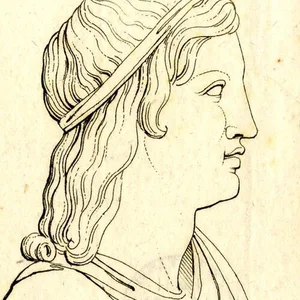

Suetonius was a Roman historian, grammarian, and rhetorician of the early 2nd century. As secretary to Emperor Hadrian, he is famous for his "Lives of the Twelve Caesars," a gallery of biographies of the first emperors rich in anecdotes and private details.
Suetonius(69 — 126)
Suetonius
Rome antique
7 min read
Frequently asked questions
Famous Quotes
« He found a Rome of brick and left it a city of marble. (a saying attributed to Augustus, reported by Suetonius)»
Key Facts
- Born around 70 AD, probably in Hippo (Roman Africa), died around 140
- Secretary (ab epistulis) to Emperor Hadrian before falling out of favor around 122
- Author of the "Lives of the Twelve Caesars" (De vita Caesarum), from Julius Caesar to Domitian
- Reports the anecdote that Augustus boasted of having left a Rome of marble where he had found a city of brick
- His work, blending public deeds and intimate details, established the model for ancient biography
Works & Achievements
A collection of biographies of Julius Caesar and the first eleven emperors, from birth to death. A masterpiece that defined the biographical genre and inspired all of Western historiography.
A series of profiles of the great Roman writers (grammarians, rhetoricians, poets, historians). Largely lost, but the section on grammarians and rhetoricians survives.
Biographies of famous writers preserved in fragments. The "Life of Virgil" is a major source for our knowledge of the great poet of the Aeneid.
A scholarly treatise, written in Greek, devoted to Greek games and pastimes. It bears witness to Suetonius's vast encyclopedic learning; now lost.
A study of insults and coarse terms in Greek and their origins. An example of Suetonius's curiosity about words and everyday language; almost entirely lost.
A vast encyclopedia covering a wide range of subjects (natural sciences, institutions, antiquities). A fragmentary work that reveals the breadth of the author's knowledge.
Anecdotes
Suetonius was the private secretary of the emperor Hadrian, in charge of his correspondence (ab epistulis). This position gave him privileged access to the imperial archives, which explains the wealth of details and documents he cites in his biographies.
According to his contemporary and friend Pliny the Younger, Suetonius was a reserved man of study, almost shy. Pliny even intervened with the emperor Trajan to obtain a legal privilege for him, and helped him acquire a small country estate.
Suetonius is said to have been dismissed from his post at court for showing disrespect to the empress Sabina, Hadrian's wife. The historian Spartianus (Historia Augusta) reports this disgrace, which put an end to his career as a senior official.
In the 'Lives of the Twelve Caesars', Suetonius does not limit himself to great political deeds: he describes the physical appearance of the emperors, their quirks, their favorite phrases and their vices. It is he who reports the famous 'Make haste slowly' (festina lente) dear to Augustus.
It is thanks to Suetonius that we know the legend of the last words of several emperors, such as the 'Qualis artifex pereo' ('What an artist dies with me!') attributed to the dying Nero. These intimate details have made his work a treasure trove of quotations for the centuries that followed.
Primary Sources
He often repeated these maxims: “Make haste slowly,” and “A cautious commander is better than a rash one,” to show that one must act with as much promptness as caution.
He kept repeating that so great an artist was about to perish with him: *Qualis artifex pereo!*
When he saw that he was surrounded on all sides by daggers aimed at him, he wrapped his head in his toga and at the same time covered the lower part of his body with his left hand.
Suetonius Tranquillus, a man of the greatest merit, wishes to buy a small estate that one of your friends, it is said, is putting up for sale.
He removed from their posts Septicius Clarus, the praetorian prefect, and Suetonius Tranquillus, his secretary for correspondence, along with many others, because they had behaved toward his wife Sabina, in their private dealings, with less reserve than the respect due to the court demanded.
Key Places
North African city where an inscription dedicated to Suetonius was discovered, suggesting a link to his career or his origins. It details the stages of his cursus.
Capital of the Empire where Suetonius worked as a lawyer, scholar, and imperial secretary. There he frequented literary circles and the archives of the Palatine.
Hill where the palace of the emperors and the offices of the chancellery stood. Suetonius worked there as Hadrian's secretary ab epistulis.
Port of Rome where Suetonius is thought, according to one hypothesis, to have held a religious office. A major commercial hub connecting the capital to the Mediterranean.
Small estate that Suetonius wished to acquire with the help of Pliny the Younger, a place well suited to study and writing far from the bustle of Rome.
Typical Objects

Ancient book made of a long strip of papyrus that was unrolled to read. Suetonius wrote and consulted his biographies and research on it.

Small wooden boards coated with wax on which notes were engraved with a pointed stylus. The secretary's everyday working tool for drafts.

A trimmed reed used as a pen, dipped in an inkwell filled with black ink. The instrument for final writing on papyrus.

Official registers and documents of the imperial administration to which Suetonius had access as Hadrian's secretary. They feed the documentary precision of his biographies.

Draped woollen garment, the distinctive mark of the Roman citizen worn for official occasions. Suetonius, a Roman knight, would put it on to appear at court.

Cylindrical box of wood or leather in which several papyrus scrolls were stored and carried. Essential for keeping a library.
School Curriculum
Vocabulary & Tags
Key Vocabulary
Daily Life
Morning
At daybreak, Suetonius receives the salutatio, the morning visit from his clients and friends. Then, as imperial secretary, he heads to the palace on the Palatine to handle the emperor's correspondence and consult the archives.
Afternoon
The afternoon is devoted to study: he reads scrolls, dictates to a slave-scribe, and compiles the anecdotes and documents that will feed his biographies. He also frequents the public libraries of Rome.
Evening
In the evening, he sometimes shares a dinner (cena) with learned men such as Pliny the Younger, where they discuss literature and history. Scholarly conversations often stretch the evening late into the night by the light of oil lamps.
Food
The diet of a well-off Roman includes bread, olives, cheese, vegetables, and fruit, accompanied by wine diluted with water. At banquets, fish, poultry, and sauces seasoned with garum, the fermented fish sauce, are served.
Clothing
Suetonius wears the linen or wool tunic day to day, and dons the toga for official duties and the court. As a knight (eques), he is entitled to the gold ring and the narrow purple stripe on the tunic (angusticlave).
Housing
A well-off citizen, he lives in a domus in Rome, a house organized around an atrium and a peristyle, or aspires to a country villa. Its rooms hold a library of scrolls stored in cases and cabinets.
Historical Timeline
Period Vocabulary
Liens externes & ressources
Références
Œuvres
Vie des douze Césars (De vita Caesarum)
vers 121 apr. J.-C.
Des hommes illustres (De viris illustribus)
début IIe siècle apr. J.-C.
Vies des poètes (Vie de Virgile, Térence, Horace…)
début IIe siècle apr. J.-C.
Des jeux des Grecs (Peri ton par' Hellesi paidion)
IIe siècle apr. J.-C.
Des injures (Peri blasphemion)
IIe siècle apr. J.-C.
Prairies (Prata / Pratum)
IIe siècle apr. J.-C.