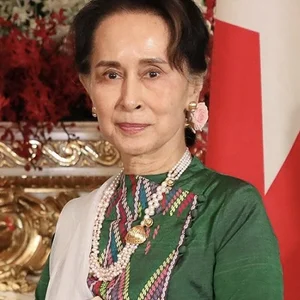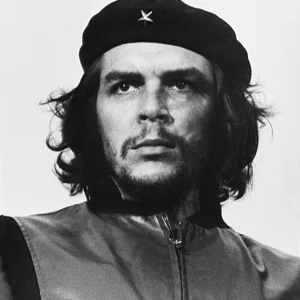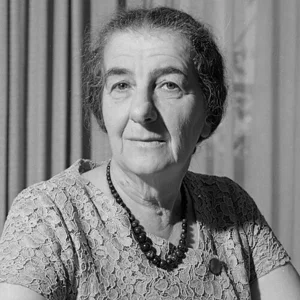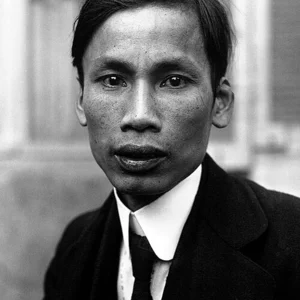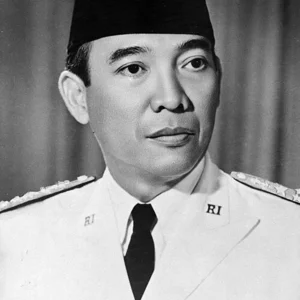

Indonesian statesman and leader of the nationalist movement against Dutch colonization. He proclaimed Indonesia's independence in 1945 and became its first president. A major figure of the Third World and the Non-Aligned Movement.
Sukarno(1901 — 1970)
Soekarno
Indonésie
6 min read
Frequently asked questions
Key Facts
- 1927: founds the Indonesian National Party (PNI) to fight against Dutch colonization
- 17 August 1945: proclaims Indonesia's independence and becomes its first president
- 1945: formulates the Pancasila, the five founding principles of the Indonesian state
- 1955: organizes the Bandung Conference, the founding act of the Non-Aligned Movement
- 1965-1967: removed from power following a coup, then replaced by General Suharto
Works & Achievements
The first major secular nationalist party demanding full independence. It gave lasting structure to the Indonesian anti-colonial struggle.
In it, Sukarno set out the five founding principles of the state. They became the official doctrine of independent Indonesia.
The founding act of the Indonesian Republic, of which Sukarno became the first president. It marked the birth of the largest country in Southeast Asia.
A gathering of 29 Asian and African nations organized by Sukarno. It laid the foundations of the Non-Aligned Movement and Third World solidarity.
Sukarno was among the founding fathers of this bloc refusing to align with either the United States or the USSR. He turned it into a major diplomatic force of the Cold War.
A political synthesis uniting nationalism, religion, and communism championed by Sukarno. It aimed to reconcile the great forces of Indonesian society.
A grand architectural project launched by Sukarno to glorify the independence struggle. It symbolizes modernity and national pride.
Anecdotes
On August 17, 1945, two days after the Japanese surrender, Sukarno proclaimed Indonesia's independence from the garden of his home in Jakarta. The declaration consisted of two hastily typed sentences, and the red-and-white flag raised that day had been sewn by his wife, Fatmawati.
In 1955, Sukarno hosted the first major Asian-African Conference in Bandung, bringing together 29 countries from Asia and Africa. This event laid the foundations of the Non-Aligned Movement and made Indonesia a leading voice of the Third World, standing apart from the two Cold War blocs.
In 1945, Sukarno set out the five founding principles of the Indonesian state, the Pancasila: belief in one God, a just and civilized humanity, national unity, democracy, and social justice. These principles remain Indonesia's official doctrine to this day.
To unify an archipelago of thousands of islands speaking hundreds of languages, Sukarno established *bahasa Indonesia* as the national language rather than Javanese, even though the latter had more speakers. This choice of a neutral language was decisive in forging a sense of nationhood.
After the failed coup of 1965 and the anti-communist massacres, Sukarno was gradually pushed out of power by General Suharto. He spent his final years under house arrest and died in 1970, isolated, despite his standing as the father of the nation.
Primary Sources
We, the people of Indonesia, hereby declare the independence of Indonesia. Matters relating to the transfer of power and other issues will be carried out carefully and as quickly as possible.
I propose five principles. The first is nationalism. The second is internationalism, or humanity. The third is democracy. The fourth is social welfare. The fifth is belief in God.
This is the first intercontinental conference of coloured peoples in the history of mankind! We, the peoples of Asia and Africa, number 1,400 million.
We, the newly emancipated nations and peoples, cannot accept a world order that was designed without us and directed against our interests.
Key Places
Port city in eastern Java where Sukarno was born in 1901. It is also a major center of Indonesian nationalism.
City where Sukarno trained as an engineer and forged his political commitment. In 1955 it hosted the famous Asian-African Conference.
Sukarno's home, where he proclaimed Indonesia's independence on 17 August 1945. The site has become a memorial place for the nation.
Place of Sukarno's exile between 1934 and 1938, imposed by the Dutch colonial authorities. It was here that he is said to have meditated on the principles of the future Pancasila.
City in eastern Java where Sukarno spent part of his youth and where he was buried in 1970. His mausoleum there is a place of pilgrimage.
Typical Objects

Black cylindrical cap that Sukarno wore on every occasion. He made it a symbol of Indonesian national identity and of secular Muslim nationalism.

Red and white flag raised at the 1945 proclamation, sewn by Fatmawati, Sukarno's wife. Red symbolizes courage and white symbolizes purity.
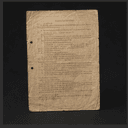
Typewritten sheet bearing Indonesia's declaration of independence. This original document is today a national relic, preserved as the country's birth certificate.

A charismatic orator, Sukarno galvanized huge crowds with his marathon speeches. The microphone is the central instrument of his power to mobilize the masses.
Statement of the five founding principles of the Indonesian state, formulated by Sukarno in 1945. It forms the ideological foundation and official motto of Indonesia.

Tall tower erected in Jakarta on Sukarno's orders to celebrate the independence struggle. Topped with a golden flame, it embodies the Indonesian revolutionary spirit.
School Curriculum
Vocabulary & Tags
Key Vocabulary
Daily Life
Morning
As president, Sukarno often began his days early by reading the press and reports in his palace in Jakarta. Mornings were devoted to official audiences and government meetings.
Afternoon
The afternoon filled up with diplomatic talks, receptions for foreign delegations, and the preparation of his speeches. Sukarno took the greatest care over this, for eloquence was at the heart of his power.
Evening
In the evening, he liked to entertain guests, discuss art, history, and politics, and deliver speeches before assembled crowds. A lover of Javanese culture, he enjoyed traditional performances such as the wayang.
Food
Sukarno enjoyed traditional Indonesian cuisine based on rice, served with spicy dishes, fish, and vegetables. He remained attached to the popular flavors of Java despite his status as head of state.
Clothing
He usually wore a plain civilian or military uniform, always topped with the black peci that became his trademark. On grand occasions, he displayed decorations and ceremonial attire underscoring his presidential office.
Housing
Sukarno resided in the presidential palaces of Jakarta and Bogor, former residences of the colonial administration. A passionate lover of architecture and an engineer by training, he liked to surround himself with works of art and to design grand urban projects.
Historical Timeline
Period Vocabulary
Liens externes & ressources
Références
Œuvres
Fondation du Parti national indonésien (PNI)
1927
Discours « La naissance du Pancasila »
1er juin 1945
Proclamation de l'indépendance de l'Indonésie
17 août 1945
Conférence de Bandung
1955
Cofondation du Mouvement des non-alignés
1961
Doctrine du Nasakom
1956-1965
Édification du Monument national (Monas) de Jakarta
1961-1975