 flip
flipZur bälesh (large closed mutton pie)
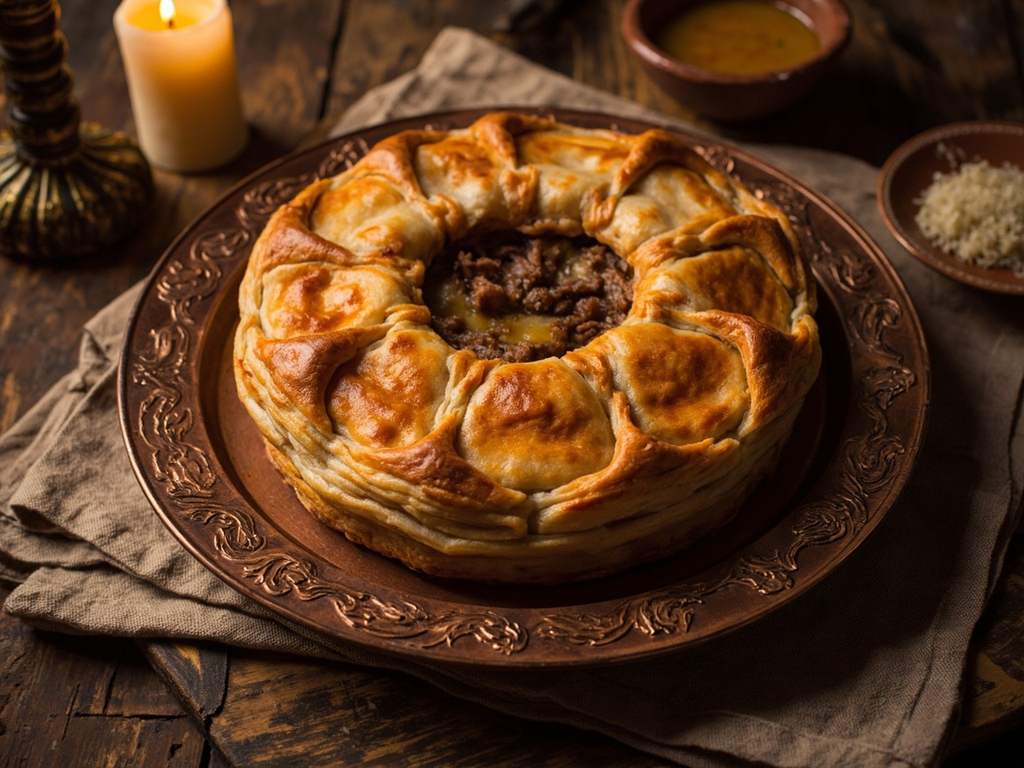
Zur bälesh (large closed mutton pie)
Why this dish? The zur bälesh is the showpiece dish of the Tatar nobility, served at khan's receptions. Söyembikä, as regent at the Kazan Kremlin, presided over diplomatic banquets where this large pie occupied the center of the table — a symbol of abundance and power in a khanate threatened by Moscow.
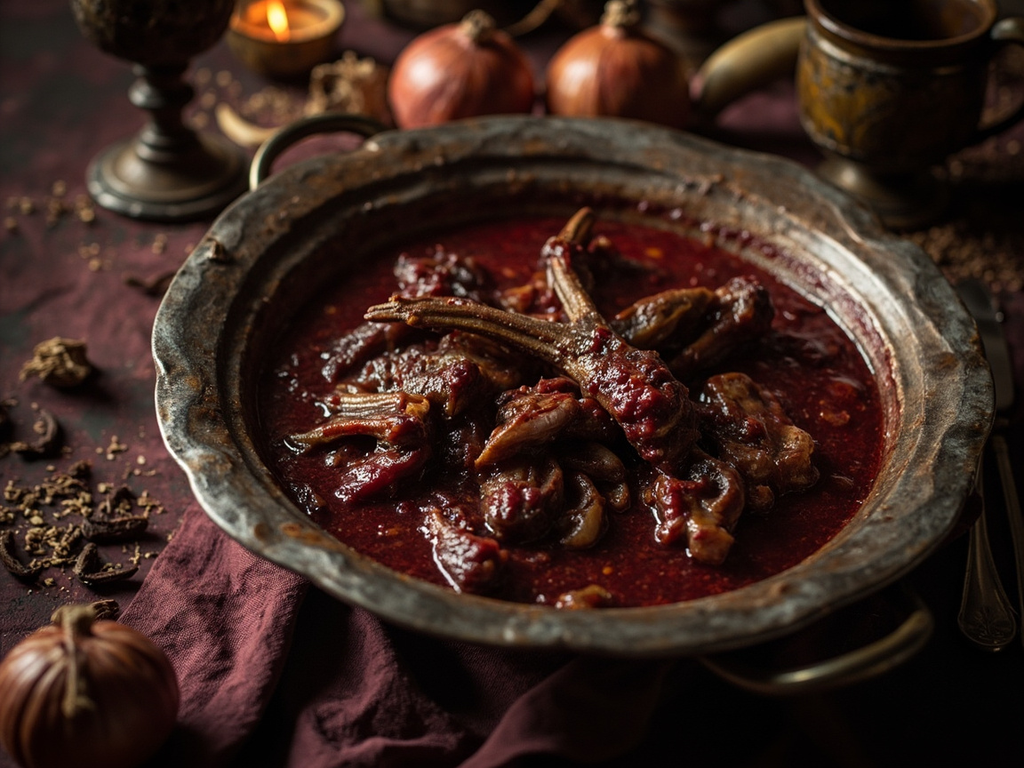
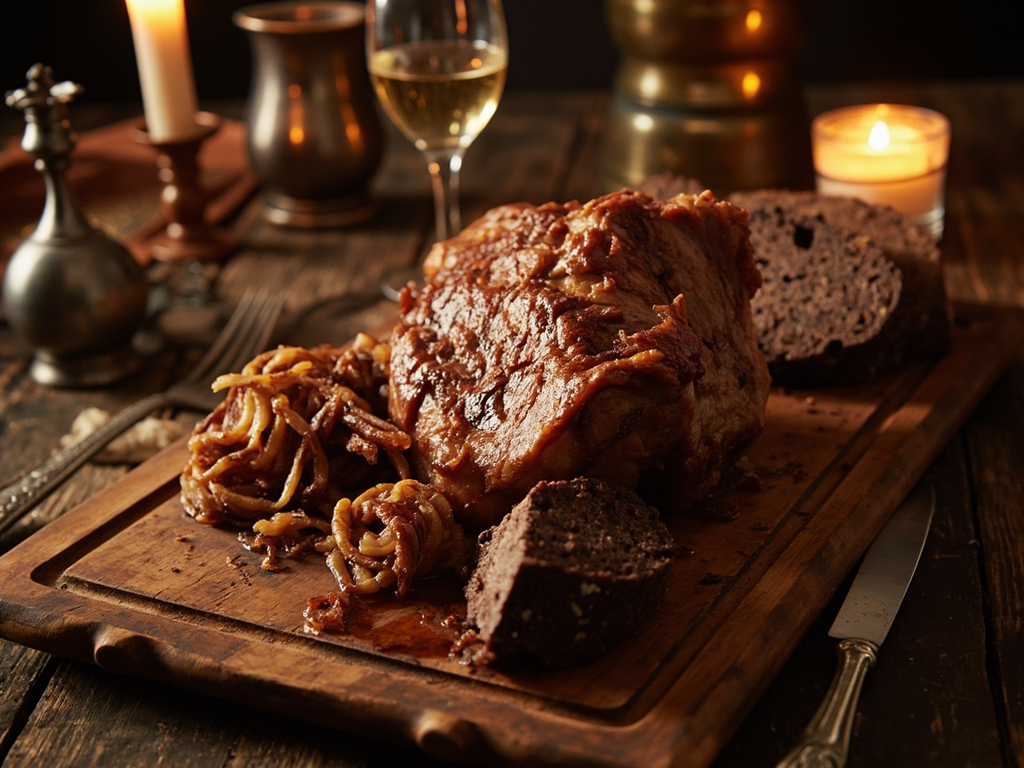
Large closed pie made with clarified butter dough, filled with pieces of mutton, potatoes replaced in the era by turnips and onions, bathed in concentrated broth poured through an opening in the lid during cooking. The lid is cut at the table and distributed to honored guests.
Know, you who come to my table, that the bälesh is the honor of the khan's house. When I receive the envoys of the Nogai or the beys of Kazan, my maids knead the dough with mare's butter, they lay the best mutton from the flock with turnips from our gardens, then they seal it all as one seals a pact. I myself cut the golden lid and offer the first piece to the most eminent guest — this is our custom, and no one refuses it. The broth poured through the hole perfumes the entire throne room, and even in the dark days of my reign, this fragrance reminded me that Kazan still lived.
- •Mutton (shoulder with bone) — a good quarter (main filling)
- •Fat-tailed sheep fat — a fistful (filling fat)
- •Turnips — three or four (base vegetable)
- •Onions — two large (aromatic)
- •Wheat flour — enough for dough (envelope)
- •Clarified butter — a ladleful (enrich dough)
- •Mutton broth — a bowl (cooking juice added during baking)
- •Salt — to taste (seasoning)
- •Black pepper — a few crushed grains (spice)
Zur bälesh (large closed mutton pie)
Large closed pie made with clarified butter dough, filled with pieces of mutton, potatoes replaced in the era by turnips and onions, bathed in concentrated broth poured through an opening in the lid during cooking. The lid is cut at the table and distributed to honored guests.
Why this dish? The zur bälesh is the showpiece dish of the Tatar nobility, served at khan's receptions. Söyembikä, as regent at the Kazan Kremlin, presided over diplomatic banquets where this large pie occupied the center of the table — a symbol of abundance and power in a khanate threatened by Moscow.
Know, you who come to my table, that the bälesh is the honor of the khan's house. When I receive the envoys of the Nogai or the beys of Kazan, my maids knead the dough with mare's butter, they lay the best mutton from the flock with turnips from our gardens, then they seal it all as one seals a pact. I myself cut the golden lid and offer the first piece to the most eminent guest — this is our custom, and no one refuses it. The broth poured through the hole perfumes the entire throne room, and even in the dark days of my reign, this fragrance reminded me that Kazan still lived.
Ingredients (period version)
- Mutton (shoulder with bone) — a good quarter (main filling)
- Fat-tailed sheep fat — a fistful (filling fat)
- Turnips — three or four (base vegetable)
- Onions — two large (aromatic)
- Wheat flour — enough for dough (envelope)
- Clarified butter — a ladleful (enrich dough)
- Mutton broth — a bowl (cooking juice added during baking)
- Salt — to taste (seasoning)
- Black pepper — a few crushed grains (spice)
Ingredients
- Boneless mutton or lamb shoulder — 800 g (main filling)
- Fat-tailed sheep fat or lamb suet — 80 g (fat (or butter if unavailable))
- Turnips — 300 g (base vegetable)
- Yellow onions — 2 medium (aromatic)
- All-purpose flour (T55) — 500 g (dough)
- Butter — 100 g (dough)
- Egg — 1 (dough)
- Cold water — 150 ml (dough)
- Lamb broth — 200 ml (broth added during baking)
- Salt — 1 tsp (seasoning)
- Ground black pepper — ½ tsp (spice)
Method
- Prepare the dough: mix flour, softened butter, egg, salt, and cold water. Knead until a smooth ball forms. Let rest 30 min under a cloth.
- Cut mutton into 2-3 cm cubes. Slice turnips into thick rounds and thinly slice onions. Mix meat, turnips, onions, fat-tailed fat cut into small dice, salt, and pepper in a bowl.
- Divide dough into two unequal parts (⅔ and ⅓). Roll out the larger part into a 35 cm disk. Line a tall round mold (or Dutch oven), letting the dough overhang.
- Pour the filling into the mold. Roll out the remaining dough as a lid. Seal the edges by folding them over. Make a 3 cm hole in the center of the lid.
- Bake at 180 °C for 30 min, then reduce to 160 °C. Every 30 min, pour 2-3 tablespoons of hot broth through the central hole. Bake for 2 hours total, until the crust is well browned.
- Let rest 10 min out of the oven. Cut the lid into portions at the table, distribute to guests, then serve the filling with a ladle.
How it was made : The bälesh (sometimes zour belech for the festive version) is attested in Tatar ethnographic sources since the Middle Ages. The nobility of the Kazan Khanate used fatty mutton or horse. Turnips, cultivated along the Volga long before the arrival of the potato (18th century), were the staple vegetable. The ritual cutting of the lid by the host is a protocol gesture still practiced today among Tatars.
The contemporary twist : Serve an individual portion in a miniature cast-iron cocotte, golden dough lid placed askew, with broth poured at the table from a small copper teapot.
Sources : Yusupov, R. Tatar aş-suw mädäniyate (Tatar Food Culture), Kazan, 2003 · Iskhakov, D. Kazan khanlygy tarikhy (History of the Kazan Khanate), Kazan, 2004
Söyembikä · Charactorium