
An American Latina trans activist, Sylvia Rivera took part in the Stonewall riots of 1969. She co-founded STAR (Street Transvestite Action Revolutionaries) to help homeless trans youth and LGBTQ+ people.
Sylvia Rivera(1951 — 2002)
Sylvia Rivera
États-Unis
9 min read
Frequently asked questions
Famous Quotes
« I'm not missing a minute of this — it's the revolution!»
« We have to be visible. We should not be ashamed of who we are.»
Key Facts
- Born on July 2, 1951 in New York to a Latin American family
- Took part in the Stonewall riots on June 28, 1969
- Co-founded STAR (Street Transvestite Action Revolutionaries) in 1970 with Marsha P. Johnson
- Fought for the inclusion of trans people in the gay rights movement throughout the 1970s
- Died on February 19, 2002 in New York
Works & Achievements
Together with Marsha P. Johnson, Sylvia Rivera founded the first American organization dedicated specifically to trans people, providing shelter, food, and support to marginalized youth. STAR is considered the pioneer of community trans organizations in the United States.
An impassioned, improvised speech at New York's pride rally in which Sylvia Rivera confronted the gay movement over its exclusion of trans people, particularly those who were incarcerated. It is now regarded as a founding text of trans activism.
A collective living space organized and run by STAR to house homeless trans youth in New York. Though short-lived due to lack of funding, the project was the forerunner of the many LGBTQ+ shelters that exist around the world today.
In the final months of her life, Sylvia Rivera actively campaigned for a law banning discrimination against transgender people in New York. The law was passed shortly after her death, in part thanks to her tireless advocacy.
Sylvia Rivera gave numerous testimonies documenting her role in the Stonewall riots and the history of the trans movement, helping to preserve a memory that had often been erased or distorted by mainstream historiography.
Anecdotes
On the evening of June 28, 1969, during the Stonewall Riots in New York, seventeen-year-old Sylvia Rivera was among the first to resist police officers raiding the bar. According to several eyewitnesses of the time, she threw an object while crying out her defiance, becoming a living symbol of trans and queer resistance on that historic night.
In 1970, with her friend Marsha P. Johnson, Sylvia Rivera co-founded STAR (Street Transvestite Action Revolutionaries). To fund an apartment serving as shelter for homeless young trans people, they collected money on the street. This 'STAR House' took in dozens of marginalized young people that institutions refused to help — the first trans community shelter in American history.
In 1973, at the large Christopher Street gathering in New York, Sylvia Rivera had to fight her way to the microphone as some demonstrators tried to block her. She delivered a passionate speech, shouting “Y’all better quiet down!” and challenging the crowd about the fate of imprisoned trans people that the LGBT movement tended to forget. This speech is now considered one of the most important in LGBTQ+ rights history.
Sylvia Rivera was eleven years old when she found herself abandoned to live on the streets of New York. She survived with the help of older trans people who taught her how to get by. This personal experience of exclusion and street survival was the driving force behind all her future work on behalf of homeless LGBTQ+ youth.
In the final months of her life, gravely ill, Sylvia Rivera campaigned tirelessly for a law banning discrimination against transgender people in New York. She died on February 19, 2002, before seeing it passed — but the law was voted through shortly after, in part thanks to her relentless fight to the very end.
Primary Sources
I am fighting for my sisters and brothers who are still on the streets. I have been living on the streets since I was eleven years old. I was there at Stonewall. I fought for this movement. Now I am asking the movement to fight for us.
I am tired of hearing this bullshit. I have been fighting for all of you for three years. Gay women and gay men don't know what it's like to be on the streets.
STAR is there for the street girls, the street boys, the people who have nowhere to go. We don't ask for permission. We help those whom nobody else helps.
Stonewall was not the beginning. The street people had been resisting long before that night. But that night, we said: never again.
Key Places
Bar frequented by LGBTQ+ people where the riots of June 28, 1969 took place, in which Sylvia Rivera participated at age 17. The site is now a U.S. national monument and a worldwide symbol of LGBTQ+ rights.
A working-class borough of New York where Sylvia Rivera was born in 1951 and spent her early years in poverty, before being abandoned by her family at the age of eleven.
A communal apartment organized by STAR in the 1970s, serving as a refuge for homeless young trans and LGBTQ+ people in New York. The first trans community house in American history, run by Sylvia Rivera and Marsha P. Johnson.
Iconic street of the New York LGBTQ+ movement, site of annual pride marches and Sylvia Rivera's landmark 1973 speech in which she challenged the movement to take a stand on the rights of trans people.
Hospital where Sylvia Rivera died on February 19, 2002, from liver cancer. Her final years were marked by a return to activism and a campaign for transgender rights legislation in New York.
Typical Objects

Sylvia Rivera wore feminine clothing from adolescence, at a time when doing so was illegal in many U.S. states under so-called "cross-dressing" laws. Her outfits were both an affirmation of her identity and an act of daily resistance.

A passionate activist, Sylvia Rivera frequently took the floor at rallies and demonstrations. The microphone became a symbol of her fight to ensure that trans voices were heard within the LGBTQ+ movement itself, as in her famous 1973 speech.

The keys to STAR House represented the heart of Sylvia Rivera's commitment: providing a concrete refuge for homeless young trans people in New York, in a home run by and for the community — a first in American history.

STAR distributed hand-made flyers in the streets of Greenwich Village to inform the community and recruit supporters. These materials were the organization's primary communication tool throughout the 1970s, long before the internet era.

Police raids on bars and streets frequented by LGBTQ+ people were a daily reality. These objects symbolized for Sylvia Rivera the systemic oppression she fought against her entire life, from her teenage years on the streets of New York.

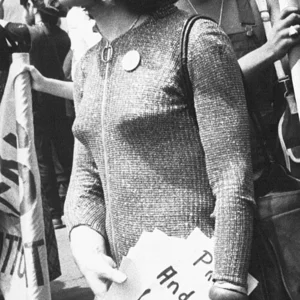
Although the rainbow flag was created in 1978 by Gilbert Baker, it quickly became the symbol of the movement whose foundations Sylvia Rivera had helped lay as early as 1969. She took part in the first Pride marches, where colorful flags and banners were already flying.
School Curriculum
Vocabulary & Tags
Key Vocabulary
Tags
Daily Life
Morning
In the 1970s, Sylvia Rivera often started her day very early, handling the practical necessities of STAR House: making sure the young people staying there had food, sorting out rent problems, reaching out to supporters. Activist work and the precarious daily struggle for survival on the streets of New York were constantly intertwined.
Afternoon
Afternoons were devoted to grassroots activism: handing out flyers in Greenwich Village, attending LGBTQ+ organization meetings, connecting with other activists at community centers. Sylvia Rivera worked to build support for trans causes within a movement that often pushed them to the margins.
Evening
In the evenings, Sylvia Rivera frequented the LGBTQ+ social spaces of Greenwich Village — bars and informal gatherings where community solidarity was built. She was also present at nighttime demonstrations and activist vigils, especially during the AIDS crisis in the 1980s.
Food
Coming from a very poor background, Sylvia Rivera lived for a long time with very few resources. Her diet was often precarious — meals shared at soup kitchens or obtained through community solidarity networks. Latina cuisine, inherited from her Puerto Rican and Venezuelan roots, was part of her cultural identity.
Clothing
Sylvia Rivera had been wearing feminine clothing since adolescence, which was illegal in many U.S. states until the 1970s. She wore dresses, makeup, and high heels, openly embracing her trans identity at a time when doing so could lead to immediate arrest. The way she dressed was both a personal expression and an act of political resistance.
Housing
Sylvia Rivera spent much of her life in extreme precarity. From a childhood spent on the streets of New York from the age of eleven to the collective and unstable housing of adulthood, she never knew lasting residential stability. STAR House was the first time she was able to offer others what she had never had herself: a roof over their heads.
Historical Timeline
Period Vocabulary
Liens externes & ressources
Références
Œuvres
Cofondation de STAR (Street Transvestite Action Revolutionaries)
1970
Discours 'Y'all Better Quiet Down' à la Christopher Street Liberation Day Rally
juin 1973
STAR House : premier foyer communautaire trans
1970-1972
Campagne pour la loi de protection trans à New York
2001-2002
Témoignages et interviews sur l'histoire de Stonewall
1989-2001