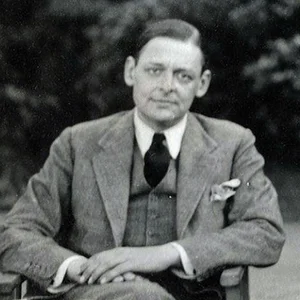

American-born poet, playwright and literary critic who became a British citizen, a major figure of modernism. His poem *The Waste Land* (1922) transformed Western poetry; he received the Nobel Prize in Literature in 1948.
T. S. Eliot(1888 — 1965)
T. S. Eliot
États-Unis, Royaume-Uni
7 min read
Frequently asked questions
Famous Quotes
« April is the cruellest month.»
« This is the way the world ends / Not with a bang but a whimper.»
Key Facts
- Born in 1888 in St. Louis, Missouri, in the United States
- Publication of *The Love Song of J. Alfred Prufrock* in 1915
- Release of *The Waste Land* in 1922, a manifesto of modernism
- Became a British citizen in 1927
- Nobel Prize in Literature in 1948; died in London in 1965
Works & Achievements
Eliot's first major poem, an interior monologue of a man paralysed by indecision. It heralds a new kind of poetry, ironic and fragmented.
An emblematic poem of modernism, a mosaic of voices, languages and quotations evoking a civilisation in ruins after the war. The most studied work of the 20th century in English.
A bleak poem on the spiritual emptiness of the age, famous for its ending: “Not with a bang but a whimper.”
A long religious poem marking Eliot's conversion to Anglicanism and his spiritual quest.
A verse play about the murder of Archbishop Thomas Becket in 1170. It revived poetic drama in the 20th century.
A collection of whimsical poems about cats, the source of the musical *Cats* (1981).
A cycle of four meditative poems on time, memory and eternity. Regarded as his mature masterpiece.
Anecdotes
For years, T. S. Eliot led a double life: by day, he worked as a clerk at Lloyds Bank in London, managing foreign accounts; in the evenings and at night, he wrote some of the most revolutionary poems of the 20th century. His fellow bankers often had no idea they were rubbing shoulders with a future Nobel laureate.
When Eliot finished *The Waste Land*, the manuscript was nearly twice as long. His friend, the poet Ezra Pound, cut it mercilessly, deleting entire passages. In gratitude, Eliot dedicated the poem to him, calling him *il miglior fabbro* (“the better craftsman” in Italian).
In 1939, Eliot published *Old Possum's Book of Practical Cats*, a collection of whimsical poems about cats that he had first written to amuse his godchildren. Decades later, in 1981, this little book inspired *Cats*, one of the most performed musicals in history.
Born American in St. Louis, Eliot settled in England in 1914 and eventually applied for British citizenship in 1927, the same year he converted to Anglicanism. He described himself as “classicist in literature, royalist in politics, and anglo-catholic in religion.”
In 1948, Eliot received both the Nobel Prize in Literature and the British Order of Merit. That same year, worldwide recognition turned this reserved, almost shy man into a genuine literary celebrity whom crowds flocked to hear at public lectures.
Primary Sources
Let us go then, you and I, / When the evening is spread out against the sky / Like a patient etherised upon a table.
April is the cruellest month, breeding / Lilacs out of the dead land, mixing / Memory and desire, stirring / Dull roots with spring rain.
This is the way the world ends / Not with a bang but a whimper.
No poet, no artist of any art, has his complete meaning alone. His significance, his appreciation is the appreciation of his relation to the dead poets and artists.
Poetry is usually considered the most local of all the arts... yet I think that the work of the poet, in the language of any one nation, is something which concerns all peoples.
Key Places
Eliot's birthplace on the banks of the Mississippi, where he grew up in a cultured family. The river would leave a lasting mark on his poetic imagination.
Eliot studied philosophy and literature here from 1906 to 1914, laying the foundations of his vast erudition. He even began a doctorate on the philosopher Bradley.
Eliot won a scholarship to study philosophy at Oxford in 1914-1915. This stay permanently rooted his life in England.
Eliot lived and worked in London for most of his life, at Lloyds Bank and then at Faber & Faber. The capital lies at the heart of the urban landscape of *The Waste Land*.
The ancestral village from which his family emigrated to America in the 17th century, and which gives its title to one of the *Four Quartets*. Eliot's ashes rest there in St Michael's Church.
Eliot stayed here in 1910-1911 to study at the Sorbonne and discovered French Symbolist poetry. This influence transformed the way he wrote.
Typical Objects

Eliot composed and revised his poems on the typewriter, whose steady clatter even shaped the rhythm of certain lines. The typed manuscript of *The Waste Land* bears Pound's handwritten annotations.

A quarterly review that Eliot founded and edited from 1922 to 1939, spreading modernist thought across Europe. In it he published major authors and forged his influence as a critic.

For eight years, Eliot kept the accounts of foreign transactions at Lloyds Bank to earn a living. This meticulous work filled his days while he wrote the rest of the time.

Awarded to Eliot in 1948 for his pioneering poetic work, it crowned literary modernism. The gold medal bears the effigy of Alfred Nobel.

Eliot cultivated the look of the impeccable English gentleman: a dark suit, a stiff collar and sometimes a bowler hat. This elegance contrasted with the boldness of his poetry.

A collection of four long meditative poems (*Burnt Norton*, *East Coker*, *The Dry Salvages*, *Little Gidding*) tied to specific places. Many consider it his spiritual peak.
School Curriculum
Vocabulary & Tags
Key Vocabulary
Tags
Daily Life
Morning
During his years at Lloyds Bank, Eliot rose early to make his way into the City of London, where he spent his mornings hunched over ledgers of foreign transactions. The discipline of the office strictly framed his time.
Afternoon
His afternoons were split between paid work and, later in his career, his duties as an editor at Faber & Faber, where he read manuscripts and advised young poets. He also received writers and friends to talk about literature.
Evening
In the evening, Eliot wrote his poetry, often in fragments accumulated over the course of months, or composed critical essays. He also frequented London's literary circles and the theatre.
Food
Eliot led a sober, English life, divided between simple meals at home and the dinners of fashionable London society. He enjoyed cheese, wine and tea, the daily ritual of the England he had adopted.
Clothing
Always impeccably dressed, Eliot wore dark three-piece suits, a starched collar and sometimes a bowler hat, embodying the English gentleman. This attire contrasted with the modernity of his writing.
Housing
Eliot lived in various flats and houses in London, some of them modest during his difficult first marriage. At the end of his life, married to Valerie Fletcher, he knew a peaceful home in the capital.
Historical Timeline
Period Vocabulary
Liens externes & ressources
Références
Œuvres
The Love Song of J. Alfred Prufrock
1915
The Waste Land
1922
The Hollow Men
1925
Ash-Wednesday
1930
Murder in the Cathedral
1935
Old Possum's Book of Practical Cats
1939
Four Quartets
1943