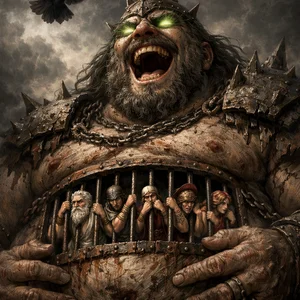

In Greek mythology, Tartarus is both a primordial deity born of Chaos and a cosmic place: the deepest abyss in the universe, located beneath the Underworld, where Zeus imprisoned the defeated Titans and where the greatest criminals atone for their crimes for eternity.
Tartarus
Tartarus
8 min read
Frequently asked questions
Key Facts
- Born of Chaos, according to Hesiod's Theogony (c. 700 BCE), among the very first primordial entities, alongside Gaia, Nyx, and Erebus.
- A cosmic realm as far below Hades as the Earth is below the sky: a bronze anvil would fall for nine days before reaching its bottom, according to Hesiod.
- After the Titanomachy, Zeus imprisoned the defeated Titans there (including Cronus), guarded by the Hecatoncheires.
- United with Gaia to father Typhon, the most fearsome monster in Greek mythology and Zeus's final adversary.
- Houses mythology's most infamous condemned souls: Sisyphus, Tantalus, Ixion, and the Danaids — punished for eternity for their crimes against the gods.
Works & Achievements
By uniting with Gaia, Tartarus sires Typhon, the most fearsome of all Greek monsters, with a hundred serpent heads. This offspring represents the forces of raw, primordial chaos that threaten the Olympian order.
Tartarus serves as the eternal prison for the defeated Titans, upholding the order of the universe under Zeus's rule. This fundamental cosmic function is described in detail by Hesiod in the *Theogony*.
In Greek tradition, Tartarus evolves into a place of punishment for mortals guilty of *hubris*, featuring eternal and exemplary torments such as those of Tantalus, Sisyphus, Ixion, and Tityos.
The depiction of Tartarus as an abyss of fire, darkness, and eternal punishment profoundly shaped Christian representations of Hell. The Latin term *Tartarus* is used in certain early Christian texts as a synonym for Hell.
Anecdotes
Tartarus is one of the first entities to emerge from the primordial Chaos, alongside Gaia (the Earth) and Eros, according to Hesiod. It is neither truly a person nor simply a place: it is a primordial power dwelling at the very bottom of the universe, as ancient as the world itself.
After ten years of bitter war — the Titanomachy — Zeus and the gods of Olympus defeated the Titans. To imprison them forever, Zeus hurled them into Tartarus and sealed it shut with heavy bronze gates. Hesiod specifies that a bronze anvil dropped from the sky would take nine days to reach the surface of the earth, and nine more days to reach the bottom of Tartarus — a poetic way of conveying the infinite depths of the abyss.
Tartarus united with Gaia to father Typhon, the most terrifying monster in all of Greek mythology: a creature with a hundred serpent heads capable of breathing fire. Typhon nearly destroyed Zeus himself in an epic battle, before being defeated and cast down into the depths in turn — or chained beneath Mount Etna, depending on the version.
Tartarus serves as a place of eternal punishment for mortals who gravely offended the gods. Tantalus suffers there from perpetual hunger and thirst, Sisyphus is condemned to roll a boulder endlessly toward a summit, and Ixion spins for eternity on a wheel of fire. These exemplary punishments illustrated for the Greeks the consequences of hubris — excessive pride in the face of the gods.
Primary Sources
“From Chaos were born Erebus and black Night. [...] The misty Tartarus lies at the far edge of the vast earth. [...] A boundless gulf: were one to pass through the gates and the bronze threshold, one would fall for a full year without ever reaching the ground.”
“As far beneath Hades as the sky is above the earth, so far beneath the earth lies Tartarus.”
“Tartarus is the lowest point of the earth, to which the most guilty souls are dragged, and from which they can never escape.”
“The judges of the dead pronounce their verdicts, and the souls of the greatest wrongdoers are sent to Tartarus, where their punishment is made visible to those who commit the same crimes.”
“Tartarus itself plunges headlong into a chasm of shadow, twice as deep as the height that separates the earth from the stars of heaven.”
Key Places
The deepest abyss in the universe in Greek cosmogony, as far below the Underworld as the earth is below the sky. A place of imprisonment for the Titans and eternal punishment for the greatest wrongdoers, surrounded by three walls of bronze.
A mountain in Thessaly that served as the headquarters of the Titans during the Titanomachy. It was from this peak that the Titans fought Zeus before their defeat and their casting into Tartarus.
Home of the Olympian gods and seat of Zeus, from which the victory over the Titans was orchestrated and their imprisonment in Tartarus decreed. It embodies the new cosmic order established in opposition to the abyssal depths.
The volcano in Sicily beneath which the Greeks sometimes placed the imprisonment of Typhon, son of Tartarus and Gaia. Its eruptions were interpreted as the rage of the monster chained under the mountain by Zeus.
Liens externes & ressources
Références
Œuvres
Génération de Typhon
Temps primordial (mythe)
Rôle de prison cosmique pour les Titans
Après la Titanomachie (mythe)
Lieu de justice divine pour les mortels
Tradition mythologique grecque classique
Modèle pour la notion d'Enfer dans la culture occidentale
IVe-Ve siècle apr. J.-C.