 flip
flipBeshbarmak (five fingers)
Beshbarmak (five fingers)
Why this dish? Beshbarmak is THE dish prepared for the honored guest, the one by which an aïl honors its host. Aïtmatov, born in the village of Sheker in the heart of the Talas valley, grew up in this culture where the arrival of a visitor was worth slaughtering a sheep; his novels constantly return to this nomadic table and its rites of hospitality.
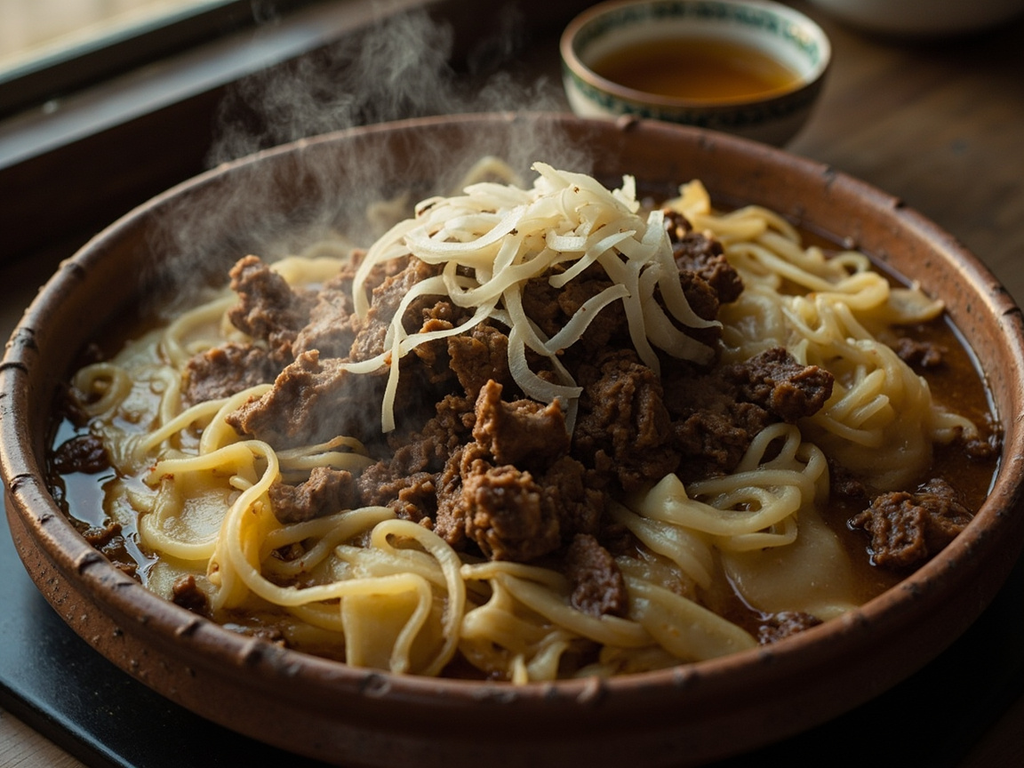
Mutton boiled for a long time, shredded by hand and laid on wide strips of scalded dough, all drizzled with onion-scented broth. It is eaten with the fingers — hence its name — from a large communal dish.
Back home in Sheker, we never asked the traveler if he was hungry: we slaughtered the beast, and the whole yurt smelled of mutton boiling in the big cast-iron cauldron. My grandmother rolled the dough as thin as a leaf, cut it into wide squares, and the eldest received the animal's head as one hands over a word of honor. We ate with full hands, huddled around the dish, and the hot onion broth warmed us to the soul. Believe me, you don't become a man of the steppe without having shared that dish.
- •Mutton shoulder and ribs (with bone) — a good piece for the table (festive meat)
- •Wheat flour — as needed (dough (kesme/salma))
- •Egg — according to dough (binds the dough)
- •Onions — several (broth (chyk))
- •Salt — to taste (seasoning)
Beshbarmak (five fingers)
Mutton boiled for a long time, shredded by hand and laid on wide strips of scalded dough, all drizzled with onion-scented broth. It is eaten with the fingers — hence its name — from a large communal dish.
Why this dish? Beshbarmak is THE dish prepared for the honored guest, the one by which an aïl honors its host. Aïtmatov, born in the village of Sheker in the heart of the Talas valley, grew up in this culture where the arrival of a visitor was worth slaughtering a sheep; his novels constantly return to this nomadic table and its rites of hospitality.
Back home in Sheker, we never asked the traveler if he was hungry: we slaughtered the beast, and the whole yurt smelled of mutton boiling in the big cast-iron cauldron. My grandmother rolled the dough as thin as a leaf, cut it into wide squares, and the eldest received the animal's head as one hands over a word of honor. We ate with full hands, huddled around the dish, and the hot onion broth warmed us to the soul. Believe me, you don't become a man of the steppe without having shared that dish.
Ingredients (period version)
- Mutton shoulder and ribs (with bone) — a good piece for the table (festive meat)
- Wheat flour — as needed (dough (kesme/salma))
- Egg — according to dough (binds the dough)
- Onions — several (broth (chyk))
- Salt — to taste (seasoning)
Ingredients
- Mutton or lamb shoulder with bone — 1.2 kg (meat)
- Wheat flour — 400 g (dough)
- Egg — 1 (binder)
- Water — ≈150 ml (dough)
- Onions — 3 large (broth and garnish)
- Black pepper and salt — to taste (seasoning)
Method
- Cover the mutton with cold water, bring to a simmer, skim, then cook gently for 2 to 2½ hours with a whole onion and salt.
- Knead flour, egg, water and a pinch of salt into a firm dough; let rest for 30 minutes under a cloth.
- Roll out very thinly and cut into wide diamonds (8–10 cm).
- Slice the onions, let them soften for a few minutes in a ladle of defatted broth: this is the chyk.
- Boil the dough diamonds for 4–5 minutes in the broth; arrange them on a large platter.
- Shred the meat by hand on top, cover with chyk onions and drizzle with hot broth. Serve the clear broth separately in bowls.
How it was made : In the yurt, the mutton cooked for hours in the kazan, the cauldron set over the hearth. The distribution of meat followed a strict etiquette: the head (bash) for the guest of honor, certain cuts for the elders, others for women and children. Nothing was wasted.
The contemporary twist : Serve the onion-scented broth in small cups as an opening, a kind of "steppe consommé," before the large shared platter.
Chingiz Aitmatov · Charactorium