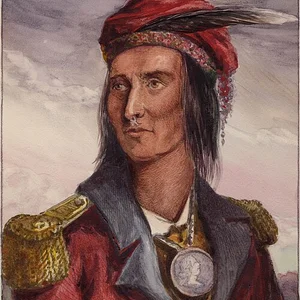

A Shawnee chief and Native American political leader, Tecumseh sought to unite the indigenous peoples of eastern North America into a vast confederacy to resist the expansion of the United States. An ally of the British during the War of 1812, he was killed at the Battle of the Thames in 1813.
Tecumseh(1768 — 1813)
Tecumseh
Shawnees
6 min read
Frequently asked questions
Famous Quotes
« Sell a country! Why not sell the air, the clouds and the great sea?»
Key Facts
- Born around 1768 in present-day Ohio, among the Shawnee people
- Beginning in 1805, he built a pan-tribal confederacy with his brother, the prophet Tenskwatawa, opposed to the ceding of lands
- In 1811, his confederacy suffered a setback at the Battle of Tippecanoe in his absence
- Allied with the British during the War of 1812, he took part in the capture of Detroit (1812)
- Killed on October 5, 1813, at the Battle of the Thames in Canada, bringing an end to his confederacy
Works & Achievements
A vast pan-Indian alliance bringing together many eastern nations to resist American expansion together. His most ambitious political project.
The creation, alongside his brother the Prophet, of a spiritual and military capital that gathered warriors from several peoples.
A long journey among the Creeks, Choctaws, Cherokees, and Chickasaws to rally them to his cause, built on powerful speeches of unity.
The assertion that Native lands belong to all peoples in common and that no single chief can sell them alone — the legal basis for his rejection of the treaties.
A major victory won with General Brock through a psychological ruse, giving the allies control of a strategic stronghold.
Military coordination with the British army during the War of 1812, making Tecumseh a recognized war chief who was appointed brigadier by the British.
Anecdotes
The name Tecumseh means roughly “shooting star” or “panther passing across” in the Shawnee language. Legend has it that a comet or meteor streaked across the sky at his birth around 1768, which is said to have given the child his name.
In 1810, during a tense meeting with Governor William Henry Harrison at Vincennes, Tecumseh was invited to sit on a chair “beside his father,” the representative of the United States. He refused and pointed to the ground, saying that the Earth was his mother and that he would rest upon her bosom.
Tecumseh opposed the sale of land piece by piece because, in his view, the soil belonged to all Native peoples in common and no single chief could give it away. He is credited with the saying that selling a country was as foolish as selling the air, the clouds, and the great sea.
While Tecumseh was traveling through the South to rally other nations to his confederacy, his brother Tenskwatawa, nicknamed the Prophet, triggered the Battle of Tippecanoe too soon in 1811. The destruction of their capital, Prophetstown, ruined part of Tecumseh's hopes upon his return.
An ally of the British during the War of 1812, Tecumseh helped capture Detroit in 1812 through a ruse: he marched his warriors past the edge of the forest several times to suggest a far greater number, intimidating the American defenders.
Primary Sources
Sell a country! Why not sell the air, the clouds and the great sea, as well as the land? Did not the Great Spirit make them all for the use of his children?
He is one of those uncommon geniuses who spring up from time to time to produce revolutions and overturn the established order of things.
Let the white men tread our land no longer. Let us unite, let us be one people, as our fathers were once a single family.
The sun is my father, and the earth is my mother; upon her bosom I will repose.
Key Places
Tecumseh was born around 1768 in a Shawnee village in present-day Ohio, near the Mad River. A region of forests contested between Native nations and settlers.
Capital of the confederacy founded in 1808 near the Tippecanoe River, in present-day Indiana. The spiritual and political center of the movement, destroyed in 1811.
Capital of the Indiana Territory where Tecumseh verbally confronted Governor Harrison in 1810 during tense negotiations over the land.
American stronghold captured in 1812 thanks to the alliance between Tecumseh and British General Isaac Brock, the site of one of his greatest military successes.
American fort in Ohio besieged in 1813 by the British and Native forces in which Tecumseh took part.
Site of the Battle of the Thames, on October 5, 1813, where Tecumseh was killed fighting alongside the British. The location of his grave remains unknown.
Typical Objects

A hardwood club, sometimes adorned with a ball or a blade, used in close combat. A traditional weapon of Shawnee warriors.

A light axe with a short handle, serving as both a tool and a weapon. Some models combined an axe head with a pipe bowl.

A firearm obtained through trade with Europeans, which became essential for hunting and war. The British supplied them to their Indigenous allies.

A band of woven shell beads, used to seal alliances, record treaties, and convey diplomatic messages between nations.

A ceremonial pipe with a long stem, smoked during councils and negotiations. Sharing it sealed the word given between peoples.

A head ornament made of dyed deer or porcupine hair, worn by warriors. A mark of status and bravery.

Soft shoes made of stitched leather, suited to walking through forests and to long expeditions. Often decorated with beads or quills.
School Curriculum
Vocabulary & Tags
Key Vocabulary
Tags
Daily Life
Morning
The day begins early, often with a swim in a river — a common purification ritual among the Shawnee. During campaigns, Tecumseh inspects his warriors, holds council, or organizes his group's movements.
Afternoon
The afternoon is devoted to hunting, training young warriors, or negotiating with allied chiefs and British officers. Tecumseh, a renowned orator, spends much of his time speaking and persuading.
Evening
In the evening, people gather around the fire to share a meal, tell stories, and debate the group's decisions. Important councils are often held after nightfall, sealed by the sharing of the calumet.
Food
The diet is based on corn, beans, and squash — the “three sisters” — supplemented by game (deer, turkey), fish, berries, and nuts. On expeditions, they carry dried corn and smoked meat.
Clothing
Tecumseh wore deerskin clothing: a tunic, leggings, and a breechcloth, with beaded moccasins. For war, he added body paint and feather ornaments; he is said to have refused European dress.
Housing
The Shawnee lived in wigwams made of bark or rush mats, clustered in villages near rivers. Semi-nomadic, they moved their camps according to the hunting seasons and the demands of war.
Historical Timeline
Period Vocabulary
Liens externes & ressources
Références
Œuvres
Confédération de Tecumseh
1808-1813
Fondation de Prophetstown
1808
Tournée diplomatique dans le Sud
1811-1812
Doctrine de la terre commune
1810
Prise de Detroit
1812
Alliance avec les Britanniques
1812-1813