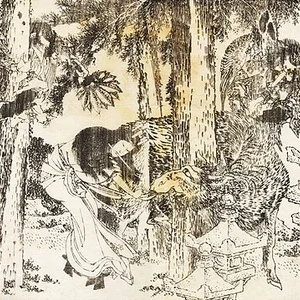

Tengu are supernatural creatures from Japanese folklore — mountain spirits, fearsome warriors, and tricksters all at once. Depicted with a long nose or a crow's beak, they are renowned masters of martial arts and military strategy.
Tengu
Tengu
8 min read
Frequently asked questions
Key Facts
- The earliest mentions of Tengu in Japan date back to the 8th century, in the Nihon Shoki (720 CE)
- Their depiction evolved over time: first portrayed as malevolent birds, then as human-faced creatures with long noses (Daitengu) from the Heian period onward (794–1185)
- According to legend, the hero Minamoto no Yoshitsune (12th century) was trained in the martial arts by a Tengu named Sōjōbō on Mount Kurama
- Tengu became associated with the ascetic practices of yamabushi (mountain hermit monks) from the 12th century onward
- They represent an ambivalent figure: protectors of esoteric Buddhism, yet also disruptors of religious and social order
Works & Achievements
A painted scroll produced in multiple copies depicting Tengu parodying corrupt monks from various Buddhist sects. This masterpiece of medieval Japanese narrative painting is preserved across several museums.
A Nō theater play depicting the encounter between the young Yoshitsune and the Tengu of Mount Kurama. It is still regularly performed today and stands as one of the founding texts of the Tengu legend.
An epic narrative tracing the life of the hero Minamoto no Yoshitsune, including his nighttime training under the Tengu. This text durably cemented the association between Tengu and the transmission of martial arts.
Many artists such as Utagawa Kuniyoshi depicted Tengu in popular woodblock prints. These works fixed the classic iconography of the long-nosed Tengu and helped spread its image throughout popular culture.
Ritual lacquered wooden masks depicting the long red nose of the Dai-Tengu, used in Shinto festivals (matsuri) and Nō theater. They are regarded as sacred protective objects in many shrines.
Anecdotes
According to legend, the young Minamoto no Yoshitsune — future hero of the Genpei War (1180–1185) — was trained in martial arts and military strategy by Sōjōbō, the king of the Tengu, on Mount Kurama near Kyoto. This story illustrates the role of the Tengu as secret masters passing down knowledge inaccessible to ordinary humans.
The Nihon Shoki, an imperial chronicle compiled in 720, contains the earliest known use of the word 'tengu' — describing a comet or meteor that Emperor Jomei reportedly spotted in the sky in 637. This passage shows that the term originally referred to a celestial omen before it came to designate a creature of folklore.
Medieval texts often describe Tengu as the spirits of proud Buddhist monks or warriors who, refusing to accept their death and unable to ascend to paradise, transformed into mountain-dwelling creatures. This belief reflects Japanese Buddhist morality and its warnings against the dangers of pride.
The Tengu Zoshi, an illustrated scroll from the 13th century, depicts Tengu parodying corrupt Buddhist monks. This satirical work reveals that Tengu also served as symbols of social and religious criticism, mocking priests who abused their power.
In the 17th century, an edict from the Tokugawa shogunate was symbolically addressed to the Tengu of Mount Iizuna, requesting that they not disrupt the construction of a road. This episode shows just how deeply the belief in Tengu was woven into Japanese public and administrative life.
Primary Sources
A great shooting star crossed the sky from north to south with a sound like thunder. The people said: 'That is the sound of a tengu.'
A Tengu took the form of a Buddhist monk and rose into the air, carrying a man it had deceived. The man was found wandering at the top of a tall tree, unable to remember what had happened to him.
The Tengu don the robes of monks and mimic their prayers, but their hearts are filled with pride and deceit. Those who seek glory through religion are destined to become Tengu.
Each night, a mysterious creature descended from Mount Kurama to teach the young Ushiwaka-maru the secrets of the sword and the tactics of war. This creature was none other than Sōjōbō, the great king of the Tengu.
Key Places
A sacred mountain north of Kyoto where the legendary Sōjōbō, king of the Tengu, is said to have taught martial arts to the young Yoshitsune. A Shinto temple and mountain trail still commemorate this legend today.
Another sacred peak in the Kyoto region, said to be the dwelling of a powerful Tengu who protects against fires. The Atago Shrine at its summit is one of the most visited in Japan.
Home to the great Buddhist monastery of Enryaku-ji, whose warrior monks (sōhei) are frequently associated with Tengu in medieval accounts. The Tengu Zoshi depicts corrupt monks from this type of monastery.
A mountain in the Japanese Alps renowned for its protective Tengu. In the 17th century, the Tokugawa shogunate symbolically addressed an edict to them, reflecting how deeply rooted this popular belief had become.
Although dedicated to the god Inari, this shrine is emblematic of the Shinto-Buddhist syncretism in which belief in Tengu — mountain spirits and guardians of sacred natural places — took root and flourished.
Typical Objects

Small black box-shaped hat worn by yamabushi (mountain ascetics) with whom the Tengu are closely associated. A symbol of their connection to the ascetic practices of Shugendo.

A fan made of palm leaves or feathers that Tengu use to fly and to unleash powerful winds. In several folktales, this fan can make noses grow or shrink.

A long metal staff adorned with jingling rings, an attribute of wandering monks and Tengu. Its chiming is said to ward off malevolent spirits and signal the presence of a supernatural being.

The Tengu are considered the guardians and supreme masters of the sword arts in Japan. They secretly teach the way of the blade to worthy warriors, as in the legend of Yoshitsune.

The most powerful Tengu, the Dai-Tengu, bear great wings that allow them to soar between mountain peaks. These wings symbolize their nature as both divine and animal, existing between the world of humans and that of the gods.

The long red nose of the Dai-Tengu is their most famous distinguishing feature. In Japanese iconography, this oversized nose symbolizes pride and arrogance — the very traits said to have transformed these beings into supernatural creatures.
School Curriculum
Vocabulary & Tags
Key Vocabulary
Tags
Daily Life
Morning
At dawn, the Tengu awaken on the peaks of sacred mountains, stretching their great wings before launching themselves into the rising air currents. They patrol their forest territory by soaring along the ridgelines, ensuring that no arrogant mortal desecrates the sacred grounds.
Afternoon
In the afternoons, master Tengu devote their time to martial arts training, practicing swordsmanship and unarmed combat techniques with superhuman precision and speed. They also observe human activity in the valleys below, ever ready to intervene and punish the proud or test worthy warriors.
Evening
At nightfall, the Tengu gather on rocks and the branches of great sacred trees to meditate or debate the affairs of the human world. The most powerful among them — the Dai-Tengu — can take human form to move unrecognized among mortals and put them to the test.
Food
Tengu feed primarily on offerings left at mountain shrines (rice, fruit, ritual sake) and on the spiritual energies of sacred places. In some tales, they also consume wild fruit, mushrooms, and forest roots, sharing the diet of the yamabushi ascetics.
Clothing
Tengu wear the garb of the yamabushi: a white robe (shiro-shozoku), hakama skirt, leg guards, straw sandals (waraji), and the small black conical cap known as a tokin. Their supernatural nature shows through in their large raptor wings and their fearsome expression.
Housing
Tengu dwell on the inaccessible summits of sacred mountains, in deep caves or within the hollow trunks of ancient thousand-year-old trees. Their abodes, invisible to ordinary mortal eyes, are located near shrines and abandoned hermitages — in the space between the world of humans and that of the gods.
Historical Timeline
Period Vocabulary
Visual Style
Style peinture japonaise médiévale (suibokuga et yamato-e) avec un Tengu puissant aux ailes sombres et au long nez rouge, dans un paysage de montagne mystique enveloppé de brume.
Sound Ambience
Ambiance sonore des montagnes sacrées japonaises médiévales : forêt de cèdres balayée par le vent, cri du corbeau, entrechocs d'épées à l'entraînement et tintement des clochettes rituelles.
Liens externes & ressources
Références
Œuvres
Tengu Zoshi (Rouleau illustré des Tengu)
vers 1296
Pièce de Nô 'Kurama Tengu'
XIVe-XVe siècle
Gikei-ki (Chronique de Yoshitsune)
XIVe siècle
Estampes ukiyo-e représentant des Tengu (période Edo)
XVIIe-XIXe siècle
Masques de Tengu (Tengu-men)
À partir du Xe siècle