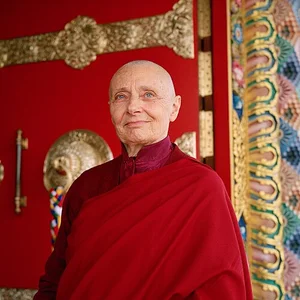

Tenzin Palmo, born Diane Perry in 1943 in London, is a Tibetan Buddhist nun of the Drukpa Kagyü school. She is famous for having spent twelve years on meditation retreat in a cave in the Himalayas, three of them in strict seclusion.
Tenzin Palmo(1943 — ?)
Tenzin Palmo
Royaume-Uni
5 min read
Frequently asked questions
Famous Quotes
« I have made a vow to attain Enlightenment in a female form, no matter how many lifetimes it takes.»
Key Facts
- Born on 30 June 1943 in London under the name Diane Perry
- Becomes one of the first Western women ordained as a Tibetan Buddhist nun in 1964
- Spends twelve years (1976-1988) on retreat in a cave in the Lahaul valley, in the Himalayas
- Founds the Dongyu Gatsal Ling nunnery in India in 2000
- Receives the title of Jetsunma (“venerable master”) from the head of the Drukpa lineage in 2008
Works & Achievements
A rare spiritual feat for a Western woman, which became a symbol of Tibetan meditation. It would inspire a world-famous book.
An institution dedicated to training nuns of the Drukpa Kagyü tradition, filling a historic gap for women.
A collection of clear and accessible teachings on Buddhist practice in everyday life, widely read in the West.
A book that explains key concepts of Tibetan Buddhism (karma, compassion, impermanence) to a general audience.
A spiritual commitment that became emblematic of her struggle for the equality of women in Buddhism.
An honorary distinction received from the 12th Gyalwang Drukpa, recognizing her role as a spiritual master.
Anecdotes
As a teenager in London, Diane Perry comes across a book on Buddhism and immediately tells her mother: “I am a Buddhist, I just didn't know it.” By the age of 18, she has already decided to set off for the East to find a master.
At just 20 years old, in 1964, she meets the 8th Khamtrul Rinpoche in India, whom she instantly recognizes as her master. A few weeks later, she becomes one of the very first Western women to be ordained as a nun in Tibetan Buddhism.
To meditate far from the world, around 1976 she settles into a cave in the Himalayas, at over 4,000 metres of altitude, in the Lahaul valley. She spends twelve years there, three of them in complete seclusion, enduring winters in which the snow blocked the entrance for months.
In her cave, she slept sitting upright in a wooden meditation box about 90 cm on each side: she never lay down to sleep during her years of retreat, following a traditional meditation discipline.
Outraged by how few resources were offered to nuns, she vowed to attain Enlightenment “in a female form, however many lifetimes it takes.” In 2000, she founds a monastery to give women back access to a complete spiritual training.
Primary Sources
“I have made a vow to attain Enlightenment in a female form — no matter how many lifetimes it takes.”
“The aim of practice is not to escape the world, but to transform our relationship with it and with our own mind.”
“We spend our whole lives running away from suffering and chasing after happiness, but true happiness arises from a mind at peace.”
Key Places
A district in London's East End where Diane Perry, the future Tenzin Palmo, grew up in a modest family. It was there that she discovered Buddhism as a teenager.
A mountain town where Tenzin Palmo settled upon her arrival in India in 1964 and where she met her teacher, the 8th Khamtrul Rinpoche.
A high-mountain hermitage, at over 4,000 metres, where she meditated for twelve years, including three in complete seclusion.
The place where Tenzin Palmo received full monastic ordination in 1973, which was then very rarely granted to women in the Tibetan tradition.
A nunnery she founded in 2000 to offer women a complete spiritual training.
Typical Objects

A string of 108 beads used to count mantra recitations during meditation. It is one of the indispensable objects of daily practice.

The traditional garment of Tibetan Buddhist monks and nuns, with no unnecessary seams and in a dark colour. It marks the renunciation of material possessions.

A small wooden box about 90 cm on each side in which Tenzin Palmo meditated and slept sitting up. It symbolises her extreme discipline during retreats.

A cylinder containing scrolls of mantras that is spun to spread prayers. Very widespread in Tibetan Buddhism.

A handwritten or printed collection containing the rituals and visualisations transmitted by the master. It guides the advanced meditation of the Drukpa Kagyü school.

A small stove used to keep warm and melt snow into water during the Himalayan winters. A vital survival object throughout her twelve years of retreat.
School Curriculum
Vocabulary & Tags
Key Vocabulary
Tags
Daily Life
Morning
As a nun, her day begins very early, before dawn, with prayers and long meditation sessions. In the cave, she also had to break the ice or melt snow to get water.
Afternoon
The afternoon is devoted to studying texts, reciting mantras, and practicing visualizations passed down by her master. Today, she also teaches the nuns of her monastery and receives visitors.
Evening
The evening is spent in meditation and ritual recitations. During her retreat, she slept sitting up in her meditation box, never lying down completely.
Food
Her diet is simple and vegetarian: tsampa (roasted barley flour), vegetables, lentils, and Tibetan tea. In the cave, she grew a few vegetables in summer and stocked up for winter.
Clothing
She wears the maroon and saffron monastic robes of Tibetan Buddhists, a sign of her renunciation of material possessions. Her shaved head completes this traditional attire.
Housing
For twelve years, she lived in a converted cave in the Himalayas, without electricity or running water. Today she lives in the monastery she founded in Himachal Pradesh.
Historical Timeline
Period Vocabulary
Liens externes & ressources
Références
Œuvres
Douze ans de retraite dans une grotte de l'Himalaya
1976-1988
Fondation du monastère Dongyu Gatsal Ling
2000
Reflections on a Mountain Lake (livre)
2002
Into the Heart of Life (livre)
2011
Vœu d'atteindre l'Éveil sous une forme féminine
vers 1970
Titre de Jetsunma
2008