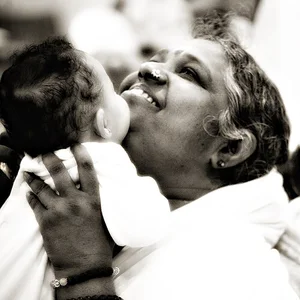

Mata Amritanandamayi, nicknamed “Amma” (the Mother), is an Indian spiritual figure born in 1953 in Kerala. Known for the embraces (darshan) she has given to millions of people, she leads a vast humanitarian and spiritual movement.
Mata Amritanandamayi(1953 — ?)
Mata Amritanandamayi
Inde
4 min read
Frequently asked questions
Famous Quotes
« My duty is to comfort those who suffer.»
Key Facts
- Born on 27 September 1953 in Parayakadavu (Kerala, India) into a family of fishermen
- Founded the Mata Amritanandamayi Math, a spiritual and charitable organization, in 1981
- Nicknamed “the hugging saint” for her darshan, during which she has embraced tens of millions of people
- Received the Gandhi-King Award for Non-violence at the United Nations in 2002
- Heads a worldwide network of humanitarian works (hospitals, universities, relief for victims of the 2004 tsunami)
Works & Achievements
Worldwide spiritual and humanitarian organization that structures all of her charitable work.
International network coordinating disaster relief, housing, soup kitchens and emergency aid.
Major charitable hospital in Kerala that treats poor patients free of charge.
Research university recognized in India, founded under her impetus.
Construction of thousands of homes and infrastructure after the 2004 tsunami.
Economic empowerment program bringing together women's self-help groups.
Talks, spiritual sayings and devotional songs published and shared throughout the world.
Anecdotes
Mata Amritanandamayi is affectionately known as “Amma,” which means “Mother” in Malayalam. She is famous around the world for her embraces: it is estimated that she has hugged more than 30 million people over the course of her life, sometimes during sessions lasting several uninterrupted hours.
Born into a humble family of fishermen in Kerala, she is said to have given away her family's food and belongings to the poorest people as a child, which earned her scoldings. This early compassion became the heart of her teaching.
In 1993, she spoke at the Parliament of the World's Religions in Chicago, becoming one of the most internationally recognized Indian spiritual figures.
After the 2004 tsunami that devastated the coasts of the Indian Ocean, her organization built thousands of homes for the victims, illustrating the connection she draws between spirituality and concrete humanitarian action.
In 2002, she received the Gandhi-King Award for Non-Violence, presented at the United Nations headquarters in Geneva, in the presence of figures such as Jane Goodall.
Primary Sources
Love is our true nature. Peace and happiness are not found in external objects, but within ourselves.
Violence will never give way to peace until love has taken root in the heart of humanity.
Women and men are like the two wings of a single bird: the bird can only fly if both wings are equally developed.
Key Places
Coastal fishing village where Amma was born in 1953 and spent her childhood.
Worldwide headquarters of the movement, founded in 1981 in Kerala, which welcomes disciples and visitors from all over the world.
City home to the Amrita Institute of Medical Sciences charitable hospital, established in 1998.
Site of the 1993 Parliament of the World's Religions, Amma's first major international platform.
Site where the Gandhi-King Award for Non-Violence was presented in 2002.
Typical Objects

Amma is almost always dressed in a simple white sari, a symbol of purity and renunciation.

Garlands of flowers offered as a sign of devotion and welcome during darshans.

During the darshan, Amma hands out petals and sacred ash as a blessing (prasad).

At the end of each embrace, Amma often slips a sweet or a piece of fruit into the visitor's hand as a blessed gift.

Instruments used during bhajans, the devotional songs that Amma sings with her disciples.

A string of beads used to count the repetitions of mantras during meditation.
School Curriculum
Vocabulary & Tags
Key Vocabulary
Daily Life
Morning
Amma's day begins very early with meditation and prayer, often facing the sea at Amritapuri. She then leads devotional songs (bhajans) with the ashram residents.
Afternoon
The afternoon is devoted to ashram affairs, humanitarian projects, and meeting with disciples. During her tours, she receives immense crowds who come for darshan.
Evening
In the evening, Amma often gives her famous embraces for long hours, sometimes late into the night, without stopping to eat or rest.
Food
Her diet is strictly vegetarian, simple, and frugal, in keeping with the ideal of renunciation. She eats little and irregularly, especially during the long darshan sessions.
Clothing
She wears an immaculate white sari, with no precious jewelry, a symbol of simplicity and spiritual purity.
Housing
She lives in the Amritapuri ashram, a vast waterside complex that combines places of prayer, housing for disciples, and charitable institutions.
Historical Timeline
Period Vocabulary
Liens externes & ressources
Références
Œuvres
Mata Amritanandamayi Math (ashram et mouvement)
1981
Embracing the World (réseau humanitaire mondial)
années 2000
Amrita Institute of Medical Sciences
1998
Amrita Vishwa Vidyapeetham (université)
2003
Programme de reconstruction post-tsunami
2004-2007
Amrita SREE (microcrédits pour femmes)
2005
Recueils d'enseignements et de bhajans
à partir des années 1980