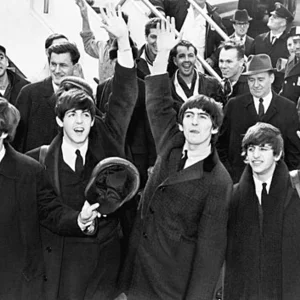

John Lennon was a British musician, singer, and songwriter, a founding member of the Beatles, the most influential rock band of the 20th century. After the band's breakup in 1970, he pursued a solo career and became a figure of pacifism before his assassination in 1980.
The Beatles (John Lennon)
John Winston Lennon
5 min read
Frequently asked questions
Famous Quotes
« Imagine all the people living life in peace»
Key Facts
- Born on October 9, 1940, in Liverpool
- Founds the Beatles in 1960 with Paul McCartney, George Harrison, and Ringo Starr
- The Beatles spark "Beatlemania" and the British Invasion starting in 1963–1964
- Releases the song "Imagine" in 1971, a global peace anthem
- Assassinated in New York City on December 8, 1980
Works & Achievements
First album that launched Beatlemania in the United Kingdom.
Album and film that established the group's international success.
Revolutionary concept album, considered a pinnacle of pop music.
Song that became the anthem of the peace movement.
John's most famous solo song, a universal call for peace and brotherhood.
Comeback album made with Yoko Ono, just before his death.
Anecdotes
In 1957, John Lennon, then aged 16, met Paul McCartney at a church parish fair in Liverpool. Impressed by Paul's mastery of chords, John invited him to join his band, the Quarrymen. This marked the beginning of one of the most famous songwriting duos in history.
During a 1966 interview, John remarked that the Beatles had become "more popular than Jesus." The statement sparked a scandal in the United States: records were publicly burned, and the band received threats. John eventually apologized to calm the controversy.
In 1969, John and his wife Yoko Ono staged their famous "Bed-In for Peace": they stayed in bed in a hotel room in Amsterdam and later Montreal to peacefully protest the Vietnam War. It was there that the song "Give Peace a Chance" was recorded.
John Lennon never fully learned to read music properly: like most Beatles, he composed mainly by ear. That did not stop him from writing hundreds of songs that became global classics.
In 1965, the Beatles received the honor of Member of the Order of the British Empire (MBE) from the Queen. In 1969, John returned his medal to the Queen to protest British policies, a rare and highly publicized gesture.
Primary Sources
“Christianity will go. It will vanish and shrink. We're more popular than Jesus now.”
“Imagine all the people living life in peace” (Imagine all the people living life in peace).
John offers a frank and bitter account of the Beatles' breakup and his early years.
“All we are saying is give peace a chance” (All we are saying is give peace a chance).
Key Places
Hometown of John Lennon and birthplace of the Beatles.
Club where the Beatles performed in their early days and gained fame.
London studio where the Beatles recorded most of their work.
Site of the 1969 Bed-In and the recording of “Give Peace a Chance.”
Building where John lived with Yoko Ono and in front of which he was assassinated in 1980.
Typical Objects

Iconic guitar from the Beatles' early years, used by John during Beatlemania.

Became his visual signature from the late 1960s onward, now a pacifist symbol.

The white grand piano on which he composed and performed "Imagine" at his Tittenhurst Park estate.

The medium for Beatles and solo albums, central to the music culture of the era.

The British Empire Medal he returned in 1969 as a protest gesture.

Clothing worn during peace happenings, blending provocation with political messaging.
School Curriculum
Vocabulary & Tags
Key Vocabulary
Tags
Daily Life
Morning
At the height of Beatlemania, mornings often start late, after late-night concerts or recording sessions. John reads fan mail, browses newspapers, and has a light snack before heading to the studios.
Afternoon
Afternoons are spent rehearsing, writing songs with Paul McCartney, or doing interviews and photo shoots requested by the world press.
Evening
Evenings are spent at Abbey Road studios, sometimes until dawn, or at London parties attended by the artists and musicians of the time.
Food
Like many Britons of the era, he enjoys tea, simple dishes, and pub food. In the late 1960s, influenced by trips to India, he becomes interested in vegetarianism.
Clothing
At first, matching collarless suits imposed by their manager; then, from 1967 onward, colorful outfits, military jackets, jeans, and long hair as symbols of the counterculture.
Housing
After a modest childhood in Liverpool with his aunt Mimi, he lives in large estates like Tittenhurst Park mansion, before settling into the Dakota building in New York.
Historical Timeline
Period Vocabulary
Visual Style
Un style visuel oscillant entre la photographie en noir et blanc de la Beatlemania et les couleurs psychédéliques de la contre-culture des années 1960.
Sound Ambience
Une ambiance mêlant la clameur des concerts de la Beatlemania, le bourdonnement chaleureux des studios d'Abbey Road et l'esprit pacifiste des années 1960.