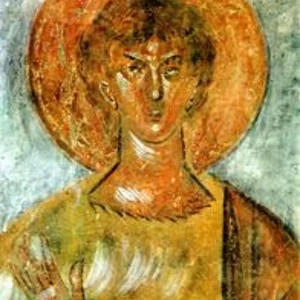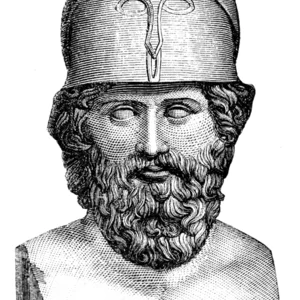

Athenian statesman and strategist, architect of Athens' naval power. He led the Greeks to the decisive victory at Salamis against the Persians in 480 BC.
Themistocles(523 av. J.-C. — 458 av. J.-C.)
Themistocles
Empire achéménide, Athènes
5 min read
Frequently asked questions
Key Facts
- Around 493 BC: as archon of Athens, he launches the fortification of the port of Piraeus
- 483 BC: pushes through a vote to use the revenues from the silver mines of Laurion to build a fleet of 200 triremes
- 480 BC: organizes and wins the naval Battle of Salamis against the fleet of Xerxes
- Around 471 BC: struck by ostracism and exiled from Athens
- End of life: taking refuge with the Persian king Artaxerxes I, he dies at Magnesia around 459 BC
Works & Achievements
The decision to turn Athens into a naval power using silver from Laurion. This fleet secured the victory at Salamis and Athens's maritime dominance.
The development of the port of Piraeus into a fortified naval base. It became the maritime and commercial lifeblood of Athens.
A strategy that lured the Persian fleet into a narrow strait where it was crushed. A decisive turning point in the Persian Wars.
The restoration of the ramparts of the city destroyed by the Persians, despite opposition from Sparta. Through cunning, it secured the defensive independence of Athens.
The idea of linking Athens to its port of Piraeus with long walls. This project, completed later, secured the city's supply lines in the event of a siege.
Anecdotes
According to tradition, Themistocles is said to have declared that he could not sleep because of the trophy of Miltiades, the victor of Marathon. Consumed by ambition, the young Athenian wanted to match and then surpass the glory of his elders.
When Athens discovered a rich vein of silver in the mines of Laurion, many wanted to share the money among the citizens. Themistocles convinced the assembly to use this fortune to build 200 triremes: this fleet saved Greece at Salamis a few years later.
Before the Battle of Salamis, the Greek leaders hesitated to fight in the strait. Themistocles secretly sent a messenger to the Persian king Xerxes to urge him to attack, thereby trapping his own allied fleet in the narrow passage where the heavy Persian ships could not maneuver.
Athens eventually banished Themistocles through ostracism: citizens would write a name on a pottery shard, the ostrakon. Dozens of these shards bearing his name have been found, sometimes written in the same hand, which suggests they were handed out ready-made to the voters.
Driven out of Greece, Themistocles paradoxically took refuge with the Persian enemy. The new king Artaxerxes welcomed him with honor and gave him the governance of several cities in Asia Minor, including Magnesia, where he ended his days.
Primary Sources
Themistocles, son of Neocles, a man whose opinion had recently prevailed among the Athenians, persuaded his fellow citizens to build ships with the silver from the mines.
Themistocles was the man who most surely revealed the power of natural genius; by his own intelligence, owing nothing to study, he was the best judge of the present and knew how to foresee the future.
He himself used to say that the trophy of Miltiades kept him from sleeping.
Go, sons of the Greeks, free your homeland, free your children, your wives, the sanctuaries of your fathers' gods and the tombs of your ancestors: it is for all this that the battle is fought today.
Key Places
Birthplace of Themistocles and the heart of the emerging democracy. He led his entire political and military career here.
The port of Athens, which Themistocles began fortifying as early as 493 BC. He turned it into the city's great naval base.
A narrow arm of the sea between the island of Salamis and Attica, the scene of the naval victory of 480 BC. Themistocles trapped the Persian fleet here.
Silver mines in southern Attica whose output funded the Athenian fleet. The source of Athens's strategic wealth.
A city in Asia Minor that the Persian king entrusted to the exiled Themistocles. He died there around 458 BC.
Typical Objects

Fast warship with three banks of oars, crewed by about 170 rowers. It was the decisive weapon of the Athenian fleet championed by Themistocles.

Bronze point fixed to the prow of the trireme, used to ram and stave in the hull of enemy ships. It was the main weapon of Greek naval combat.

Potsherd on which Athenian citizens wrote the name of the person they wanted to banish. Themistocles himself was exiled by this ostracism vote.

Large round shield made of wood and bronze carried by the Greek hoplite. It symbolizes the citizen combat of the land-based phalanx.

Bronze helmet covering the entire face, typical of the Greek hoplite. It protected the head at the cost of reduced vision and hearing.

Silver coin minted in Athens, adorned with the owl of Athena. The silver from Laurion that funded the fleet was also used to strike this coin.
School Curriculum
Vocabulary & Tags
Key Vocabulary
Daily Life
Morning
In the morning, an Athenian statesman like Themistocles would head to the agora, the great public square. There he met with citizens and allies, discussed the affairs of the city, and prepared for the debates of the assembly.
Afternoon
The afternoon might be devoted to sessions of the Ecclesia, the assembly of the people gathered on the hill of the Pnyx. There Themistocles delivered speeches to win over the citizens — for example, to fund the fleet.
Evening
In the evening, well-to-do Athenians gathered for the banquet, the symposion. Over wine mixed with water and conversation, they forged political alliances and debated philosophy and strategy.
Food
The Greek diet rested on the “Mediterranean triad”: wheat (flatbreads and porridges), olive oil, and wine. To this they added vegetables, cheese, fish, and, more rarely, meat during sacrifices.
Clothing
Men wore the chiton, a tunic of linen or wool, covered by a himation, a large draped cloak. Citizens walked barefoot or in leather sandals.
Housing
Athenian houses, made of mud brick and wood, were arranged around an inner courtyard. Plain on the outside, they separated the men's space (andron) from the women's (gynaeceum).
Historical Timeline
Period Vocabulary
Liens externes & ressources
Références
Œuvres
Construction de la flotte de 200 trières
483 av. J.-C.
Fortification du Pirée
493 av. J.-C.
Victoire de Salamine
480 av. J.-C.
Reconstruction des murs d'Athènes
478 av. J.-C.
Les Longs Murs (projet)
vers 478 av. J.-C.