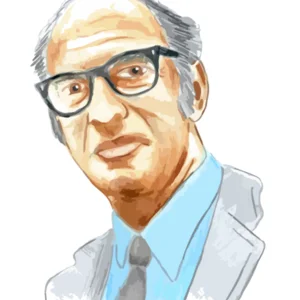

Thomas Kuhn was an American physicist, historian, and philosopher of science. His work *The Structure of Scientific Revolutions* (1962) profoundly transformed our understanding of how science evolves by introducing the notion of the “paradigm”.
Thomas Kuhn(1922 — 1996)
Thomas Kuhn
États-Unis
6 min read
Frequently asked questions
Key Facts
- Born July 18, 1922, in Cincinnati (Ohio), died June 17, 1996, in Cambridge (Massachusetts)
- Earned a doctorate in physics from Harvard University in 1949
- Published *The Structure of Scientific Revolutions* in 1962, a major work of 20th-century epistemology
- Popularized the concept of the “paradigm” and of the “paradigm shift”
- Taught notably at Berkeley, Princeton, and MIT
Works & Achievements
A historical study of the shift from the model with the Earth at the center of the universe to the one with the Sun at its center. Here Kuhn already shows how a great scientific idea transforms an entire worldview.
His most famous work, which introduces the notions of paradigm, normal science, and scientific revolution. It upended the philosophy and history of science.
A collection of essays in which Kuhn clarifies and defends his ideas, notably the necessary balance between tradition and innovation in research.
A sharp historical study of the birth of quantum physics at the turn of the twentieth century, showing Kuhn as a rigorous historian of science.
More than a book, an expression that has entered everyday language to describe a complete upheaval in a way of thinking, far beyond the sciences.
Anecdotes
Thomas Kuhn came up with his most famous idea by chance: in 1947, while preparing a lecture on mechanics for humanities students, he read Aristotle and was at first astonished to find him “so bad” at physics. Then he realized that Aristotle wasn't talking nonsense: he simply saw the world through a different framework of thought. This insight steered him toward his entire philosophy of science.
Kuhn popularized a word that is everywhere today: “paradigm.” Before him, this Greek term mainly referred to a model in grammar. After his 1962 book, people started talking about a “paradigm shift” in politics, economics, marketing and even advertising, often far from what he meant.
Kuhn was not originally a philosopher but a physicist: he earned a doctorate in physics from Harvard in 1949. It was almost by accident, while teaching the history of science, that he became one of the twentieth century's most influential thinkers on how knowledge advances.
His book *The Structure of Scientific Revolutions* is one of the most cited and best-selling academic works of all time, with more than a million copies sold. Yet it was first published in a series devoted to... an encyclopedia of unified science, a project whose very ideas Kuhn would go on to challenge.
Kuhn distinguished between “normal science,” where researchers quietly solve puzzles within an accepted framework, and “scientific revolutions,” those rare moments when everything tips over, as with Copernicus, Newton or Einstein. According to him, after a revolution scientists literally “see” the world differently.
Primary Sources
By [paradigms] I mean universally recognized scientific achievements that for a time provide model problems and solutions to a community of practitioners.
After a revolution, scientists work in a different world.
Effective scientific research demands an essential tension between traditional and innovative thinking.
I was reading Aristotle, and I kept wondering how a mind so brilliant could have said such manifestly absurd things about motion — until I realized he had to be read differently.
Key Places
Thomas Kuhn's birthplace, where he was born in 1922.
Kuhn completed all his physics studies here, through to his doctorate, and later taught the history of science here as well. It was here that he had his founding insight.
Kuhn taught here during the 1950s and 1960s and wrote The Structure of Scientific Revolutions here.
Kuhn was a professor of the history and philosophy of science here starting in 1964.
Kuhn ended his career here as a professor of philosophy starting in 1979.
The city where Thomas Kuhn died in 1996.
Typical Objects

His major 1962 book, which became a worldwide classic in the philosophy of science. In it he argues that science does not advance steadily but through a succession of ruptures.

For Kuhn, teaching textbooks embody the dominant paradigm of a discipline and pass on to students the accepted problems and methods. They often erase past revolutions.

An everyday tool of the 20th-century academic for writing books and articles before the computer era. Kuhn composed most of his work on one.

The instruments of the teacher and researcher for laying out reasoning and equations in front of students. It was through teaching that Kuhn forged his ideas.

Original documents by Aristotle, Copernicus, or Newton that Kuhn studied as a historian of science. His careful reading of them is the source of his insights.
School Curriculum
Vocabulary & Tags
Key Vocabulary
Tags
Daily Life
Morning
As a 20th-century university professor, Kuhn often began his day with reading and lesson preparation. He devoted long hours to studying the original texts of ancient scholars such as Aristotle, Copernicus, and Newton.
Afternoon
His afternoons were set by the rhythm of classes, seminars, and discussions with students and colleagues. Kuhn loved to debate, and it was in these exchanges that he refined his ideas about how science advances.
Evening
In the evening, he carried on with his writing, patiently composing books and articles on his typewriter. The conception of his works took him years of reflection.
Food
Kuhn led the ordinary life of an American academic in the second half of the 20th century. His meals were those of the middle class of the time, shared between home, campus, and university cafeterias.
Clothing
He wore the classic attire of a university professor: a plain suit, shirt, and jacket, sometimes finished off with a tie. Glasses were part of his intellectual's silhouette.
Housing
Kuhn lived in comfortable houses in American university towns such as Cambridge, Berkeley, and Princeton. His living space always included a study filled with books and archives.
Historical Timeline
Period Vocabulary
Liens externes & ressources
Références
Œuvres
La Révolution copernicienne
1957
La Structure des révolutions scientifiques
1962
La Tension essentielle (The Essential Tension)
1977
Black-Body Theory and the Quantum Discontinuity
1978
Concept de « changement de paradigme »
1962