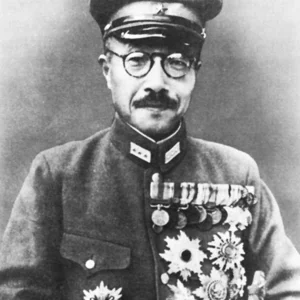

Japanese general and statesman, Prime Minister of Japan from 1941 to 1944. A leading figure of Japanese militarism, he ordered the attack on Pearl Harbor, which brought Japan into war against the United States. Tried as a Class A war criminal, he was sentenced to death and executed in 1948.
Tojo(1884 — 1948)
Hideki Tōjō
Japon
6 min read
Frequently asked questions
Key Facts
- Becomes Prime Minister of Japan in October 1941
- Orders the attack on Pearl Harbor on December 7, 1941, triggering the Pacific War
- Holds simultaneously the offices of Prime Minister, Minister of War, and Chief of Staff
- Resigns in July 1944 after the fall of Saipan and a string of military setbacks
- Tried as a Class A war criminal at the Tokyo Trials, sentenced to death and executed on December 23, 1948
Works & Achievements
As head of the military police in Manchuria, Tōjō suppresses opposition and tightens Japanese control over the occupied region.
Tōjō becomes head of the Japanese government while keeping the War Ministry, concentrating considerable military and political power.
Under his government, the offensive against the United States is launched, triggering the Pacific War.
Tōjō holds up to three key positions (Prime Minister, War Minister, Chief of Staff) to direct the Japanese war effort.
He champions this ideological project, presenting Japanese expansion as a liberation of Asia from Western domination.
Anecdotes
Tōjō was nicknamed “Kamisori” (the Razor) because of his methodical, sharp mind and his reputation as an uncompromising, efficient bureaucrat. The nickname came from his years in the military police, the feared Kenpeitai, which he led in Manchuria.
On December 8, 1941 (Japan time), it was under Tōjō's government that the surprise attack on Pearl Harbor was launched. Japan had not officially declared war before the first bombs fell, which led American President Roosevelt to brand the attack as a day of “infamy.”
In 1944, after the fall of the island of Saipan, which placed Japan within range of American bombers, Tōjō lost the emperor's confidence and was forced to resign from all his posts — he who held the offices of Prime Minister, Minister of War, and Chief of Staff at once.
When the American soldiers came to arrest him in September 1945, Tōjō attempted suicide by shooting himself in the chest, aiming for his heart. He missed and was saved by American doctors... before being tried and hanged three years later.
During the Tokyo trial, Tōjō took responsibility for the wartime decisions while seeking to shield Emperor Hirohito from any accusation. The emperor was never tried and kept his throne.
Primary Sources
We hereby declare war on the United States of America and the British Empire. The men and officers of Our army and navy shall do their utmost in prosecuting the war.
Japan is waging a war for its existence and self-defense, as well as for the establishment of a Greater East Asia Co-Prosperity Sphere.
There has never been a case in which a Japanese subject could have acted against the express will of His Majesty. I bore the responsibility for the conduct of the war.
The defendant Tōjō is found guilty of the counts of indictment and is sentenced by the Tribunal to death by hanging.
Key Places
Tōjō's birthplace and the imperial capital where he held power as Prime Minister. It was also here that he was tried and then executed.
A region of northeastern China occupied by Japan, where Tōjō led the military police and the general staff of the Kwantung Army during the 1930s.
The American naval base attacked by surprise by Japan on December 7, 1941, bringing the United States into the war. The attack was decided under Tōjō's government.
The prison where Japanese war criminals were held under the Allied occupation. Tōjō was imprisoned, tried, and then hanged here on December 23, 1948.
The institution where Tōjō received his officer training in the early 20th century, the starting point of his career in the army.
Typical Objects

Khaki military attire adorned with rank insignia and decorations, a symbol of **Tōjō**'s authority at the top of the Japanese army. He wore it even in his role as Prime Minister.

A sword carried by Japanese officers, inspired by the traditional katana and a symbol of the warrior spirit (*bushidō*) claimed by the imperial army. It embodied the military honor of the modern samurai.

**Tōjō**'s thin circular spectacles, combined with his shaved head and mustache, formed a silhouette that was instantly recognizable both in propaganda and in Allied caricatures.

An official document proclaiming Japan's entry into war against the United States and the British Empire in December 1941. It sealed the country's commitment to the Pacific War.

An image circulated to justify Japanese expansion in Asia under the slogan of a “Greater East Asia” freed from the West. A tool for the ideological mobilization of the militarist regime.

The weapon with which **Tōjō** tried to take his own life during his arrest in September 1945, missing his heart. The episode became the symbol of his downfall and that of Japanese militarism.
School Curriculum
Vocabulary & Tags
Key Vocabulary
Daily Life
Morning
As Prime Minister and Minister of War, Tōjō rose early and approached each day with rigorous military discipline. His mornings were devoted to reading military reports and to meetings with the general staff.
Afternoon
His afternoons were filled with cabinet councils, audiences, and decisions about the conduct of the war. Known as a relentless worker with a keen eye for detail, he liked to oversee many files personally.
Evening
In the evening, Tōjō often continued working late, receiving officers or preparing official communications. An austere man, he devoted little time to leisure.
Food
Tōjō followed a traditional and frugal Japanese diet, based on rice, fish, miso soup, and vegetables. In wartime, he made a point of sharing the restrictions imposed on the population.
Clothing
He most often wore the khaki military uniform of a general, even in his civilian role as Prime Minister. His shaved head, moustache, and round glasses gave him a stern and recognizable appearance.
Housing
Tōjō lived in official residences in Tokyo befitting his rank. His domestic life remained discreet, in keeping with the conventions of Japanese society at the time.
Historical Timeline
Period Vocabulary
Liens externes & ressources
Références
Œuvres
Direction de la Kenpeitai de l'armée du Guandong
1935-1937
Accession au poste de Premier ministre
Octobre 1941
Décision de l'attaque de Pearl Harbor
Décembre 1941
Loi de mobilisation totale et concentration des pouvoirs
1941-1944
Promotion de la Sphère de coprospérité de la Grande Asie orientale
1940-1943