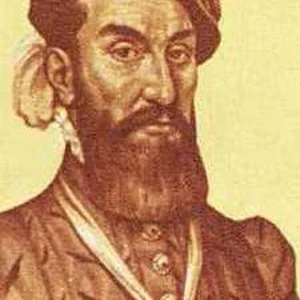

Tokugawa Ieyasu (1543-1616) unified Japan after decades of civil wars and founded the Tokugawa shogunate in 1603, establishing a peace lasting more than two centuries. His regime, the Edo period, kept Japan in near-total isolation until 1868.
Tokugawa (shogun)
Tokugawa Ieyasu (founder of the Tokugawa shogunate)
7 min read
Frequently asked questions
Key Facts
- 1600: decisive victory at the Battle of Sekigahara, consolidating his hegemony over Japan
- 1603: appointed shogun by the emperor, he founds the Tokugawa shogunate (bakufu) in Edo
- 1635: under Tokugawa Iemitsu, Japan adopts the sakoku isolationist policy
- 1853: the arrival of American Commodore Perry forces Japan to open up
- 1868: the Meiji Restoration overthrows the shogunate and ends the Tokugawa era
Works & Achievements
By having himself appointed shogun by the Emperor, Ieyasu established a centralized military government in Edo that would last 265 years, ushering in the longest period of peace in Japanese history.
A code of conduct imposed on all daimyo, restricting their castle construction, marriage alliances, and freedom of movement, in order to prevent any rebellion against the shogunate.
A set of rules confining the Emperor and the Kyoto nobility to cultural and ceremonial functions, permanently stripping the imperial court of all effective political power.
The transformation of a fishing village into a metropolis through the construction of Edo Castle, irrigation networks, canals, and infrastructure that would make it the largest city in the world by the 18th century.
Ieyasu favored trade with the Dutch and English (Protestants) over the Portuguese and Spanish, whom he considered too zealous in spreading their faith, setting in motion the isolationist policy that would eventually lead to the *sakoku*.
Anecdotes
Tokugawa Ieyasu spent much of his childhood as a hostage: sent at the age of six to live with the Imagawa clan, he learned patience and endurance in captivity. Those difficult years shaped his strategic character and taught him to wait for the right moment rather than act impulsively.
A famous anecdote captures the temperaments of Japan's three great unifiers through the question: what would you do with a cuckoo that refuses to sing? Nobunaga's answer was: 'I kill it'; Hideyoshi's: 'I make it sing'; and Ieyasu's: 'I wait for it to sing.' This legendary patience earned him the nickname *tanuki-oyaji* — the cunning old raccoon dog.
The Battle of Sekigahara, fought on **October 21, 1600**, lasted barely a few hours yet proved decisive for Japanese history. Ieyasu, leading a coalition of eastern lords, crushed the supporters of the Toyotomi clan, paving the way for his appointment as shogun three years later.
After founding the shogunate, Ieyasu took care to secure his succession by abdicating as early as **1605** in favor of his son Hidetada. This move made it unmistakably clear that power would remain within the Tokugawa family — unlike what had happened after Hideyoshi's death. Nevertheless, he continued to govern from behind the scenes until his death in **1616**.
Tradition holds that Ieyasu died in **April 1616** after eating tempura — a dish introduced by the Portuguese — and suffering a bout of indigestion that reportedly worsened into a fatal illness. While historians still debate the exact cause of his death, the story vividly illustrates the cultural exchanges between Japan and Europe at that time.
Primary Sources
The lords of domains must devote themselves to the practice of martial arts and the study of letters. Any gathering of armed men is forbidden without authorization from the shogunate.
The Emperor must devote himself to the arts and culture. Matters of government and the appointment of officials fall under the authority of the shogunate.
We grant the Dutch permission to trade freely in all ports of our country, subject to compliance with the laws in force.
The life of a man is like carrying a burden on a long road; do not be in a hurry. He who knows only victory and is ignorant of defeat will come to harm himself. Blame yourself, not others.
Key Places
Birthplace of Tokugawa Ieyasu, where Okazaki Castle still stands today. It was in this domain of the Matsudaira clan that the future unifier of Japan and founder of the shogunate was born in 1543.
Site of the decisive battle of October 21, 1600, which pitted Ieyasu against the supporters of the Toyotomi clan. The eastern coalition's victory, secured within a matter of hours, permanently paved the way for the founding of the shogunate.
A small fishing village that Ieyasu chose as the seat of his military government in 1603, which grew to become the largest city in the world by the 18th century. The city lends its name to the entire 1603–1868 period.
Ieyasu's retirement residence after his abdication in 1605, from which he continued to wield power behind the scenes until his death in 1616. This castle was the true center of decision-making during the shogunate's early years.
A magnificent mausoleum built after Ieyasu's death, where he was deified under the name Tosho Daigongen. This UNESCO World Heritage complex remains one of the most visited sites in Japan.
Liens externes & ressources
Références
Œuvres
Fondation du shogunat Tokugawa (bakufu d'Edo)
1603
Buke Shohatto (Lois pour les maisons militaires)
1615
Kinchu Narabini Kuge Shohatto (Règlements pour la cour impériale)
1615
Développement d'Edo comme capitale administrative
1603-1616
Politique commerciale sélective avec les puissances étrangères
1600-1616