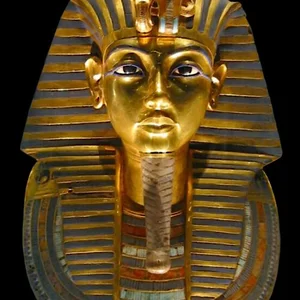

An Egyptian pharaoh of the 18th Dynasty, he reigned around 1332–1323 BCE. Ascending to the throne at approximately nine years old, he restored polytheistic worship after the Atenist revolution of Akhenaten. His tomb, discovered intact in 1922, is one of the greatest archaeological discoveries of the 20th century.
Tutankhamun(1340 av. J.-C. — 1323 av. J.-C.)
Tutankhamun
Nouvel Empire
7 min read
Frequently asked questions
Key Facts
- Around 1332 BCE: ascends to the throne at approximately 9 years old under the name Tutankhaten
- Around 1331 BCE: abandons Tell el-Amarna and restores the cult of Amun, changing his name to Tutankhamun
- Around 1323 BCE: dies at approximately 18–19 years old under circumstances still debated today
- 1922: Howard Carter discovers his tomb (KV62) intact in the Valley of the Kings
- 1925: opening of the sarcophagus, revealing the famous solid gold funerary mask
Works & Achievements
The founding act of his reign, this decree officially reinstated polytheistic worship, ordered the restoration of temples, and symbolically erased the Atenist legacy of Akhenaten.
Tutankhamun had several columns and statues erected at Karnak, including a large colonnade bearing the image of Amun. These works symbolize the return to traditional religious orthodoxy.
Reliefs and statues commissioned by Tutankhamun still adorn the Luxor Temple today, although his successor Horemheb had his own name carved over them.
Though modest compared to the tombs of the great pharaohs, Tutankhamun's burial is the best-preserved ever discovered, containing more than 5,000 intact funerary objects.
Anecdotes
Tutankhamun ascended to the throne at around nine years old, making him one of the youngest pharaohs in Egyptian history. His reign was largely guided by his advisors, most notably General Horemheb and the high priest Ay, who would become his successor.
At the time of his coronation, Tutankhamun was named Tutankhaten, in reference to the god Aten imposed by his presumed father Akhenaten. Upon restoring the cult of Amun and the ancient gods, he officially changed his name to Tutankhamun, meaning "living image of Amun."
The discovery of his tomb in November 1922 by Howard Carter and Lord Carnarvon in the Valley of the Kings was a worldwide sensation. The burial chamber contained more than 5,000 intact objects, including the famous solid gold death mask weighing approximately 11 kilograms.
Modern medical analyses have revealed that Tutankhamun suffered from several hereditary conditions, including a deformity of his left foot that forced him to walk with a cane. More than 130 canes were found in his tomb, confirming this disability.
The so-called "Curse of the Pharaohs" arose from a series of deaths that followed the opening of the tomb in 1922. Lord Carnarvon died a few months later from an infection, fueling widespread rumors. Scientists have since proposed rational explanations, such as the presence of toxic mold inside the tomb.
Primary Sources
"His Majesty has driven out evil from the Two Lands. Truth has been restored. He has done more than any other king since the beginning of time."
Official report of the inspections of the royal tombs at Thebes, recording checks on the integrity of the royal burials of the 18th Dynasty.
"My husband has died and I have no son. It is said that you have many sons. If you send me one of your sons, he will become my husband."
Tutankhamun orders the reopening of the closed temples, the recasting of destroyed statues, and the resumption of offerings to Egypt's traditional gods.
Key Places
The religious and political capital restored by Tutankhamun following the Amarna period. This is where the great temples of Amun at Karnak and Luxor were located, both of which he had restored.
The burial site of Tutankhamun, whose tomb KV62 was discovered intact in 1922. It is the only royal tomb in the Valley of the Kings found with its funerary contents almost entirely complete.
The capital founded by Akhenaten and abandoned under Tutankhamun. It was in this city that the young pharaoh spent his childhood before the royal court returned to Thebes.
The ancient administrative capital of Egypt, rehabilitated under Tutankhamun. The royal palace at Memphis served as a secondary residence for the pharaoh and his court.
Has housed nearly the entire treasure of Tutankhamun since 1922, including the golden death mask. It is slated to be transferred to the Grand Egyptian Museum in Giza.
Typical Objects

A masterpiece of Egyptian goldsmithing crafted from solid gold and lapis lazuli, it covered the mummy of Tutankhamun. It is today the most recognized symbol of ancient Egypt.

Found in the tomb, this throne is inlaid with gold, silver, and precious stones. The backrest depicts Tutankhamun and his wife Ankhesenamun in a solar setting, still bearing traces of Atenist iconography.

Essential royal insignia of the pharaoh, they symbolize pastoral authority and royal power respectively. Several examples were found in the tomb.

Six ritual and ceremonial chariots were discovered in the tomb, attesting to the military and symbolic importance of this equipment for a pharaoh, even a minor one.

These four translucent calcite vessels contained the embalmed organs of the king. Their human-headed lids represent the idealized face of Tutankhamun.

Pairs of gold leaf sandals intended for life in the afterlife. Their presence underscores the divine status of the pharaoh, whose feet were not to touch the profane earth.
School Curriculum
Vocabulary & Tags
Key Vocabulary
Tags
Daily Life
Morning
Tutankhamun began his day with purification rituals in the palace baths, attended by his priests and servants. He then performed the morning offerings to the gods in the private royal chapel — a daily act essential to maintaining cosmic order (Ma'at). Due to a malformation in his foot, he likely moved with the aid of a cane.
Afternoon
Afternoons were devoted to royal audiences, meetings with his advisors Ay and Horemheb, and reviewing reports from across the empire. Despite his young age, he was trained in physical pursuits such as archery, hunting, and chariot driving — all required attributes of the ideal warrior pharaoh — as evidenced by the objects found in his tomb.
Evening
In the evenings, the court gathered for royal banquets accompanied by music and dance. Musicians playing harp, lyre, and lute provided entertainment. Reading religious texts and planning major religious festivals, such as the Beautiful Feast of the Valley, also occupied part of the royal evenings.
Food
The pharaoh's diet was rich and varied: breads of many kinds, roasted meats (beef, poultry, Nile fish), vegetables (lentils, onions, leeks), fruits (figs, grapes, dates), and light barley beer. His tomb contained food provisions for the afterlife, including jars of oil, wine, and honey.
Clothing
Tutankhamun wore the shendyt, a pleated white linen kilt fastened at the waist by a gilded belt, and the nemes, the striped linen headdress characteristic of pharaohs. During ceremonies, he wore the double crown (pschent) symbolizing the unity of Upper and Lower Egypt, along with necklaces, bracelets, and pectorals made of gold and faience.
Housing
Tutankhamun resided primarily in the royal palace at Thebes — a vast complex of hypostyle halls, irrigated gardens, pools, and private apartments. The furnishings, reconstructed in part from funerary objects, reveal a luxurious setting: ebony beds with animal-shaped legs, folding stools inlaid with ivory, and decorated cedarwood chests.
Historical Timeline
Period Vocabulary
Visual Style
Style art égyptien du Nouvel Empire, XVIIIe dynastie : mélange de la tradition hiératique et de la douceur naturaliste héritée de l'époque amarnienne, dominé par l'or, le lapis-lazuli et les couleurs vives.
Sound Ambience
L'atmosphère sonore du palais royal thébain sous Toutânkhamon, mêlant rituels religieux, vie de cour et environnement nilotique caractéristique de l'Égypte du Nouvel Empire.
Liens externes & ressources
Références
Œuvres
Décret de restauration (Stèle de Karnak)
vers 1331–1330 av. J.-C.
Restauration du temple de Karnak
vers 1330–1323 av. J.-C.
Aménagement du temple de Louxor
vers 1330–1323 av. J.-C.
Tombe royale KV62 (Vallée des Rois)
vers 1323 av. J.-C.
Rechercher
See also
Related Characters

Aten
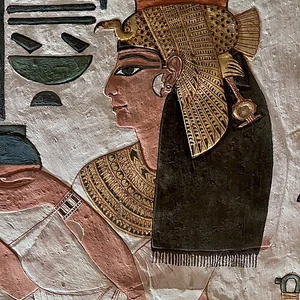
Nefertari
1289 av. J.-C. — 1254 av. J.-C.
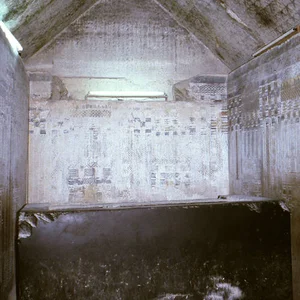
Unas
2374 av. J.-C. — 2349 av. J.-C.
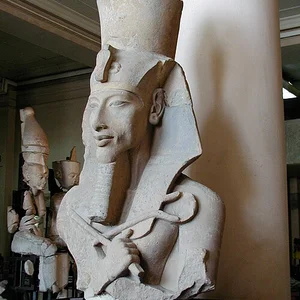
Akhenaten
1400 av. J.-C. — 1335 av. J.-C.
Amenhotep III
1399 av. J.-C. — 1350 av. J.-C.
Ay
1400 av. J.-C. — 1400 av. J.-C.