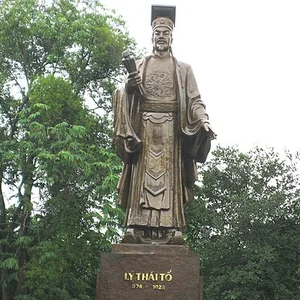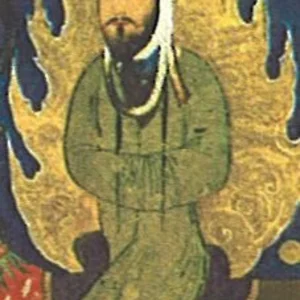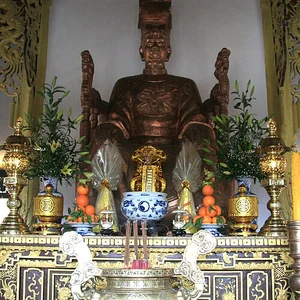

Third emperor of the Trần dynasty in Đại Việt (r. 1278–1293), he led the victorious resistance against two Mongol invasions under Kublai Khan (1285, 1287). After abdicating, he became a Buddhist monk and founded the Trúc Lâm Yên Tử sect, the first truly Vietnamese school of Chan meditation.
Trần Nhân Tông(1258 — 1308)
Trần Nhân Tông
Đại Việt
8 min read
Frequently asked questions
Key Facts
- 1258: Birth of Trần Khâm, eldest son of Emperor Trần Thánh Tông
- 1278: Enthroned before the age of 20, he takes the reign name Trần Nhân Tông
- 1285 and 1287: Together with General Trần Quốc Tuấn, leads the resistance that repels two major Mongol offensives
- 1293: Abdicates in favor of his son Trần Anh Tông and enters monastic life under the title Trúc Lâm Đại Sĩ
- 1308: Dies; as founder of the Trúc Lâm Yên Tử sect, he is honored as one of Vietnam's 14 national heroes (official ranking, 2013)
Works & Achievements
The first school of Buddhist meditation with a distinctly Vietnamese identity, synthesizing Chan Buddhism with local culture. The major spiritual achievement of Trần Nhân Tông, the sect remains active today.
Trần Nhân Tông was a celebrated poet whose texts, written in chữ Hán, transmit the teachings of the Trúc Lâm sect and reflect his syncretic thought blending Buddhism, Taoism, and Confucianism.
Standardization of measurement systems across the entire territory to facilitate domestic trade — a notable economic reform from his early reign that prepared the war economy against the Mongols.
Dredging and development of the Tô Lịch River to make it the main communication artery of the capital — an illustration of his infrastructure policy in service of economic and military development.
Marriage of Princess Huyền Trân to King Chế Mân of Champa, securing two provinces as dowry (Ô and Rí) — a territorial expansion achieved without armed conflict, and a masterpiece of medieval Vietnamese matrimonial diplomacy.
Anecdotes
As a young crown prince, Trần Nhân Tông secretly attempted to flee to the monastery on Yên Tử mountain to become a monk. Setting out in the middle of the night, he reached the Đông Cứu temple at dawn, exhausted; a monk fed him without recognizing him. His father Emperor Thánh Tông sent soldiers to bring him back and begged him to return to take the throne — which he did reluctantly.
At his birth, diviners noticed a black mole the size of a bean on his left shoulder. His father and grandfather immediately gave him the nickname 'Kim Tiên đồng tử' (Child of the Golden Immortal); the chronicles of the Trần court took it as a sign of an extraordinary destiny.
Even while on the throne
Trần Nhân Tông fasted with such severity that his body visibly wasted away. His father the Thái thượng hoàng broke into tears and told him:
I am old and have only you to rely on; if you carry on like this, what will become of the legacy of our ancestors?" The Thánh đăng ngữ lục records that the Emperor himself also wept.
In 1280, a commoner stopped the Emperor in the street to complain about an unjust ruling shielded by the influence of a high-ranking official. Trần Nhân Tông immediately ordered a counter-investigation; the complainant was found to be in the right and justice was served. The chronicler Ngô Sĩ Liên cited this episode as a model of royal fairness.
In 1280, the rebellion of chieftain Trịnh Giác Mật threatened the Đà Giang region. Rather than launching a military campaign, the Emperor sent Prince Trần Nhật Duật — renowned for his knowledge of local cultures — to negotiate peace. Giác Mật surrendered without a fight and was ultimately pardoned along with his entire family, a rare example of diplomacy chosen over force.
Primary Sources
'From birth, Trần Khâm possessed the radiance of saints: a complexion like gold, a perfect body, a luminous mind'; the text also records his direct judicial interventions and economic reforms (unification of weights and measures, dredging of the Tô Lịch river).
'His nature was highly intelligent and studious; he possessed many talents, had read all the books, and was equally versed in Buddhist and secular texts.' The text also recounts his father's tears at his excessive fasting.
An account of the founding of the Trúc Lâm Yên Tử sect by Trần Nhân Tông following his abdication, designating him as Trúc Lâm Đại Sĩ (Great Master of the Bamboo Forest) and first patriarch of this school.
Annotations by the Ming scholar Trần Quang Chỉ attesting that Trần Nhân Tông had reached a high level in the military arts, music, calendrics, astronomy, and medicine, as well as a deep mastery of the three teachings (Buddhism, Taoism, Confucianism).
Key Places
The imperial capital where Trần Nhân Tông reigned from 1278 to 1293. It was evacuated twice during the Mongol invasions (1285, 1287) before being recaptured, and it was here that he carried out his administrative reforms.
The place where Trần Nhân Tông withdrew after his abdication to found the Trúc Lâm Yên Tử Buddhist sect, and where he died in 1308. He is still venerated there under the title of Phật Hoàng (Buddha King).
Site of the decisive naval victory against the second Mongol invasion in 1287–1288, under the command of Trần Quốc Tuấn. Wooden stakes driven into the riverbed trapped and destroyed the Mongol fleet.
The neighboring kingdom to the south with which Trần Nhân Tông maintained skillful diplomatic relations: he gave his daughter, Princess Huyền Trân, in marriage to King Chế Mân, enabling a peaceful expansion of Vietnamese territory.
Typical Objects

After his abdication, Trần Nhân Tông wore the Buddhist monastic robe of coarse fabric, a sign of his renunciation of imperial power. Its austerity stood in stark contrast to the splendor of the court of Thăng Long.

The emblem of sovereign power over Đại Việt, the seal was used to authenticate royal edicts. Trần Nhân Tông symbolically handed it to his son at the time of his abdication in 1293.

Bamboo lies at the very heart of the name of the sect founded by Trần Nhân Tông — *Trúc Lâm*, meaning "Bamboo Forest." The bamboo staff was the emblematic attribute of the wandering monk on Mount Yên Tử.

Trần Nhân Tông was as well versed in Buddhist texts as in Confucian classics, according to the *Thánh đăng ngữ lục*. Hand-copied sutras were the primary vehicle for transmitting the teachings of the Trúc Lâm sect.

In 1280, Trần Nhân Tông ordered the unification of measurement systems throughout Đại Việt to facilitate domestic trade. These standards of weight and length were essential instruments of economic governance, part of the broader preparations for resistance against the Mongols.

During the two Mongol invasions (**1285**, **1287**), Trần Nhân Tông personally led the resistance alongside Trần Quốc Tuấn. His field armor symbolizes his dual role as warrior-emperor and defender of Vietnamese independence.
School Curriculum
Vocabulary & Tags
Key Vocabulary
Daily Life
Morning
The Emperor began his day with meditation and the recitation of Buddhist sutras, a practice he maintained even at the height of military crises. Chronicles report that he fasted regularly with unusual frugality for a monarch, to the point that the Thái thượng hoàng had to personally intervene.
Afternoon
Afternoons were devoted to affairs of state: royal audiences, receiving Mongol envoys (such as Sài Thung), overseeing administrative reforms and public works. He personally settled disputes brought to his attention, as illustrated by the episode of the petitioner he encountered outside the walls of Thăng Long.
Evening
In the evenings, Trần Nhân Tông gathered Buddhist masters for discussions on Thiền tông (Chan/Zen). His principal spiritual teacher was Tuệ Trung Thượng Sĩ, who, according to the Thánh đăng ngữ lục, led him to “attain the marrow of Chan” — transcending mere devotional practice.
Food
The future monk observed strict fasts long before his abdication, limiting his food intake to the bare minimum. His vegetarian practices followed Buddhist precepts prohibiting animal flesh, contrasting sharply with the banquets of the imperial court.
Clothing
On the throne, the Emperor wore imperial silk robes in the colors of the Trần court. After his abdication and entry into holy orders, he permanently adopted the rough monastic habit — a concrete and deliberate sign of his break with the world of power.
Housing
In Thăng Long, he resided in the imperial palace of the capital. After 1293, he settled in a simple monastery on Yên Tử mountain, amid bamboo forests that gave their name to his sect: Trúc Lâm (Bamboo Forest).
Historical Timeline
Period Vocabulary
Liens externes & ressources
Références
Œuvres
Fondation de la secte Trúc Lâm Yên Tử
vers 1299
Poèmes et textes de méditation bouddhiques
fin XIIIe – début XIVe siècle
Réforme des poids et mesures du Đại Việt
1280
Travaux hydrauliques du Tô Lịch à Thăng Long
1284
Alliance diplomatique avec la Champa
1306