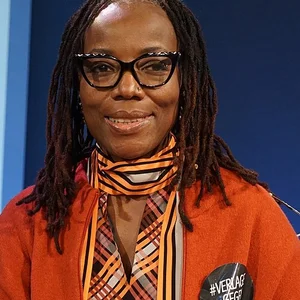

Zimbabwean novelist and filmmaker born in 1959, Tsitsi Dangarembga is the first Black woman from Zimbabwe to have published a novel in English. Her work explores colonization, the condition of women, and African identity in a postcolonial society.
Tsitsi Dangarembga(1959 — ?)
Tsitsi Dangarembga
Zimbabwe
8 min read
Frequently asked questions
Key Facts
- 1959: born in Mutoko, in Southern Rhodesia (present-day Zimbabwe)
- 1988: publication of Nervous Conditions, the first English-language novel by a Black Zimbabwean woman
- 2006: publication of The Book of Not, the second installment of the trilogy
- 2018: publication of This Mournable Body, shortlisted for the 2020 Booker Prize
- 2020: arrested during a protest for press freedom in Zimbabwe
Works & Achievements
The first novel in English by a Black Zimbabwean woman, it follows Tambu, a rural girl who gains access to colonial education. A landmark work of African women's literature, it is now studied at universities around the world.
A play written while Dangarembga was still a student, already addressing the condition of Zimbabwean women. One of her earliest published works, it reveals her early vocation as a committed writer.
A Zimbabwean film about the inheritance rights of widowed women, co-written by Dangarembga. A popular success in Zimbabwe, it helped raise national awareness of women's rights under Shona customary law.
A feature film she directed solo, addressing the plight of children orphaned by AIDS in Zimbabwe. The first Zimbabwean film directed by a woman to receive international distribution.
The second installment of the Tambu trilogy, following the heroine through a colonial boarding school during the independence war. The novel explores the psychological violence of colonial assimilation on African identity.
The third novel in the trilogy, shortlisted for the 2020 Booker Prize. Written in the second person singular — a rare narrative device — it portrays the disillusionment of post-colonial Zimbabwe through an adult Tambu struggling with failure and social violence.
Anecdotes
Tsitsi Dangarembga was born in 1959 in Southern Rhodesia, a British colony, and spent part of her childhood in England before returning to Zimbabwe. This dual experience — growing up between two cultures, two languages, two worlds — deeply informs her writing and her reflections on colonized African identity.
Her first novel, *Nervous Conditions* (1988), was rejected by many publishers before finally being published by the British feminist press The Women's Press. It has since become a classic of Anglophone African literature and is taught at universities around the world.
Dangarembga studied medicine and then psychology at Cambridge before turning to filmmaking, which she studied in Berlin. This unconventional intellectual journey — literature, the humanities, cinema — is reflected in the psychological complexity of her female characters.
In July 2020, as Zimbabwe was facing a serious political crisis, Tsitsi Dangarembga took part in a peaceful anti-corruption protest in Harare. She was arrested by police, triggering a wave of international solidarity. Despite the pressure, she did not abandon her civic engagement.
In 2020, her novel *This Mournable Body* was shortlisted for the Booker Prize, one of the most prestigious literary awards in the English-speaking world. This international recognition crowned a career spanning more than thirty years and brought the voices of Zimbabwean women onto the global literary stage.
Primary Sources
I was not sorry when my brother died. Nor am I apologising for my callousness, as you may define it, my lack of feeling. For it is not that at all. I feel many things these days, much more than I was able to feel in the days when I was young and my brother was alive.
You are not the person you want to be. The person you want to be would not have done what you have done. You have done what you have done because you are you, and not what you want to be.
Writing is an act of resistance. Every word I put on the page is a challenge to the silence that was imposed on us — on women, on Africans, on those whose stories were deemed unworthy of telling.
I wrote about what I knew: the experience of being a girl in colonial Rhodesia, the ambivalence of education, the way colonialism enters the mind and the body. I wanted to bear witness.
Key Places
Birthplace of Tsitsi Dangarembga, located in Mashonaland East province. This rural Zimbabwean setting, with its social and colonial realities, is the direct source of the landscapes and communities depicted in *Nervous Conditions*.
Dangarembga studied psychology at the University of Cambridge here in the 1980s. This experience of the colonial metropolis, seen through the eyes of an African student, profoundly shaped her understanding of cultural domination.
The capital of Zimbabwe where Dangarembga lives and works. She founded the International Images Film Festival for Women (IIFF) here and pursues her cultural and political commitments — including the protest that led to her arrest in 2020.
Dangarembga studied filmmaking at the Deutsche Film- und Fernsehakademie Berlin (DFFB) here in the 1990s. This European training gave her command of cinematic language while she retained an African perspective on the world.
A city in eastern Zimbabwe, near the Mozambican border, which serves as the setting for several episodes in Dangarembga's trilogy — notably in *The Book of Not*, where the heroine attends a colonial boarding school.
Typical Objects

A fundamental tool for the writer, on which her novels and screenplays were composed. Dangarembga has spoken of the shift from mechanical typewriter to computer as a profound change in her relationship with writing.

As a filmmaker, Dangarembga used the camera as a second artistic language, to film Zimbabwean realities that words alone could not fully convey.

Dangarembga's personal library reflects her dual cultural heritage: anglophone literature (Doris Lessing, Chinua Achebe) and Shona oral traditions — two inheritances she seeks to reconcile in her work.

She has shared that she uses notebooks to jot down daily observations, dialogue fragments, and lived scenes — the raw material of her fiction, deeply rooted in reality.

Dangarembga regularly wears clothing in Shona fabrics or African wax print at public events, visually asserting her Zimbabwean identity within international literary spaces.

Her shooting scripts, covered in corrections and directives, bear witness to a demanding collaborative process bridging literature and cinema — two art forms she refuses to rank above one another.
School Curriculum
Vocabulary & Tags
Key Vocabulary
Daily Life
Morning
During her years of intense writing, Dangarembga starts her mornings early, before the city of Harare awakens. She devotes the first hours to writing, working on her manuscripts in the quiet of her home, before the family and professional demands of the day take over.
Afternoon
Afternoons are often given over to her cultural centre's activities and her filmmaking work: production meetings, rushes screenings, workshops with young Zimbabwean filmmakers she mentors and supports. She also manages the preparation of the International Images Film Festival (IIFF) she founded.
Evening
In the evenings, Dangarembga reconnects with her family and reads widely — African literature, philosophy, international press. She also regularly takes part in public debates, lectures, and civic association meetings, true to a social commitment that extends well beyond literature.
Food
Daily meals in Harare are built around traditional Shona Zimbabwean dishes: *sadza* (maize porridge, the staple food), leafy green vegetables (*muboora*, rape), beans, and chicken or meat stews. As in many Zimbabwean families, the evening meal is the central moment of family life.
Clothing
Dangarembga favours a simple, professional wardrobe for everyday life — dresses or tailored suits — but often chooses colourful African fabrics for public appearances and festivals. This sartorial choice is a deliberate statement of identity and a form of resistance to Western uniformity.
Housing
Dangarembga lives in Harare in a residential neighbourhood of the Zimbabwean capital. Her home serves at once as a family dwelling, a workspace, and a welcoming space for artistic collaborators. She experienced difficult material conditions during Zimbabwe's economic crises of the 2000s and 2010s, an experience that feeds her thinking on inequality.
Historical Timeline
Period Vocabulary
Liens externes & ressources
Références
Œuvres
Nervous Conditions (Les Conditions nerveuses)
1988
She No Longer Weeps
1987
The Book of Not
2006
This Mournable Body
2018