 flip
flipTýros in Brine, the Cyclops' Cheese
Týros in Brine, the Cyclops' Cheese
Why this dish? In the Cyclops Polyphemus' cave, Odysseus finds racks full of cheeses and buckets of whey: the giant is a shepherd as much as a monster. On Ithaca too, a land of goats, they curdle milk and preserve cheese in brine to last through winter. This is the ópson par excellence, what accompanies the barley flatbread.
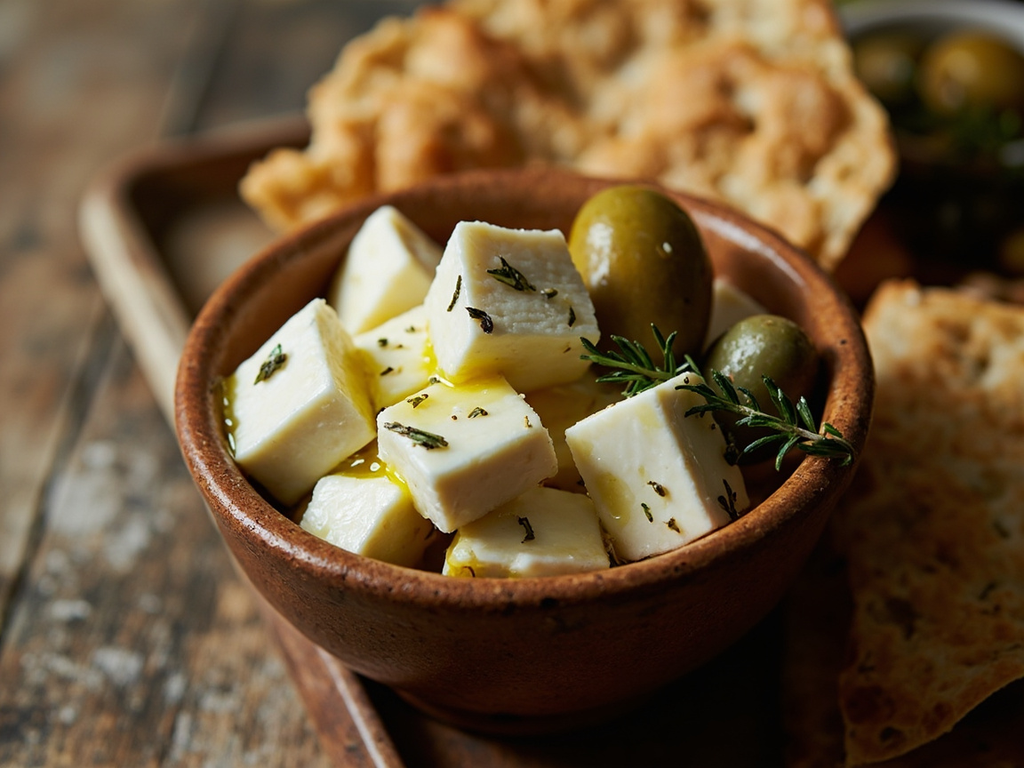
A fresh goat or sheep cheese, drained and then preserved in a salty brine where it firms up and gains character. A staple of Greek shepherds, direct ancestor of feta.
In the Cyclops' den, stranger, I saw racks groaning under cheeses and vessels full of curdled milk — that lawless brigand at least knew how to tend his flocks! At home on Ithaca, we do the same: we curdle the goats' milk, drain it in wicker baskets, then lay it in salt water so it lasts until the bad days. On a barley flatbread with an olive, that is the meal of a man who knows how to wait — and I, the gods know, have learned to wait.
- •Goat or sheep milk — a large bucket (base)
- •Rennet (fig sap or abomasum) — as needed (coagulant)
- •Sea salt — generously (preservation)
- •Spring water — for the brine (preservation)
Týros in Brine, the Cyclops' Cheese
A fresh goat or sheep cheese, drained and then preserved in a salty brine where it firms up and gains character. A staple of Greek shepherds, direct ancestor of feta.
Why this dish? In the Cyclops Polyphemus' cave, Odysseus finds racks full of cheeses and buckets of whey: the giant is a shepherd as much as a monster. On Ithaca too, a land of goats, they curdle milk and preserve cheese in brine to last through winter. This is the ópson par excellence, what accompanies the barley flatbread.
In the Cyclops' den, stranger, I saw racks groaning under cheeses and vessels full of curdled milk — that lawless brigand at least knew how to tend his flocks! At home on Ithaca, we do the same: we curdle the goats' milk, drain it in wicker baskets, then lay it in salt water so it lasts until the bad days. On a barley flatbread with an olive, that is the meal of a man who knows how to wait — and I, the gods know, have learned to wait.
Ingredients (period version)
- Goat or sheep milk — a large bucket (base)
- Rennet (fig sap or abomasum) — as needed (coagulant)
- Sea salt — generously (preservation)
- Spring water — for the brine (preservation)
Ingredients
- Fresh goat or sheep cheese (or low-salt feta) — 300 g (base)
- Water — 500 ml (brine)
- Salt — 50 g (brine)
- Olive oil — for serving (flavor)
- Dried thyme or oregano — 1 tsp (aroma)
Method
- Prepare the brine by dissolving the salt in the water; let cool.
- Cut the fresh cheese into cubes or thick slices.
- Submerge them in the brine in a clean jar, covering completely with liquid.
- Let rest in a cool place for at least 24 hours (and up to several days): the cheese firms up and becomes salty.
- Drain, drizzle with olive oil and herbs, and serve on a maza flatbread (r1).
How it was made : The Odyssey precisely describes Polyphemus' dairy: curdled milk, cheeses on racks, whey collected. Greeks curdled goat and sheep milk (often with fig sap) and preserved the cheese in brine — a technique that millennia later gave rise to feta. It was an essential protein reserve for shepherds and sailors.
The contemporary twist : Serve it "herb-marbled" in cubes on picks, meze style, with a drizzle of honey to play on the salty-sweet contrast the Greeks loved.
Sources : Homer, The Odyssey (Book IX, the cave of Polyphemus) · Andrew Dalby, Siren Feasts (1996)
Odysseus · Charactorium