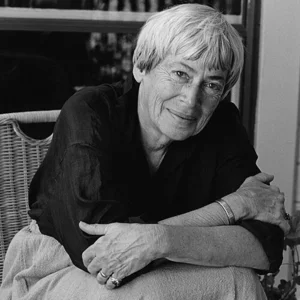

Ursula K. Le Guin (1929–2018) was an American science fiction and fantasy author, known for her philosophical and feminist works. Her novel *The Left Hand of Darkness* (1969) explores questions of gender and otherness. She is one of the major figures of imaginative literature in the 20th century.
Ursula K. Le Guin(1929 — 2018)
Ursula K. Le Guin
États-Unis
9 min read
Frequently asked questions
Famous Quotes
« The creative adult is the child who survived.»
« We read books to find out who we are.»
Key Facts
- 1929: born in Berkeley, California, daughter of anthropologist Alfred Kroeber
- 1969: publication of *The Left Hand of Darkness*, winner of the Hugo and Nebula Awards
- 1974: *The Dispossessed*, an anarchist and utopian novel, double Hugo and Nebula Award winner
- 1968–1990: the Earthsea cycle, a groundbreaking fantasy series
- 2018: died in Portland, Oregon
Works & Achievements
First volume of the Earthsea cycle, originally aimed at a young adult audience. This foundational novel of modern fantasy explores magic as the secret language of things, and the quest for identity of a young man facing his own shadow.
A masterpiece of feminist science fiction, this novel imagines a planet whose inhabitants have no fixed sex. Winner of both the Hugo and Nebula awards, it opened the door to an entire body of literature exploring gender and otherness.
A major political novel that places a capitalist society and an anarchist one side by side, without idealizing either. Doubly awarded (Hugo and Nebula), it is studied in philosophy and political science curricula.
A short and striking story, winner of the Hugo Award, that poses a radical moral dilemma: a prosperous and happy city rests on the suffering of a single child. This text is now a classic of moral philosophy taught in secondary schools and universities.
An experimental and unclassifiable novel blending narrative, poems, musical scores, and imaginary ethnographic maps to describe a peaceful future civilization. A total work that pushes the boundaries of the novel as a form.
A collection of essays in which Le Guin theorizes imaginative literature, defends its artistic legitimacy, and sets out her conception of fantasy as a tool for understanding reality rather than mere entertainment.
A personal translation of the founding text of Taoism, accompanied by commentary. A testament to her deep philosophical commitment and mastery of classical Chinese, this work reveals the spiritual backbone running through all her fiction.
Anecdotes
Ursula K. Le Guin is the daughter of Alfred Kroeber, one of the greatest American anthropologists, and Theodora Kroeber, author of *Ishi in Two Worlds*. Raised in a household where intellectuals and members of Native American tribes mingled freely, she absorbed from childhood a fascination with different cultures. This anthropological immersion directly shaped her fictional worlds: her extraterrestrial societies and imaginary archipelagos are built with the same rigor as an ethnography.
In writing *The Left Hand of Darkness* (1969), Le Guin invented an entire society whose inhabitants have no fixed sex — they are androgynous most of the time, becoming male or female only during short periods of fertility called 'kemmer'. This radical device unsettles readers and forces them to confront how deeply gender structures their own assumptions. The novel simultaneously won the Hugo Award and the Nebula Award, the two most prestigious honors in American science fiction.
For decades, 'serious' literary criticism dismissed science fiction as a minor genre. In 2014, at nearly 85 years old, Le Guin received the National Book Foundation's Medal for Distinguished Contribution to American Letters for her body of work. In her acceptance speech, before an audience of publishers and authors, she declared forcefully that “we live under capitalism” and that “any human power can be resisted and changed.” The speech, filmed and shared online, was seen by millions and became a manifesto for the freedom of the imagination.
Le Guin learned classical Chinese in order to read the *Tao Te Ching* in the original text, and published her own English translation in 1997. Taoist philosophy — the balance of opposites, the principle of non-action, the harmony between shadow and light — runs throughout her entire body of work, most notably in the Earthsea novels, where magic rests on a fragile equilibrium between opposing forces.
*The Dispossessed* (1974) carries the provocative subtitle 'An Ambiguous Utopia'. The novel depicts two twin planets: one capitalist and hierarchical, the other anarchist and egalitarian. Rather than idealizing either, Le Guin exposes the flaws and virtues of each system. This refusal of black-and-white thinking, rare in political fiction, earned her the admiration of thinkers as different as anarchists and liberals, and brought her a Hugo-Nebula double award.
Primary Sources
I'll make my report as if I told a story, for I was taught as a child that Truth is a matter of the imagination.
We live under capitalism. Its power seems inescapable. So did the divine right of kings. Any human power can be resisted and changed by human beings. Resistance and change often begin in art, and very often in our art — the art of words.
Fantasy is not an escapist art — though escape is one of its legitimate functions — it is an art of inquiry into reality.
There was no wall at Anarres. There was nothing to stop the eye, nothing to force it to stop. There was only the wind, the dust, and in the distance the grey hills.
The answer to the question ‘What do women do?’ is: they do everything. The question is: why is it not seen, named, recognized as everything?
Key Places
Ursula Kroeber's hometown, where her father Alfred directed the anthropology museum at the University of California. It was in this intellectual and multicultural atmosphere that her worldview took shape.
The Harvard-affiliated women's college where Le Guin pursued her undergraduate studies in literature. There she discovered the European literary traditions that would shape her style.
Le Guin spent time in Paris in 1953 on a Fulbright fellowship, and there she married Charles Le Guin. This immersion in French culture deepened her appreciation for continental literature and philosophy.
The city where Le Guin settled with her husband in the 1960s and spent most of her creative life. She died there on January 22, 2018. Portland remains deeply associated with her work and her legacy.
She earned her master's degree in Romance literatures here in 1952. The academic rigor she gained at Columbia gave her an analytical and comparative approach to cultures that enriched her fiction.
Liens externes & ressources
Références
Œuvres
Le Sorcier de Terremer
1968
La Main gauche de la nuit
1969
Les Dépossédés — Une Utopie ambiguë
1974
Ceux qui partent d'Omelas
1973
Toujours revenir
1985
La Langue de la nuit — Essais sur la fantasy et la science-fiction
1979
Tao-tö king de Lao-Tseu (traduction)
1997