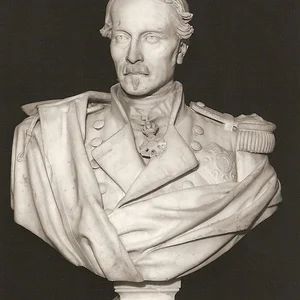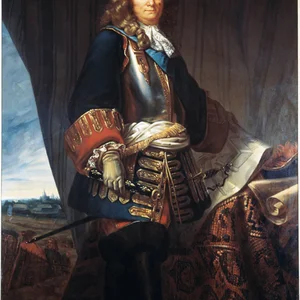

French military engineer and architect during the reign of Louis XIV, regarded as the greatest fortification specialist of his time. A Marshal of France, he designed a defensive system protecting the kingdom's borders and revolutionized the art of the siege.
Vauban(1633 — 1707)
Sébastien Le Prestre de Vauban
Royaume de France
6 min read
Frequently asked questions
Famous Quotes
« A town defended by Vauban is an impregnable town; a town besieged by Vauban is a town taken.»
Key Facts
- Born in 1633 in Saint-Léger-de-Foucheret (the Morvan region) and died in 1707 in Paris
- Fortified or improved around 300 strongholds and directed some fifty sieges in the service of Louis XIV
- Designed the “pré carré,” a double line of strongholds protecting the kingdom's northern border
- Appointed Marshal of France in 1703, the high point of his career
- Wrote the “Projet d'une dîme royale” (Plan for a Royal Tithe) in 1707, a tax reform plan that earned him royal disgrace
Works & Achievements
A fortress overlooking the loop of the Doubs river, regarded as one of Vauban's finest works and listed as a UNESCO World Heritage Site.
An ideal star-shaped fortified town, Vauban's last great creation and the consummate synthesis of his defensive system.
The citadel of Lille, nicknamed “the queen of citadels,” protecting the kingdom's new northern border.
A double line of strongholds designed to protect the kingdom's northern border, conceived as a single coherent whole.
A theoretical work setting out his scientific method of siege warfare, which remained authoritative throughout Europe for a century.
An essay on fiscal reform proposing a single, equitable tax paid by everyone; condemned by the royal authorities.
Mountain fortifications protecting the Alpine frontier, prime examples of adaptation to steep terrain.
The widespread adoption within the French army of a weapon that lastingly modernized the infantry.
Anecdotes
Vauban took part in about fifty sieges and personally directed around twenty without losing a single one. His reputation was such that a saying went: "A town besieged by Vauban is a town taken; a town defended by Vauban is a town impregnable."
To reduce the number of soldiers killed during assaults, Vauban perfected the technique of zigzag trenches (the "parallels") that allowed troops to approach the ramparts sheltered from enemy fire. He is said to have preferred to "burn much powder and shed little blood."
In 1707, an old and sick man, Vauban published a book without royal permission, the *Projet d'une dîme royale* ("Project for a Royal Tithe"), in which he proposed a fairer tax to be paid by everyone, including the nobility. The work was seized and condemned, and Louis XIV withdrew his favour from him shortly before his death.
Vauban was also a great inventor of attack techniques: he is credited with developing ricochet fire, in which the cannonball bounces along the ramparts to sweep away the defenders, used for the first time at the siege of Philippsburg in 1688.
In 1808, by order of Napoleon, his heart was placed at Les Invalides in Paris, while his body rests at Bazoches in Burgundy. It is an exceptional tribute paid to the most famous military engineer in France.
Primary Sources
It is certain that the greatness of kings is measured by the number of their subjects: this is what constitutes their wealth, their happiness, their riches, their strength.
The art of attacking fortresses consists in making oneself master of a stronghold as swiftly and with as little loss as possible.
One can never be too sparing of the blood of soldiers: it is through ingenuity and labour that men must be saved.
Sire, I would rather be reproached for having been too slow, provided that I preserve my soldiers, than for having been too hasty and having had them killed needlessly.
Key Places
Vauban's native village in the Morvan, then called Saint-Léger-de-Foucheret. He spent his childhood there in a family of modest minor nobility.
A fortress built by Vauban on a rocky spur overlooking the Doubs, a masterpiece of his art. Today it is listed as a UNESCO World Heritage Site.
A new fortified town shaped like an eight-pointed star, designed by Vauban late in his life. It is the perfect culmination of his theory of fortifications.
Capital of the kingdom where Vauban died in 1707. His heart was transferred to Les Invalides in 1808 on Napoleon's orders.
A residence that Vauban acquired and refurbished to serve as his study and home. His body still rests there today.
A mountain stronghold fortified by Vauban to defend the Alpine frontier against the Duchy of Savoy. It is one of the highest fortified towns in Europe.
Typical Objects

Wood and cardboard model reproducing a fortified town and its terrain to scale. These models helped the king and engineers prepare attacks and defenses.

Drawing and measuring instruments used to draft fortification plans. They made it possible to calculate the angles of bastions and lines of fire.

An arrow-shaped fortification work allowing defenders to cover one another with crossfire. It is the key element of the “Vauban system”.

A blade that fitted around the musket barrel without blocking the muzzle, whose adoption Vauban promoted in the French army. It turned the musketeer into an infantryman capable of fighting hand to hand.

A blue baton strewn with fleurs-de-lis presented to marshals, a dignity Vauban received in 1703. It symbolized the highest military rank in the kingdom.

Earth-moving tools used by soldiers to dig the zigzagging approach trenches. For Vauban, the spade was worth more than a deadly assault.
School Curriculum
Vocabulary & Tags
Key Vocabulary
Daily Life
Morning
On a fortification site or during a siege, Vauban would rise early to inspect the works and lay out the plans on the ground. He spent long hours on horseback, notebook in hand, measuring distances and surveying the terrain.
Afternoon
The afternoon was devoted to directing the diggers, correcting the layout of the bastions, and dictating his reports to the engineers. During sieges, he monitored the progress of the approach trenches.
Evening
In the evening, he tirelessly wrote memoranda, letters, and observations intended for the king and the minister Louvois. A curious mind, he also jotted down his reflections on agriculture, the economy, and the population.
Food
On campaign, Vauban shared the everyday fare of the officers: ration bread, salted meat, soup, and wine cut with water. In his homes in Burgundy, the table was more varied, based on local produce.
Clothing
As an officer and later a marshal, he wore the military dress of his time: a cloth justaucorps, leather boots, a plumed hat, and a sword at his side. In full regalia, he displayed the insignia of his rank.
Housing
Vauban spent little time at home: he passed most of his life on the roads, lodged in camps, inns, or requisitioned houses. His true residence was the **Château de Bazoches**, in Burgundy.
Historical Timeline
Period Vocabulary
Liens externes & ressources
Références
Œuvres
Citadelle de Besançon
à partir de 1668
Place forte de Neuf-Brisach
1698-1703
Fortifications de Lille
années 1668-1670
Le « pré carré »
à partir de 1678
Traité de l'attaque et de la défense des places
vers 1704
Projet d'une dîme royale
1707
Fortifications de Briançon et Mont-Dauphin
années 1690-1700