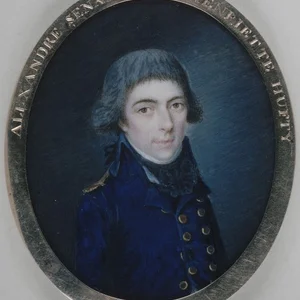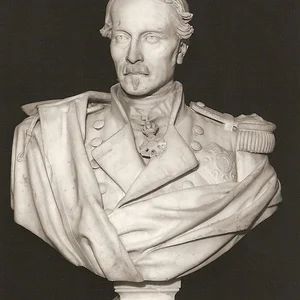

French general of the Corps of Engineers (1796–1855), director of the École polytechnique. He distinguished himself during the capture of Constantine (1837) and died at the Siege of Sevastopol during the Crimean War.
Michel Bizot(1795 — 1855)
Michel Bizot
France
9 min read
Frequently asked questions
Key Facts
- Born in 1796 in Brest, into a military family
- Took part in the capture of Constantine in 1837 during the conquest of Algeria
- Appointed director of the École polytechnique in 1850
- Mortally wounded at the Siege of Sevastopol on 11 July 1855
- A Paris Métro station (line 8) bears his name
Works & Achievements
A technical report detailing the layout of the parallels, the positioning of batteries, and the mining works that enabled the breach to be opened during the taking of Constantine. This document became a reference for subsequent siege operations in North Africa.
Bizot delivered lectures and practical instruction on the principles of bastion fortification, grounded in the legacy of Vauban and adapted to the new realities of ballistics. His courses trained several generations of French military engineers during the Second Empire.
As director, Bizot undertook a modernization of the curricula by strengthening applied mathematics, materials resistance, and chemistry in the service of military arts. This reform helped adapt Polytechnique to the technical and industrial challenges of the 19th century.
Operational documents drafted by Bizot to methodically organize the works before Sebastopol, establishing the order in which trenches were to be dug and the coordination between French and Allied engineering units.
Observations drawn from the Algerian campaigns, compiling lessons learned from sieges in mountainous terrain and against unconventional urban defenses. These notes informed French military engineering doctrine for the decades that followed.
Anecdotes
During the siege of Constantine in October 1837, Bizot, then a colonel in the engineering corps, was one of the architects of the final breach in the city's ramparts. Faced with fierce resistance from Algerian defenders, he personally directed the approach works under enemy fire, exposing himself relentlessly to galvanize his troops. His courage during the assault earned him a citation in army dispatches and cemented his reputation as a soldier-engineer.
As director of the École polytechnique in the 1840s, Bizot imposed a scientific and military rigor that left a lasting mark on his students. He insisted that future engineering officers not be content with knowing how to calculate, but also know how to wield a shovel and pickaxe when the need arose. Several of the generals who fought in the 1870 war would remember the exacting standards of their former director.
During the Crimean War, Bizot commanded the French army's engineering forces at Sebastopol. He was known for personally inspecting the trenches at night, despite fire from Russian snipers that made such reconnaissance particularly perilous. On April 22, 1855, a bullet struck him fatally during one of these nocturnal sorties; he died the following day, leaving his troops in dismay.
Bizot had absolute faith in the siege methods inherited from Vauban, the great engineer of the 17th century. He believed that patience and method were worth more than frontal assaults costly in human lives. At Sebastopol, Russian resistance and the extreme winter conditions sorely tested these convictions, and he died without seeing the fall of the city whose path to defeat he had nonetheless laid out.
Although a high-ranking general, Bizot did not disdain kneeling in the mud of the trenches to check the alignment of a sap or the installation of a mine gallery. This closeness with the sappers earned him exceptional loyalty from the troops, who saw in him a commander who shared their risks. This reputation outlived him and long nourished the memory of the engineering corps.
Primary Sources
The sapping and mining works were carried out steadily despite frequent enemy sorties; the practicable breach was opened on 13 October 1837 after several days of intensive bombardment, enabling the decisive infantry assault.
General Bizot was struck down on 22 April 1855 in the left approach trench, while inspecting the works under enemy fire. He died the following day, leaving in the army the memory of a commander as learned as he was fearless.
The parallels are advancing steadily toward the Russian works; losses among engineering officers remain significant owing to the necessity of conducting night reconnaissance to correct the attack plans.
General Bizot, director, continued the reform of the entrance examinations by strengthening the tests in mathematics and fortification drawing, in line with the current needs of the engineering corps.
The students of the class were assigned to the engineering and artillery corps according to their rankings; sieur Bizot, ranked among the top students, chose the engineers in keeping with his aptitude for fortification work.
Key Places
Bizot studied there and later became its director, training several generations of military and civil engineers. He led a major pedagogical reform that strengthened applied mathematics and fortification within the curriculum.
During the siege of October 1837, Bizot directed the engineering works that opened a breach in the walls of this city perched atop a rocky promontory. His conduct during the assault earned him national renown and accelerated his career.
It was before this great Russian naval base that Bizot commanded the French engineering corps during the long siege of 1854–1855. He was mortally wounded there on 23 April 1855 while inspecting the forward trenches.
The birthplace of Michel Bizot, Valenciennes was a historic fortress town in northern France whose strong military tradition left a deep mark on the future general of engineers. The region was at the time a well-known nursery of military officers and engineers.
The capital of the French conquest in North Africa, Algiers served as the rear base for the operations in which Bizot took part during the 1830s and 1840s. The military engineering corps played a central role there in building colonial infrastructure.
Typical Objects

An indispensable instrument for drawing fortification and attack plans, the compass allowed Bizot to calculate distances and angles on siege maps. He used it daily at the École Polytechnique to teach descriptive geometry applied to military engineering.

Before each operation, Bizot relied on precise maps to plan the layout of trenches and artillery batteries. At Sebastopol, the night reconnaissance missions he carried out served precisely to correct and supplement these cartographic surveys as close as possible to enemy lines.

The dark blue coat with black facings, distinctive of the French engineer corps, was what Bizot wore during ceremonies and inspections. The gold buttons struck with a grenade symbolized membership in the technical and scientific elite of the imperial army.

Symbols of the engineer corps, the shovel and pickaxe were the tools of the sappers Bizot commanded. At Constantine as at Sebastopol, it was these rudimentary instruments, wielded methodically and under fire, that dug the trenches allowing French forces to approach enemy defenses.

Indispensable for observing enemy defenses from French lines without unnecessary exposure, the spyglass accompanied every engineer officer in the field. It was during a reconnaissance with his spyglass in the forward trenches that Bizot was mortally wounded before Sebastopol.

Engineer officers of Bizot's generation were steeped in the writings of Vauban and Lazare Carnot on fortification and siege warfare. These theoretical works formed the foundation of their training at the École Polytechnique and guided their tactical decisions in the field.
School Curriculum
Vocabulary & Tags
Key Vocabulary
Daily Life
Morning
Rising early in keeping with military tradition, Bizot began his day by reviewing reports and dispatches. At the École Polytechnique, he inspected the study halls and conferred with tutors before classes began. In the field during a siege, he set out on reconnaissance at dawn, before daylight too clearly exposed troop movements to enemy sentries.
Afternoon
Afternoons were devoted to staff meetings, signing orders, and studying plans spread across large tables covered with topographic maps. At Polytechnique, he occasionally presided over practical sessions in fortification, personally correcting students' technical drawings. On campaign, the afternoon was the time to draft progress reports for the high command.
Evening
In the evening, Bizot dined simply with his staff officers, as was the military custom of the time. Meals were an occasion for technical discussion about the day's difficulties and the decisions to be made the following day. He would sometimes return to work late into the night, rereading technical memoirs or preparing instructions for the engineering corps' operations.
Food
Like any officer of his rank, Bizot ate reasonably well but plainly, in keeping with the austere tradition valued in the engineering corps. On campaign — particularly in Algeria and Crimea — food was reduced to whatever rations were available: hard bread, salt meat, and legumes, supplemented by local resources when the situation allowed. The Crimean winters, exceptionally harsh, imposed severe privations on the entire army.
Clothing
On duty, Bizot wore the regulation uniform of the engineering corps: a dark blue coat with black facings, epaulettes embroidered according to his rank of general, and a bicorne hat or képi depending on the occasion. In the field during sieges, he preferred more practical attire — a frock coat and senior officer's képi — to inspect the trenches without hampering his movements or drawing unnecessary enemy attention.
Housing
In Paris, as director of the École Polytechnique, Bizot had an official residence within the institution's buildings on the Rue Descartes. On campaign, he occupied a staff tent or a requisitioned billet, furnished at minimum with a work table and a camp cot, set up in the immediate vicinity of the engineering corps' command post.
Historical Timeline
Period Vocabulary
Liens externes & ressources
Références
Œuvres
Cours de fortification permanente (enseignement à l'École polytechnique)
1845-1850
Réforme des programmes de l'École polytechnique
1845-1848
Notes et mémoires sur la guerre de siège en terrain difficile (Algérie)
1838-1840