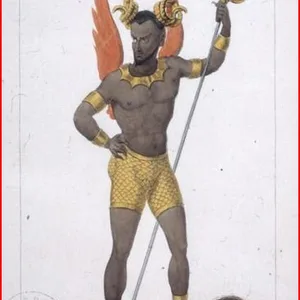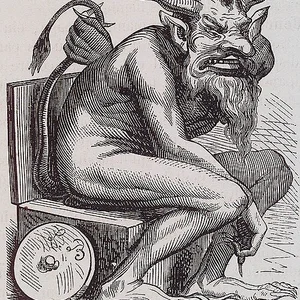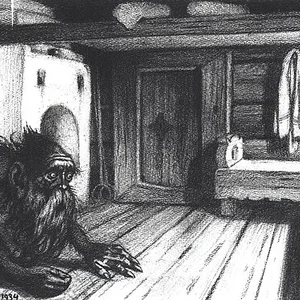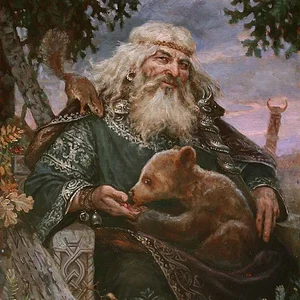

Veles is one of the major deities of the Slavic pantheon, ruler of the underworld, protector of cattle, and god of magic. He stands in eternal opposition to Perun, the god of thunder, in a cosmic battle symbolizing the duality between darkness and light. His cult, widespread among Slavic peoples, survived in syncretic form after the Christianization of the 9th–12th centuries.
Veles
Veles
9 min read
Frequently asked questions
Key Facts
- Mentioned in the Primary Chronicle (12th century) as a cattle god venerated in Kyiv
- Cosmic adversary of Perun: their eternal conflict (serpent/earth vs. thunder/sky) structures Slavic cosmology
- Associated with underground wealth, the souls of the dead, and divination
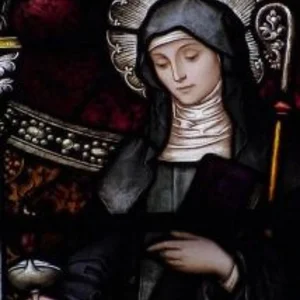
- His cult merged with that of Saint Blaise (Blasius) in Slavic Orthodox Christianity
- A central figure in the reconstruction of Proto-Slavic mythology by Slavicists of the 19th–20th centuries
Works & Achievements
Vélès steals Perun's cattle or wife, who pursues him with his thunderbolts. Vélès transforms into an animal to escape, is defeated, but is reborn to begin again. This cosmic cycle explains, in Slavic mythology, storms, the renewal of seasons, and the tension between order and chaos.
Vélès reigns over Nav, the Slavic underworld, and guides the souls of the deceased from the world of the living to their eternal dwelling. In Slavic funerary rites, he was invoked to ensure the safe passage of the dead and to watch over the ancestors.
The Tale of Igor's Campaign refers to the bard Boyan as the "grandson of Vélès", establishing Vélès as the mythical ancestor of all Slavic poets and storytellers. As the god of hidden wisdom and magic, he inspired the singers who carried collective memory from generation to generation.
Each year, Slavic peasants sacrificed animals and offered first fruits to Vélès to protect their herds from disease and predators. These rites survived into the Middle Ages in the disguised form of the cult of Saint Blaise.
The volkhvy (Slavic priest-shamans) invoked Vélès for their magical practices: divination through runes and spells, healing the sick, protection against evil spirits. He was the source of the supernatural power held by medicine men in pre-Christian Slavic societies.
Anecdotes
In the diplomatic treaties of 907 and 945 between Kievan Rus and the Byzantine Empire, Slavic warriors swore oaths invoking two gods: Perun, master of thunder, and Vélès, guardian of cattle and the underworld. This official dual invocation, recorded in the Primary Chronicle, shows that Vélès was recognized as a tutelary deity of the first importance, guarantor of one's given word and the prosperity of trade.
When Prince Vladimir I of Kiev established an official pantheon on the city's sacred hill in 980, he erected statues of six gods — but Vélès was deliberately excluded. His idol was placed below, in the merchants' quarter, near the river. Some scholars see in this a reflection of a mythic principle: Vélès, god of the depths and the underworld, could not reside on the heights, the exclusive domain of his adversary Perun.
In the famous 12th-century epic poem The Tale of Igor's Campaign, the bard Boyan is called “grandson of Vélès.” This phrase reveals that Vélès was also the patron of poets, storytellers, and musicians — a god of hidden wisdom and the arts as much as of the underworld. It testifies to the richness and complexity of this deity, far beyond his role as protector of cattle alone.
After the Christianization of Kievan Rus in 988, the clergy sought to eradicate the cult of Vélès. But Slavic peasants quietly continued to honor their protector of livestock by substituting Saint Blaise (Sveti Vlasiy), whose feast day on February 11 was associated with the protection of herds. This phenomenon of syncretism illustrates how pre-Christian beliefs survived for centuries beneath a Christian veneer.
During the destruction of idols ordered by Vladimir I, Bishop Joachim of Novgorod reportedly had the statue of Vélès thrown into the Volkhov River — a powerful symbolic act that inverted the natural order: by sending the god of waters and the depths into the river, it was hoped he would be neutralized once and for all. The Volkhov River itself was considered a passageway between the world of the living and the world of the dead.
Primary Sources
The Rus swore by their weapons and by Perun, their god, and by Veles, god of cattle, and thus confirmed the peace.
And if any of the Rus violates this agreement, let him and those around him be cursed by the god in whom they believe, by Perun and by Veles, god of cattle.
Boyan, the wise enchanter, grandson of Veles, when he wished to compose a song in someone's honor, would let his thoughts soar through the tree, like a grey wolf across the land, like an eagle beneath the clouds.
Bishop Joachim ordered the idols of the Slavic gods to be torn down, some smashed and others cast into the river; many people were grieved by this and wept.
Key Places
It was in the merchant quarter of Kyiv, at the foot of the hill housing the official Pantheon, that the main idol of Veles stood. In 988, during the forced Christianization, the statue was destroyed on the orders of Vladimir I, marking the official end of his cult in the capital.
Novgorod was one of the great centers of the Veles cult in medieval Russia. In 989–990, Bishop Joachim had the god's statue thrown into the Volkhov River — a powerful symbolic act meant to drown the old religion once and for all.
Nav is the realm of the dead in Slavic cosmology, the absolute domain of Veles. Located at the roots of the World Tree (*Drevo mira*), it stands in opposition to Prav (the divine world) and Yav (the world of the living). It is a mythical space with no real geographical location.
In Slavic cosmology, Veles dwells at the roots of the cosmic Tree, while Perun reigns at its crown. This vertical opposition symbolizes the eternal conflict between the two deities — between sky and underworld, light and shadow, order and magic.
Rostov was one of the last strongholds of the Veles cult in medieval Russia. Chronicles record that its inhabitants long resisted Christianization and continued to venerate the old Slavic gods, including Veles, well after 988.
Typical Objects

Veles is frequently depicted as a great serpent or dragon coiling around the roots of the World Tree. This reptilian symbol embodies his connection to the chthonic depths, the underworld, and the primordial waters.

The gusli, a plucked string instrument characteristic of medieval Slavic music, is the attribute of Veles as patron of bards and poets. In mythic accounts, its melodies enchant the souls of the dead and open the gates of Nav.

As the god of subterranean wealth — gold, silver, and treasures hidden within the earth — Veles is associated with an overflowing cornucopia. Slavic merchants invoked him for the prosperity of their trade and the fertility of their herds.

The bear is one of Veles's sacred animals in Slavic folklore. Bear pelts were left at his shrines as offerings, and warriors would don the furs of wild beasts during rituals invoking his power.

The *volkhvy* (Slavic priest-shamans) who officiated in Veles's name carried a wooden staff carved from a lightning-struck tree, a symbol of his magical power and mastery over invisible forces.

Veles is the guardian of the gates of Nav and the ferryman of the souls of the dead. The keys are his attribute as benevolent jailer of the realm of the dead, reflecting his role as psychopomp — the one who guides souls to the afterlife.
School Curriculum
Vocabulary & Tags
Key Vocabulary
Tags
Daily Life
Morning
In Slavic cosmology, Veles begins his day in the depths of Nav, watching over the souls of the dead entrusted to him. At sunrise — the moment of transition between night and day — his priests (volkhvy) performed invocation rites around his idols to secure his protection over the herds heading out to pasture. It was also the hour of omens and divination, disciplines placed under his patronage.
Afternoon
In broad daylight, Veles is active in his mythic rivalry with Perun: the myths often place episodes of their cosmic battle — the theft of cattle, animal transformations, chases — under the harsh light of the sun, over which Perun holds sway. The volkhvy received consultations from peasants and merchants, practiced oracles, and performed sacrifices to seek Veles's favor in matters of trade and the fertility of the land.
Evening
At dusk, Veles is at the height of his power: it is the threshold hour between the world of the living (Yav) and the world of the dead (Nav). Funeral rites were held at nightfall, under his protection, to ensure safe passage for the departed. Bards (pevtsy) would then sing heroic tales and secrets of the afterlife, guided by the inspiration of the poet-god.
Food
As a deity, Veles “fed” symbolically on the offerings brought to him by the Slavs: sacrificed animals (oxen, sheep), grain, and fermented drinks such as kvas and mead (fermented honey). These offerings were burned or buried to reach his underground domain. During the great festivals held in his honor, communities organized collective feasts shared between the living and the memory of the dead.
Clothing
In Slavic iconography and folklore, Veles appears as a long-bearded old man dressed in a dark cloak or animal hide — bear or serpent. He sometimes carries a cornucopia symbolizing the riches of the underworld. In his many animal forms, he takes the shape of a great serpent, a black bull, or a bear — always creatures bound to the earth and its depths.
Housing
Veles resides in Nav, the Slavic underworld, at the roots of the World Tree (Drevo mira). His domain lies beneath the earth and beneath the waters, in an inverted space where the rules of the world of the living are overturned. His earthly sanctuaries were always built in low-lying places — valley floors, riverbanks, the foot of hills — the exact opposite of the high places sacred to Perun.
Historical Timeline
Period Vocabulary
Liens externes & ressources
Références
Œuvres
Le combat cosmique éternel contre Perun
Mythe fondateur, traditions slaves, Ve-XIIe siècle
Gouvernement du royaume des morts (Nav)
Tradition slave préhistorique
Patronat de la poésie et des bardes
Attesté dans le Dit de la campagne d'Igor, vers 1185-1187
Protection du bétail et des troupeaux
Culte attesté, IXe-Xe siècle, continuité jusqu'au XIIe siècle
Magie, divination et arts chamaniques
Tradition des volkhvy slaves, Ve-XIIe siècle