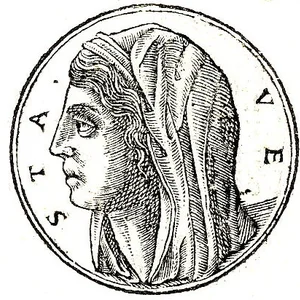

Roman goddess of the hearth, sacred fire, and family. Her cult, one of the oldest in Rome, was maintained by the Vestal Virgins — priestesses bound to chastity who were charged with tending the eternal flame in the Temple of Vesta in the Forum.
Vesta
Vesta
9 min read
Frequently asked questions
Key Facts
- Vesta is the Roman equivalent of Hestia, the Greek goddess of the hearth
- Her temple in the Forum Romanum housed an eternal flame, a symbol of Rome's enduring existence
- The Vestal Virgins, six in number, were chosen between the ages of 6 and 10 and served for 30 years
- The accidental extinction of the sacred flame was considered an ill omen for Rome
- The Lupercalia and the Vestalia (June 7–15) were Roman festivals associated with her cult
Works & Achievements
A foundation legendarily attributed to King Numa Pompilius, establishing a college of six priestesses entirely devoted to the cult of Vesta. This institution lasted more than a thousand years without major interruption, becoming one of the most respected in Rome.
An annual festival in honor of Vesta, during which the temple was opened to married women walking barefoot, and bakers adorned their donkeys with garlands. It was one of the rare occasions when the inner sanctuary was accessible to non-initiates.
The Vestals kept the Palladium in the depths of the temple — a talisman believed to have protected Rome since it was brought from Troy. The loss of this sacred object was thought to inevitably bring about the fall of the city.
A short Greek poem describing Hestia-Vesta as the first to receive libations from mortals and the last to be offered prayers. This text is one of the few direct testimonies to her place at the top of the pantheon.
Following the fire of 191, the rebuilding of the Temple of Vesta gave it its final form. The ruins still visible in the Forum correspond to this last phase of the sanctuary, with its twenty Corinthian columns.
The Vestals held custody of the wills of prominent Roman figures, including those of Julius Caesar and Augustus. This administrative role underscores the exceptional moral authority granted to the priestesses of Vesta.
Anecdotes
The sacred flame of Vesta's temple, at the heart of the Roman Forum, could never be allowed to go out, for its extinction would bring ruin upon Rome. If a Vestal Virgin let the fire die through negligence, she was subjected to corporal punishment administered by the Pontifex Maximus. The flame was then rekindled not with ordinary embers, but by concentrating the sun's rays onto dry wood, emphasizing the pure and divine nature of the fire.
The priestesses of Vesta, the Vestal Virgins, enjoyed extraordinary privileges in Roman society. They could travel alone through the city in a litter, had reserved seats at the circus games, and could pardon a condemned man they happened to encounter on his way to execution. In return, they committed to thirty years of service and an absolute vow of chastity.
According to the tradition recorded by Ovid in his *Fasti*, Vesta nearly fell victim to an assault by the god Priapus during a divine feast. She was saved by the braying of a donkey, which woke the entire gathering. This is why, during the Vestalia festival, donkeys adorned with flower garlands were exempted from work and honored in memory of that night.
In 390 BC, when the Gauls under Brennus invaded and burned Rome, the Vestal Virgins fled the city carrying the temple's sacred objects, including the Palladium, a protective statue believed to guard Rome. According to Livy, a pontiff named Lucius Albinus made his family get off his cart so he could load the priestesses and their sacred relics onto it — so great was their importance in the eyes of the Romans.
The cult of Vesta was one of the last to disappear during the Christianization of the Empire. In 382 AD, Emperor Gratian stripped the Vestal Virgins of their financial privileges and had the Altar of Victory removed from the Senate. In 391, Theodosius I permanently closed the temple and extinguished the eternal flame, bringing an end to a cult that had lasted approximately eleven centuries.
Primary Sources
Vesta is the same as the Earth: beneath both burns an inextinguishable fire; the Earth and the Hearth both represent the fixed center of all things.
The Romans wished Vesta — whose name derives from the Greek Hestia — to preside over the hearth and the household altars; her priestesses, the Vestals, guard the sacred fire so that the eternal flame may symbolize the permanence of the State.
Numa established the order of the Vestal Virgins and regulated the honors and keeping of the inextinguishable fire, entrusting these priestesses with the preservation of a pure flame — an emblem of the divine power that engenders all things without itself being consumed.
Numa Pompilius appointed six priestesses to tend the sacred fire, requiring of them absolute chastity for thirty years: the first ten to learn, the next ten to perform their duties, and the final ten to teach those who would succeed them.
The pontiffs and the Vestals deliberated: should they stay and guard the sacred objects, or carry them away? They resolved to flee and entrust to the gods what they could not defend, bearing the holiest things along the Tiber.
Key Places
Small circular temple at the heart of the Roman Forum, housing the eternal flame and Rome's sacred objects. Its fluted columns, partially reconstructed, are still visible today.
Large residence adjacent to the temple where the six Vestal Virgins lived, featuring interior gardens, baths, and a pool. Nineteenth-century excavations uncovered numerous statues of the chief priestesses.
Legendary Latin city where the cult of the sacred fire is said to have existed before Rome, later brought to the new city by its founders. Vesta was venerated there from the oldest Latin traditions.
Mythological home of the Greek and Roman gods, where Vesta-Hestia held the central hearth. According to some traditions, she gave up her place among the twelve Olympians to Dionysus in order to remain guardian of the fire — a choice symbolizing her peaceful and essential nature.
The emperor Hadrian had a round temple built here, directly inspired by that of Vesta, reflecting the enduring prestige of her cult in the 2nd century AD.
Typical Objects

Sacred fire burning perpetually in the temple of Vesta, symbol of life and the eternal continuity of Rome. The Vestal Virgins' primary duty was to guard it day and night, feeding it with carefully selected wood.

A small ritual ladle used by the Vestals to draw wine or water for libations during ceremonies. This implement frequently appeared on Roman coins as a symbol of the cult of Vesta.

An ancient statue of Pallas Athena, legendarily brought from Troy by Aeneas and kept secretly in the temple of Vesta. It was believed that possession of this talisman guaranteed Rome's divine protection.

A sacred cake made from spelt flour and sea salt, prepared exclusively by the Vestals three times a year. This ritual offering was sprinkled over the heads of sacrificial animals during major state ceremonies.

White woolen ribbons worn by the Vestals around their heads and used to decorate vases, altars, and sacrificial animals. Touching a Vestal's vittae without permission was considered a sacrilege punishable by death.

An open circular altar at the center of the temple of Vesta, on which the sacred flame burned. Its round shape evoked the primitive hearth of Roman homes, of which Vesta was the tutelary deity.

The white liturgical garments of the Vestals — the palla being a long robe, the infula a woolen headband. These immaculate robes symbolized the purity and total consecration of the priestess to the goddess.
School Curriculum
Vocabulary & Tags
Key Vocabulary
Daily Life
Morning
Before dawn, the Vestals took turns keeping watch over the sacred flame to ensure it had not weakened during the night. Each morning they drew fresh running water (aqua viva) from a sacred spring — never from the aqueduct — for the temple's purification rites. The day began with prayers and libations to Vesta, poured onto the hearth in a simpulum.
Afternoon
The Vestals prepared the mola salsa, a sacred mixture of spelt flour and sea salt that they harvested themselves, required for all official sacrifices in Rome. They took part in major public ceremonies and the festivals of the religious calendar, seated in the places of honor reserved for their rank. The afternoon was also devoted to managing the Atrium Vestae, a residential complex of more than fifty rooms.
Evening
In the evening, the Vestals checked the flame one last time and recited the protective formulas for Rome before retiring to their apartments. They enjoyed an exceptional standard of living for women of Antiquity: dinners offered by magistrates, attendance at official banquets, and the right to manage their own personal property. A priestess on duty remained awake throughout the night to watch over the sacred hearth.
Food
The Vestals received food rations provided by the Roman state, including grain, legumes, olive oil, fish, and meat on feast days. They were invited to the official banquets of magistrates and the emperor, where their presence was considered a sign of good omen. Their diet excluded certain foods deemed impure on ceremony days.
Clothing
The Vestals wore a long white robe (the stola), a draped palla over it, and the infula, a band of white wool encircling the head and shoulders. Their hair was braided into six tight plaits (the sex crines), an archaic hairstyle recalling Rome's most ancient rites. During ceremonies, they added a white veil, a symbol of absolute purity.
Housing
The Vestals resided in the Atrium Vestae, a vast peristyle house adjoining the temple on the Forum Romanum, with gardens, baths, and sumptuous rooms decorated with marble. Each Vestal had comfortable personal apartments, reflecting the great prestige of their office. The complex also included storage spaces for state archives and wills that Romans entrusted to their keeping.
Historical Timeline
Period Vocabulary
Liens externes & ressources
Références
Œuvres
Institution du collège des Vestales
v. 715 av. J.-C.
Les Vestalia
Chaque année, 7-15 juin
Garde du Palladium
Du VIIIe s. av. J.-C. à 391 apr. J.-C.
Hymne homérique à Hestia
v. VIe s. av. J.-C.
Temple reconstruit sous Septime Sévère
191 apr. J.-C.
Conservation des testaments et archives d'État
Du IIIe s. av. J.-C. à 391 apr. J.-C.