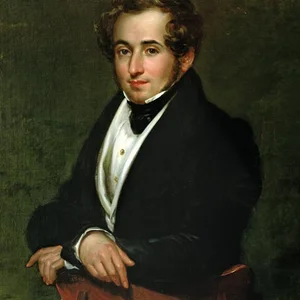

Vincenzo Bellini was an Italian opera composer of the Romantic period, a major figure of bel canto alongside Rossini and Donizetti. His brief but brilliant career established him as a master of the long, expressive melody, before his untimely death at 33.
Vincenzo Bellini(1801 — 1835)
Vincenzo Bellini
Kingdom of Sicily
6 min read
Frequently asked questions
Key Facts
- Born on 3 November 1801 in Catania, Sicily, into a family of musicians
- Created his opera Norma in 1831 at La Scala in Milan, containing the famous aria “Casta diva”
- Composed La Sonnambula in 1831, another pinnacle of bel canto
- Completed I Puritani in 1835 in Paris, his last opera
- Died prematurely on 23 September 1835 in Puteaux, near Paris, at the age of 33
Works & Achievements
Opera premiered at La Scala that revealed Bellini's talent and launched him onto the international stage.
Opera inspired by the story of Romeo and Juliet, premiered in Venice, showcasing his mastery of tragic melody.
A semi-serious opera of great melodic sweetness, one of the most beloved in the bel canto repertoire.
Bellini's masterpiece, containing the famous aria "Casta diva"; a pinnacle of romantic bel canto.
A tragic opera premiered in Venice, marking the end of his collaboration with the librettist Felice Romani.
Bellini's last opera, premiered in Paris shortly before his death, hailed as a triumph of Italian melody.
Anecdotes
Bellini was born in Catania, Sicily, into a family of musicians: his grandfather and father were both organists and chapel masters. Local legend, later encouraged, claims he sang tunes before he could even speak — beyond the myth, he composed his first religious pieces as a teenager.
In 1830, the great composer Gioachino Rossini, who reigned over opera in Paris, took Bellini under his wing and encouraged him. This kindness from such a famous rival helped the young Sicilian make his mark in the French capital during his final years.
For his masterpiece 'Norma' (1831), Bellini composed the famous aria 'Casta diva'. The soprano who created the role, Giuditta Pasta, at first found the aria too difficult and refused to sing it; Bellini persuaded her to try it for a week, and it became one of the most admired arias in all of opera.
Bellini died at only 33, in September 1835, in a house near Paris, from the effects of an intestinal illness (probably an acute dysentery with abscesses). His untimely death shook musical Europe; Rossini and others organized his funeral, and his body was much later repatriated to his native Catania in 1876.
Bellini's melodic writing, made of long, winding and expressive vocal lines, fascinated composers far beyond the world of opera: Frédéric Chopin admired his melodies, and the influence of Bellinian bel canto can be heard in the singing sweetness of his nocturnes.
Primary Sources
If in a single opera I could succeed, through song, in expressing all the passions of the human heart, I would have reached my goal. Above all, music must make one weep, shudder, and die through song.
Casta diva, che inargenti queste sacre antiche piante… (Chaste goddess, who silver-plate these ancient sacred trees…)
I am working in Paris with a care I have never devoted to anything elsewhere, for here judgment is severe and I want to show what I am capable of.
Key Places
Bellini's birthplace, at the foot of Mount Etna. There he received his first musical training in a family of organists, and there he rests today in the cathedral.
Bellini studied at the San Sebastiano Conservatory there from 1819 and composed his first works in the city. Naples was then a great capital of Italian opera.
It was at La Scala that Bellini achieved his greatest triumphs, notably *Il pirata* (1827) and *Norma* (1831). Milan was the center of his Italian career.
Bellini settled here in 1833 and premiered *I puritani* in 1835. There he mixed with Rossini and the most brilliant musical circles in Europe.
Bellini died in a house in Puteaux in September 1835, at just 33 years old, from the effects of an intestinal illness.
Bellini stayed in London in 1833, where his operas were performed with success before he moved to Paris.