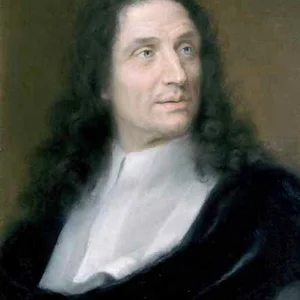

Vincenzo Viviani was an Italian mathematician and physicist, the last disciple and assistant of Galileo. He worked to preserve and publish his master's scientific legacy and contributed to geometry and the study of motion.
Vincenzo Viviani(1622 — 1703)
Vincenzo Viviani
grand-duché de Toscane
6 min read
Frequently asked questions
Key Facts
- Born in 1622 in Florence, died in 1703 in the same city
- In 1639, at age 17, became the assistant and last disciple of Galileo until the latter's death in 1642
- Founding member of the Accademia del Cimento in 1657, one of the first scientific societies
- In 1660, together with Giovanni Borelli, measured the speed of sound
- Edited Galileo's works and wrote the first biography of him
Works & Achievements
A scholarly reconstruction of a lost book of Greek geometry, which established Viviani's European reputation as a geometer.
The first biography of Galileo, a major source of our knowledge of the scientist's life, despite a few legendary embellishments.
The work of collecting and publishing the writings of his master, essential to preserving the Galilean legacy.
A geometric result stating that the sum of the distances from an interior point to the sides of an equilateral triangle is constant.
A curve arising from the intersection of a sphere and a cylinder, posed as a geometric challenge to the mathematicians of Europe.
Studies and projects on river regulation and flood prevention, putting mathematics at the service of the Medici state.
An experiment conducted with Borelli timing the delay between the flash and the sound of a cannon, yielding an estimate that was precise for its time.
Anecdotes
In 1639, at just 17 years old, the young Viviani was introduced to Galileo, by then old and blind, under house arrest at his villa in Arcetri. The master took him on as an assistant and secretary: Viviani read aloud to him and took down his dictation, thus becoming his very last disciple until Galileo's death in 1642.
All his life, Viviani proudly presented himself as “the last pupil of Galileo.” He devoted decades to gathering his master's writings and wrote the first biography of Galileo, helping to forge the legend of the great scholar in his struggle with the Church.
Viviani dreamed of raising a mausoleum worthy of Galileo in the Basilica of Santa Croce in Florence. During his lifetime the Church opposed it, as the scholar was still suspected of heresy. The tomb was not completed until 1737, long after the death of Viviani, who bequeathed part of his fortune to the project.
In 1660, together with his friend Giovanni Borelli, Viviani carried out a famous experiment to measure the speed of sound by timing the delay between the flash of a cannon and the sound of its detonation. Their measurements came remarkably close to the true value.
His fame was such that Louis XIV of France and King John II Casimir of Poland offered him prestigious posts at their courts. Viviani declined in order to remain in the service of the Grand Duke of Tuscany, Ferdinand II de' Medici, who appointed him court mathematician.
Primary Sources
Historical account written by Viviani recounting the life of his master, the first biography of Galileo, in which he records in particular his memories of their final exchanges at Arcetri.
Viviani's attempt to reconstruct the lost fifth book of the Conics of Apollonius of Perga, demonstrating his mastery of Greek geometry.
Edition annotated by Viviani of the fifth book of Euclid's Elements, devoted to the theory of proportions.
A treatise on applied hydraulics in which Viviani puts his mathematical skills at the service of regulating the rivers of Tuscany.
Key Places
Viviani's native city and capital of the Grand Duchy of Tuscany, a brilliant hub of the sciences under the patronage of the Medici.
The forced residence of the blind Galileo near Florence, where the young Viviani became his assistant and gathered his final teachings.
A scientific academy founded by the Medici in 1657 and devoted to experimentation, of which Viviani was an active member.
The Franciscan church where Viviani worked to have Galileo's monumental tomb erected, completed only in 1737.
Viviani's home, whose façade he had decorated with inscriptions glorifying Galileo, a true public monument to his master.
Typical Objects

A calculating instrument with graduated arms, perfected by Galileo, used to perform multiplications, divisions and the extraction of roots mechanically.

An optical tube fitted with lenses, inherited from Galileo's workshop, used to observe the heavenly bodies and to magnify distant objects.

A glass tube filled with mercury that measures atmospheric pressure, invented by Torricelli, the friend and colleague of Viviani.

Drawing tools indispensable for the classic geometric constructions, of which Viviani was a virtuoso in the tradition of Euclid and Apollonius.

Writing materials used to take down dictation from the blind Galileo and to compose Viviani's immense scholarly correspondence.

The master's notebooks and letters, which Viviani carefully preserved and gathered to save the Galilean scientific legacy from oblivion.

A time-measuring mechanism based on the isochronism of the pendulum studied by Galileo, whose research Viviani recorded.
School Curriculum
Vocabulary & Tags
Key Vocabulary
Daily Life
Morning
As mathematician to the Medici court, Viviani devoted his mornings to studying ancient geometric texts, from **Euclid** to **Apollonius**, and to writing out proofs. He also kept up a vast correspondence with the scholars of Europe.
Afternoon
Afternoons often took him to the practical affairs of the grand duchy: hydraulic surveys, advice on regulating the Tuscan rivers, or expert assessments of engineering works. He also took part in the meetings of the *Accademia del Cimento*.
Evening
In the evening, Viviani sorted and copied out the manuscripts of **Galileo**, taking care to save every page of his master's legacy. He welcomed visitors and disciples to discuss geometry by candlelight.
Food
Like the well-to-do Florentine bourgeoisie of the 17th century, he lived on bread, soups, vegetables, meats, and fish, accompanied by Tuscan wine. Olive oil and the fruits of the Chianti held pride of place at his table.
Clothing
A man of the court and a respected scholar, he wore plain but well-kept clothing: a dark doublet, a linen shirt with a collar, a coat, and a hat, in keeping with the Italian fashion of the *Grand Siècle*.
Housing
Viviani lived in Florence in a comfortable residence, the *Palazzo dei Cartelloni*, whose façade he had adorned with Latin inscriptions in honor of **Galileo**, turning his home into a public tribute to his master.
Historical Timeline
Period Vocabulary
Liens externes & ressources
Références
Œuvres
Restauration du cinquième livre des Coniques d'Apollonius (De maximis et minimis)
1659
Racconto istorico della vita di Galileo Galilei
1654
Édition des Œuvres de Galilée
1655-1656
Le théorème de Viviani
vers 1660
La courbe de Viviani (« fenêtre de Viviani »)
1692
Travaux d'hydraulique pour la Toscane
1660-1690
Mesure de la vitesse du son
1660