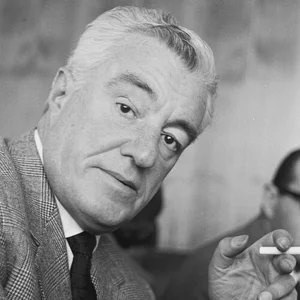

Vittorio De Sica (1901-1974) was an Italian director, screenwriter, and actor, a major figure of neorealism. His film *Bicycle Thieves* (1948) is regarded as a masterpiece of world cinema.
Vittorio De Sica(1901 — 1974)
Vittorio De Sica
Italie, France, royaume d'Italie
6 min read
Frequently asked questions
Key Facts
- Born on July 7, 1901, in Sora (Italy), died on November 13, 1974, in Neuilly-sur-Seine (France)
- Began as a stage and film actor in the 1920s and 1930s
- Directed *Shoeshine* (1946), awarded an honorary Oscar for best foreign film
- Directed *Bicycle Thieves* (1948), a manifesto of neorealism and an honorary Oscar in 1950
- Won several Oscars for Best Foreign Language Film, including *Yesterday, Today and Tomorrow* (1964) and *The Garden of the Finzi-Continis* (1971)
Works & Achievements
A heartbreaking tale of two shoeshine boys in post-war Rome. De Sica's first major neorealist success, honored with an Academy Honorary Award.
An absolute masterpiece of neorealism: a man searches Rome for the stolen bicycle his job depends on. Shot with non-professional actors.
A poetic, fantastical fable about the poor of a shantytown. Awarded the Grand Prix at the Cannes Film Festival.
A restrained, deeply moving portrait of a lonely old pensioner and his dog. A peak of neorealism, yet criticized by the political authorities.
A drama about a mother and her daughter during the war, which earned Sophia Loren the Academy Award for Best Actress — a first for a non-English-language role.
A comedy in three episodes starring Sophia Loren and Marcello Mastroianni, crowned with the Academy Award for Best Foreign Language Film.
A Neapolitan comedy-drama, once again carried by the Loren–Mastroianni duo, a major international success.
A drama about an Italian Jewish family confronting the Fascist racial laws. Golden Bear at Berlin and Academy Award for Best Foreign Language Film.
Anecdotes
For *Bicycle Thieves*, the powerful American producer David O. Selznick offered to finance the film on the condition that the star Cary Grant play the lead role. De Sica refused and chose Lamberto Maggiorani, a genuine factory worker with no acting experience, to portray Antonio Ricci. He wanted real faces, not stars.
The child Bruno, the little boy who follows his father across Rome, was played by Enzo Staiola, whom De Sica spotted by chance in the street while the boy was watching the shoot. His slightly heavy walk and attentive face instantly won over the director.
De Sica was an inveterate gambler, passionate about games of chance and often in debt. To pay off his debts and finance his auteur films, which were not very profitable at the box office, he agreed to act in many popular comedies.
When *Umberto D.* (1952) was released, depicting the distress of a destitute old pensioner, Under-Secretary of State Giulio Andreotti publicly accused De Sica of having done “a disservice to his homeland” by parading Italy's poverty. The filmmaker fully embraced his focus on the humble.
Before becoming the master of neorealism, De Sica was a major star of 1930s Italian cinema, a female idol of the “white telephone” films—those elegant, lighthearted comedies shot in luxurious settings, a world away from the poor streets he would later film.
Primary Sources
Bicycle Thieves is one of the first examples of pure cinema: no more actors, no more story, no more mise-en-scène — that is to say, in the perfect aesthetic illusion of reality, no more cinema.
If one fights evil by crudely exposing its harshest aspects, then De Sica has done a disservice to his homeland — a homeland that is also known for many things besides its miseries.
The deepest dream of neorealism is to recount ninety minutes in the life of a man to whom nothing happens.
Key Places
Small town in Lazio where Vittorio De Sica was born in 1901, into a modest family that would face financial hardship.
City where De Sica spent part of his youth and which shaped his sensibility; the working-class south of Italy would inspire many of his films, such as *Marriage Italian Style*.
The heart of De Sica's career and the setting of *Bicycle Thieves*, shot in its streets and working-class neighbourhoods in the postwar years.
The great film studios of Rome, founded in 1937. A symbol of Italian cinema, they existed alongside neorealism, which preferred to film outdoors, in the street.
Town in the Paris suburbs where Vittorio De Sica died in 1974, at the age of 73.
Typical Objects

A bicycle essential to the hero of Bicycle Thieves to keep his job as a bill-poster. Its theft sets the whole plot in motion and symbolizes the fragility of the poor in post-war Italy.

Neorealism took the camera out of the studios to film in the streets, among real crowds. De Sica shot in natural settings, as close as possible to everyday life.

In Bicycle Thieves, Antonio pastes up a poster for the American film Gilda starring Rita Hayworth just before his bicycle is stolen. The image of the Hollywood dream contrasts with the character's poverty.

An emblematic object of the 1930s Italian comedies known as “white telephone” films, in which De Sica was an elegant star. The white telephone, a sign of luxury, symbolized an escapist cinema cut off from reality.

A tool that marks the start of each take and synchronizes image and sound. The demanding De Sica sometimes did many takes to draw out the naturalness of his amateur actors.

De Sica received four awards from the American Academy, including two honorary Oscars for Shoeshine and Bicycle Thieves, at a time when the Best Foreign Film category did not yet officially exist.
School Curriculum
Vocabulary & Tags
Key Vocabulary
Daily Life
Morning
A tireless filmmaker-actor, De Sica often began his day by scouting the streets of Rome, searching for natural settings and authentic faces. He loved watching passersby, convinced that a real laborer could play hardship better than a star.
Afternoon
Afternoons were spent on set or on location, patiently directing actors who were often amateurs. De Sica would demonstrate the gestures himself, miming each scene and shooting take after take to achieve perfect naturalness.
Evening
In the evening, the elegant De Sica frequented fashionable salons, theaters and, above all, casinos. A passionate gambler, he lost sums there that drove him to take on one acting role after another to refill his accounts.
Food
Like many Italians of his time, he enjoyed Mediterranean cuisine, pasta and simple dishes from the south. But his social life also led him to the fine tables of Rome's restaurants and grand hotels.
Clothing
Renowned for his elegance, De Sica wore well-cut suits, carefully chosen ties and hats, retaining the bearing of the comedy heartthrob who had made him famous in the 1930s.
Housing
He lived mainly in Rome, the capital of Italian cinema, and often stayed abroad for his shoots and co-productions. His final years took him as far as the Paris region.
Historical Timeline
Period Vocabulary
Liens externes & ressources
Références
Œuvres
Sciuscià (Le Garçon aux semelles d'or)
1946
Le Voleur de bicyclette
1948
Miracle à Milan
1951
Umberto D.
1952
La Ciociara
1960
Mariage à l'italienne
1964